
VerifiableSettle — The Verifiable Settlement Standard for Atomic Financial Finality
In 2026, settlement is no longer a post-trade process — the Verifiable Settlement Standard ensures every transfer of value is atomic, cryptographically final, and legally binding from the moment of execution.
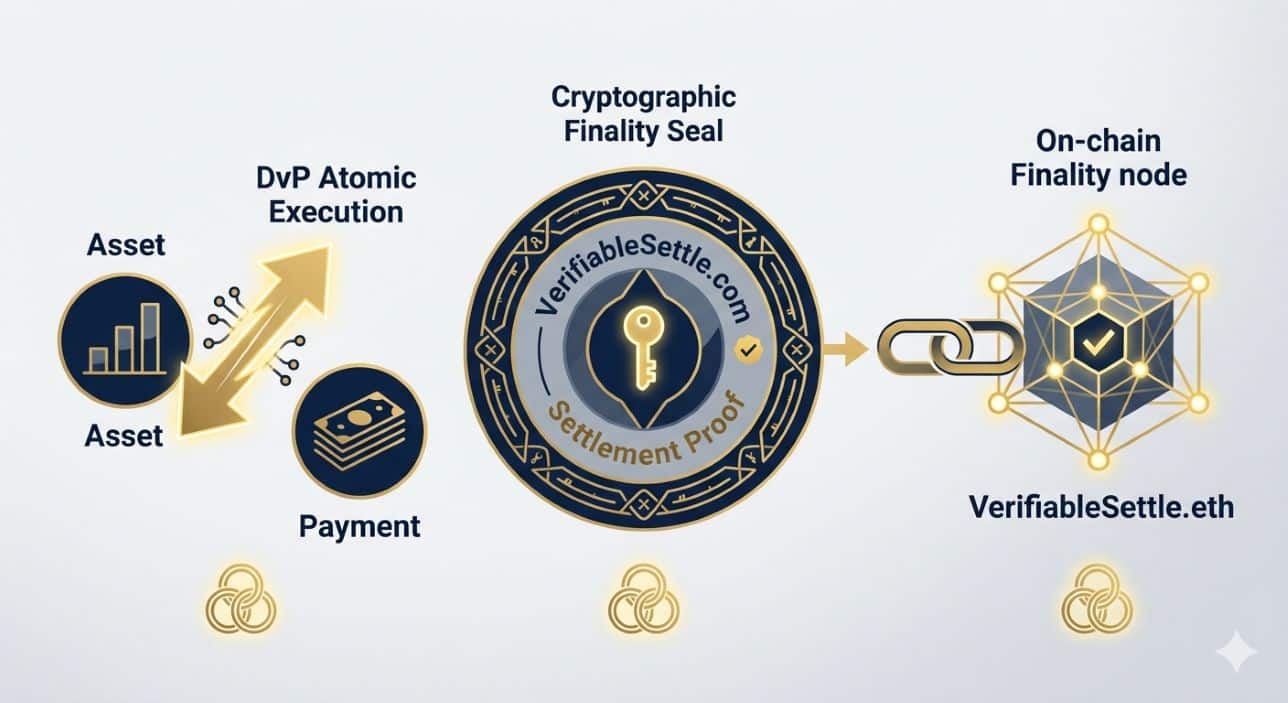
Pillar 1: Why Cryptographic Settlement Finality Is Now a Legal Requirement
The ultimate goal of any financial infrastructure is the irrevocable transfer of value. Under the GENIUS Act (12 U.S.C. § 5903), the CLARITY Act (2026), and the UNCITRAL Model Law on Electronic Transferable Records (MLETR), institutions are no longer permitted to rely on sequential, intermediary-dependent settlement processes for digital asset operations. The regulatory mandate is unambiguous: Delivery versus Payment must be a synchronized, atomic event — legally binding and cryptographically provable at the moment of execution.
The OCC operationalizes this requirement through two specific obligations:
Atomic Settlement Efficiency: Every permitted reserve asset transaction must achieve T0 finality — eliminating the Herstatt risk that arises when payment and delivery occur in separate, non-synchronized steps. In a 24/7 digital asset environment, any settlement lag creates an unacceptable window of counterparty exposure that OCC supervisory standards explicitly prohibit.
Cross-Jurisdictional Legal Certainty: Settlement finality must be legally enforceable across multiple jurisdictions simultaneously. An atomic transaction that achieves cryptographic finality on-chain but lacks legal recognition under applicable law is a compliance failure — regardless of its technical perfection. The Verifiable Settlement Standard bridges this gap by binding cryptographic proof to legal enforceability in a single, simultaneous execution event.
The Verifiable Settlement Standard is the direct institutional response: a cryptographically anchored, legally binding settlement layer that satisfies both mandates simultaneously — eliminating counterparty risk at the architectural level.
Source: OCC Proposed Rules – Permitted Payment Stablecoin Issuers, Federal Register, March 2, 2026
Pillar 2: The Settlement Finality Gap — When Execution and Legal Certainty Are Not the Same Thing
The operational challenge for settlement teams in 2026 is not the speed of execution. Modern systems can move assets in milliseconds. The critical gap is simultaneous, cryptographically provable legal finality — the ability to demonstrate that delivery and payment occurred at the exact same moment, under the exact same conditions, with zero window of counterparty exposure.
Three failure modes define the institutional risk landscape:
Herstatt Risk Persistence: In sequential settlement systems, payment and delivery occur in separate steps — creating a window where one party has fulfilled its obligation but the other has not. Even in modern digital asset environments, non-atomic settlement processes preserve this risk. Without Atomic Settlement Efficiency at the execution layer, every high-value transaction carries residual counterparty exposure that OCC supervisory standards explicitly prohibit.
Cross-Border Legal Fragmentation: A transaction that achieves technical finality on-chain may lack legal enforceability in one or more jurisdictions simultaneously. Without a standardized Interoperability Standard at the settlement layer, cross-border DvP transactions remain legally ambiguous — exposing institutions to jurisdictional challenges that can unwind apparently final settlements days or weeks after execution.
Audit Trail Disconnection: Settlement proof and ledger record must be cryptographically linked at the moment of execution. When settlement systems operate independently from record-keeping infrastructure, the audit trail between intent, execution, and finality breaks — creating the exact gap that OCC examiners are specifically trained to identify.
This is where VerifiableSettle.com operates as the institutional settlement proof layer — a continuously updated, cryptographically anchored finality registry accessible via API to compliance teams, legal departments, and counterparty systems. And this is where VerifiableSettle.eth becomes the critical on-chain layer: translating each settlement event into a blockchain-native finality proof, queryable by smart contracts and AI agents at the precise moment of execution — with cryptographic certainty that delivery and payment occurred simultaneously.
Source: BIS — Tokenisation and the future of money, 2025 — The BIS framework identifies atomic, cryptographically provable settlement finality as the foundational requirement for eliminating systemic counterparty risk across Unified Ledger infrastructures.
Pillar 3: VerifiableSettle as the Finality Layer of the PillarsX Settlement Stack
Every atomic transaction in a regulated settlement environment culminates in one non-negotiable output: an irrevocable, cryptographically proven finality event that confirms delivery and payment occurred simultaneously, legally, and without counterparty exposure. Without this finality layer, every preceding step — intent authorization, reserve attestation, asset classification, and record sealing — remains legally incomplete.
Within the PillarsX infrastructure, VerifiableSettle.com/.eth functions as the finality backbone — the layer that converts every verified, recorded transaction into an irrevocable, legally binding settlement proof:
VerifiableIntent.eth       →  Intent authorized & cryptographically bound
        ↓                     [Fiduciary Agentic Responsibility]
VerifiableReserve.eth      →  Reserve position proven & attested
        ↓                     [Programmable Compliance]
EligibleAsset.eth          →  Asset classification confirmed
        ↓                     [Qualified Digital Asset Custody]
mcpsettle.com/.eth         →  Atomic T0 execution initiated
        ↓                     [Atomic Settlement Efficiency]
VerifiableLedger.eth       →  Transaction sealed & forensic record created
        ↓                     [Confidential Computing]
VerifiableSettle.eth       →  Irrevocable finality confirmed & legally bound
                              [Operational Resilience]
→ Every settlement proof begins with a cryptographically sealed ledger entry: VerifiableLedger — The Verifiable Ledger Standard
This is the complete PillarsX Verifiable Infrastructure stack — from the first cryptographic intent signal to the final legally binding settlement proof. Every layer is verified. Every action is recorded. Every settlement is final.
Strategic Constellation & Bundle Potential
“The Settlement Finality Stack” · For Atomic DvP Under GENIUS Act & CLARITY Act
Designed for institutions requiring cryptographically proven, legally binding settlement finality across every layer of their digital asset operations — from pre-execution authorization through to irrevocable cross-border finality:
| Domain | Function | Regulatory Hook |
|---|---|---|
| VerifiableSettle.com/.eth | Atomic DvP finality & cryptographic settlement proof | CLARITY Act – Atomic Settlement Efficiency |
| VerifiableLedger.com/.eth | Forensic-grade record sealing at moment of settlement | OCC – Audit Trail Requirements |
| mcpsettle.com/.eth | T0 execution rails & settlement engine | GENIUS Act – T0 Settlement Mandate |
| syncsettle.com/.eth | Cross-chain settlement synchronization layer | MLETR – Cross-Jurisdictional Finality |