
The Verifiable Infrastructure Standard — Intent, Reserve, Ledger & Settle (Twin-Bundle Series: .com + .eth)
The GENIUS Act and the 2026 global regulatory framework have replaced the “Trust-but-Verify” model with a single mandate: Verify-then-Trust. Every financial movement must be backed by cryptographic proof — before execution, not after. The PillarsX Verifiable Infrastructure Series is the complete institutional namespace for this mandate: four interlocking Twin-Bundles that cover every layer of the compliant financial stack.
Why Verifiable Infrastructure Is the Statutory Floor of the GENIUS Act
The GENIUS Act does not merely recommend transparency — it mandates it at every layer of the PPSI operational stack. Monthly public attestations and annual independent audits are required to verify reserve assets — making real-time verifiable infrastructure a statutory obligation, not a competitive differentiator. Focus World Exchanges
Three structural requirements define the GENIUS Act’s verifiable infrastructure mandate:
1:1 Reserve Verification at All Times: PPSIs are required to demonstrate the operational capability to access and monetize reserves rapidly — not quarterly, not annually, but continuously at agent speed. A reserve that cannot be verified in real time is a reserve that cannot satisfy the GENIUS Act’s monetization requirement under stress conditions. Bank for International Settlements
Monthly Attestation as Examination Standard: The GENIUS Act’s attestation mandate was codified into the final bill to instill trust and reduce risk — requiring that digital tokens circulating on-chain are reliably anchored to real-world assets off-chain, verifiable by the millisecond, not the fiscal quarter. The AICPA’s 2025 Stablecoin Reporting Criteria provide the standardized framework for issuers and auditors implementing this mandate. Chainlink
BSA Financial Institution Treatment: Every PPSI is treated as a financial institution under the Bank Secrecy Act — subject to AML risk assessments, suspicious transaction reporting, and technical capabilities to block impermissible transactions in real time. Verifiable infrastructure is the technical architecture that makes BSA compliance operationally achievable at stablecoin transaction speed. International Monetary Fund
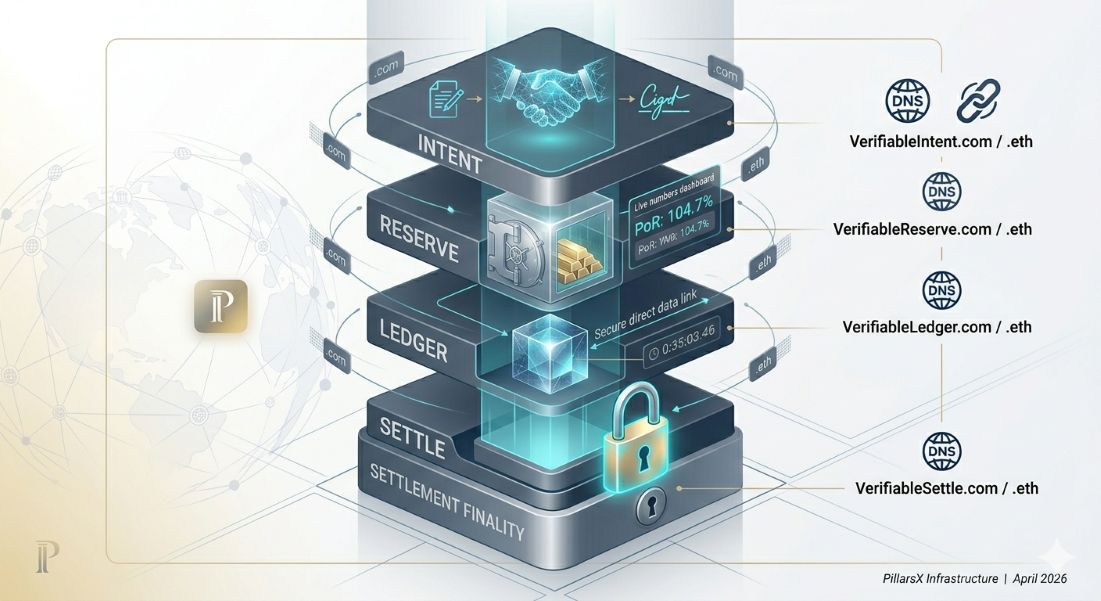
The four domains of the PillarsX Verifiable Infrastructure Series address each layer of this mandate: VerifiableIntent binds the actor, VerifiableReserve confirms the backing, VerifiableLedger seals the record, VerifiableSettle delivers final proof.
Source: GENIUS Act – Congress.gov · FDIC GENIUS Act Proposed Rule, Federal Register, April 10, 2026
Strategic Constellation & Bundle Potential
“The Verifiable Stack” · The Complete Institutional Compliance Bundle
For institutions requiring end-to-end cryptographic proof across every layer of their financial operations — from transaction authorization through to final settlement audit:
| Domain | Function | Compliance Layer |
|---|---|---|
| VerifiableIntent.com/.eth | Cryptographic mandate & pre-execution authorization | Authorization |
| VerifiableReserve.com/.eth | Real-time solvency attestation & Proof-of-Reserve | Solvency |
| VerifiableLedger.com/.eth | Immutable triple-entry record-keeping & audit integrity | Integrity |
| VerifiableSettle.com/.eth | Atomic DvP finality & cross-border settlement proof | Finality |
The Verifiable Infrastructure Series — ENS Relevance Overview
The four Twin-Bundles of the Verifiable Infrastructure Series each carry distinct ENS relevance ratings based on their function in the on-chain compliance stack:
| Domain | ENS Relevance | On-Chain Function |
|---|---|---|
| VerifiableIntent.com/.eth | 9.5/10 | Pre-execution mandate authorization |
| VerifiableReserve.com/.eth | 9.5/10 | Real-time reserve attestation endpoint |
| VerifiableLedger.com/.eth | 9/10 | Cryptographically sealed record-keeping |
| VerifiableSettle.com/.eth | 10/10 | Atomic DVP settlement finality proof |
Together, these four ENS endpoints form the complete on-chain compliance chain — from intent authorization to settlement proof — that the GENIUS Act’s “Verify-then-Trust” mandate demands.
The Four Layers of the Verifiable Infrastructure Stack
VerifiableIntent.com/.eth — The Pre-Execution Mandate Layer
In a high-velocity agentic finance environment, the origin point of every transaction is the Intent. A Verifiable Intent is a pre-execution cryptographic signature that binds a specific market participant to a specific set of transaction conditions — before a single asset moves.
The GENIUS Act’s BSA treatment of PPSIs requires that every transaction be traceable to an authorized mandate. In an automated environment where AI agents execute PPSI settlement flows without human intervention, this authorization must be machine-readable, on-chain verifiable, and cryptographically bound at the moment of execution — not reconstructed after the fact.
VerifiableIntent.com is the institutional API portal and legal identity for intent-based transaction authorization. VerifiableIntent.eth is the on-chain endpoint where the cryptographic mandate is generated, stored, and queried by settlement agents before execution is initiated. Together they provide the Proof of Intent that OCC examiners require and that smart contracts can verify in real time.
VerifiableReserve.com/.eth — The Real-Time Attestation Layer
The era of quarterly reserve audits ended with the GENIUS Act. The stablecoin market’s expansion into mainstream financial infrastructure means that reserve attestation is now a continuous, on-chain requirement — every tokenized liability must be matched by a verifiable asset in real time. Chainlink
VerifiableReserve.com is the institutional reserve attestation portal — the compliance interface where reserve composition, custody arrangements, and WAM compliance are documented and published. VerifiableReserve.eth is the on-chain oracle endpoint where reserve adequacy is queryable by smart contracts at the moment of settlement execution — confirming that the 1:1 backing requirement is satisfied before any PPSI transaction achieves finality.
This is the layer that transforms reserve compliance from a periodic audit function into a continuous, automated, cryptographically verifiable operational standard.
VerifiableLedger.com/.eth — The Immutable Record Layer
The integrity of a regulated financial system is only as strong as its record-keeping layer. Every PPSI transaction must generate an immutable, time-stamped ledger entry that satisfies OCC §15.14 audit and reporting requirements — a record that cannot be retroactively modified, selectively presented, or reconstructed from incomplete data.
VerifiableLedger.com is the institutional ledger compliance portal — the legal identity and API interface for cryptographically sealed transaction records. VerifiableLedger.eth is the on-chain root for the ledger’s state proofs — allowing regulators and auditors to verify the complete transaction history without requiring full access to private database systems.
This creates the Privacy-Preserving Auditability framework that the OCC demands: complete transparency for examiners, complete confidentiality for counterparties.
VerifiableSettle.com/.eth — The Atomic Finality Layer
Every layer of the Verifiable Infrastructure Stack converges at a single point: settlement finality. PPSIs must demonstrate the operational capability to access and monetize reserves rapidly — and every settlement flow must satisfy OCC prudential standards, FDIC custody requirements, and FinCEN/OFAC AML and sanctions obligations simultaneously. Bank for International Settlements
VerifiableSettle.com is the institutional settlement compliance portal — the legal identity and API endpoint where settlement finality is documented, compliance-cleared, and delivered. VerifiableSettle.eth is the on-chain settlement endpoint where the atomic DVP transaction is executed — asset and payment simultaneously, with cryptographic proof of OCC-compliant finality generated at T0.
VerifiableSettle.eth carries the highest ENS relevance rating in the Verifiable Series — 10/10 — because settlement finality is by definition an on-chain operation. The smart contract IS the settlement mechanism, and VerifiableSettle.eth is the institutional namespace that anchors that mechanism.
The Verifiable Stack as the PillarsX Compliance Architecture
The four layers of the Verifiable Infrastructure Series are not independent assets — they are an interlocking compliance chain where each layer’s output is the next layer’s input:
VerifiableIntent.eth    →  Mandate authorized & cryptographically bound
        ↓                  [Fiduciary Agentic Responsibility]
VerifiableReserve.eth   →  Reserve adequacy confirmed in real time
        ↓                  [GENIUS Act §4 – Reserve Requirements]
VerifiableLedger.eth    →  Transaction sealed & audit trail created
        ↓                  [OCC §15.14 – Audit & Reporting]
VerifiableSettle.eth    →  Atomic T0 finality with compliance proof
                           [GENIUS Act – Settlement Finality]
This four-step chain is the complete GENIUS Act compliance architecture — from intent authorization to settlement proof — in a single, institution-agnostic, protocol-native namespace.
→ For the complete PPSI settlement infrastructure: ppsisettle.com & .eth → For the DVP atomic settlement standard: dvpsettle.com & .eth
The Verifiable Infrastructure Series Within the PillarsX Compliance Stack
| Layer | Domain | Function | Regulatory Hook |
|---|---|---|---|
| Intent | VerifiableIntent.com/.eth | Pre-execution mandate | GENIUS Act – BSA Treatment |
| Reserve | VerifiableReserve.com/.eth | Real-time attestation | GENIUS Act §4 – 1:1 Reserve |
| Ledger | VerifiableLedger.com/.eth | Immutable records | OCC §15.14 – Audit |
| Settle | VerifiableSettle.com/.eth | Atomic T0 finality | GENIUS Act – Settlement |
| PPSI Execution | ppsisettle.com/.eth | PPSI settlement endpoint | OCC §15.11 |
| DVP Execution | dvpsettle.com/.eth | Cross-chain DVP settlement | BIS CPMI DVP Standard |
Strategic Constellation & Bundle Potential
“The Complete Verifiable Stack” · For GENIUS Act Full-Stack Compliance
| Domain | Function | Regulatory Hook |
|---|---|---|
| VerifiableIntent.com/.eth | Pre-execution mandate & authorization | GENIUS Act – BSA Fiduciary Standard |
| VerifiableReserve.com/.eth | Real-time reserve attestation | GENIUS Act §4 – Reserve Requirements |
| VerifiableLedger.com/.eth | Immutable audit trail | OCC §15.14 – Reporting |
| VerifiableSettle.com/.eth | Atomic T0 settlement finality | GENIUS Act – Settlement Standard |
“The Institutional Trust Bundle” · For Regulated PPSI Infrastructure Providers
| Domain | Function | Regulatory Hook |
|---|---|---|
| VerifiableReserve.com/.eth | Reserve attestation endpoint | GENIUS Act §4 – Attestation Mandate |
| VerifiableSettle.com/.eth | Settlement finality proof | GENIUS Act – T0 Standard |
| ppsisettle.com/.eth | PPSI execution layer | OCC §15.11 |
| stablecoindisclosure.com/.eth | CLARITY Act disclosure | Tillis-Alsobrooks Compromise |
Frequently Asked Questions
What is Verifiable Reserve Infrastructure and why is it required under the GENIUS Act?
Verifiable Reserve Infrastructure is the technical and institutional architecture that enables continuous, real-time, cryptographically provable reserve attestation — as opposed to periodic, manual, document-based audits.
The GENIUS Act mandates monthly public attestations and annual independent audits for every PPSI, effectively requiring that reserve backing be verifiable at any moment by regulators, counterparties, and smart contracts.
VerifiableReserve.com/.eth is the institutional namespace for this infrastructure — the portal and on-chain endpoint that makes GENIUS Act-compliant reserve attestation operationally achievable at stablecoin transaction speed.
How do the four Verifiable Infrastructure domains work together?
The four domains form an interlocking compliance chain: VerifiableIntent authorizes the mandate before execution begins. VerifiableReserve confirms that reserves are adequate before the transaction proceeds.
VerifiableLedger seals the immutable record as the transaction executes. VerifiableSettle delivers atomic T0 finality with cryptographic proof that all compliance layers have been satisfied.
Each domain’s output is the next domain’s input — together they represent the complete GENIUS Act compliance architecture from intent to settlement proof.
Why does each Verifiable domain have both a .com and a .eth version?
Every PPSI operates in two simultaneous regulatory environments: the traditional banking system under OCC supervision, and the on-chain settlement layer where stablecoin transactions achieve finality.
The .com domains provide the institutional Web2 layer — legal identity, API portals, compliance interfaces, and audit trails that OCC examiners can access and verify. The .eth domains provide the on-chain Web3 layer — ENS endpoints where compliance signals are generated, stored, and queryable by smart contracts at the moment of execution. A PPSI that operates only in one environment cannot achieve the Front-to-Back compliance the GENIUS Act demands.
Legal Notice & Disclaimer:
The information provided on this website, including all descriptions of the Verifiable Infrastructure Bundle (comprising Intent, Reserve, Ledger, and Settle), is for informational and educational purposes only. PillarsX and its associated domains do not provide financial, investment, legal, or tax advice. The digital assets and infrastructure solutions described herein represent technological frameworks and nomenclature standards designed for the 2026 digital ecosystem.
Any engagement with digital assets, domain acquisitions, or infrastructure implementation should be conducted only after consultation with qualified professional advisors. PillarsX operates solely as a technology and strategic domain portfolio provider; we are not a financial institution, broker-dealer, or registered investment advisor. Availability of specific regulatory frameworks, such as the GENIUS Act or Basel IV extensions, may vary by jurisdiction.
© 2026 PillarsX Infrastructure | All Rights Reserved.