
ppsisettle.com & .eth | PPSI Settlement Identity
🔴 Regulatory Update — June 27, 2026
GENIUS Act Final Rules deadline 21 days — PPSI settlement infrastructure must be operational before January 18, 2027 as OCC, FDIC and NCUA finalize simultaneous settlement standards for permitted payment stablecoin issuers
With 21 days remaining until the July 18, 2026 GENIUS Act Final Rules deadline, the settlement infrastructure layer for Permitted Payment Stablecoin Issuers is entering its final regulatory definition. OCC, FDIC and NCUA have all published proposed rules establishing the settlement standards PPSIs must meet — atomic redemption capability, real-time settlement finality, and 1:1 reserve backing with high-quality liquid assets including US Treasuries, agency securities, and FDIC-insured deposits. The GENIUS Act takes effect on the earlier of January 18, 2027, or 120 days after Final Rules are issued — meaning every PPSI must have its settlement infrastructure compliant before year-end 2026. ppsisettle.com & .eth is the institutional namespace for PPSI settlement identity — the compliance anchor for the settlement layer that every regulated stablecoin issuer must establish.
→ Source: Chapman and Cutler — GENIUS Act Rulemaking Tracker, PPSI Settlement Standards, June 27, 2026🔴 Regulatory Update — June 22, 2026
OCC GENIUS Act Final Rule due July 18, 2026 — 26 days to statutory deadline for PPSI settlement framework publication
All primary federal payment stablecoin regulators — OCC, FDIC, NCUA, Treasury, FinCEN — are required by statute to publish Final Rules implementing the GENIUS Act by July 18, 2026. Once final rules publish, the GENIUS Act takes effect 120 days later, no later than January 18, 2027. The OCC proposal (February 25, 2026) establishes weekly confidential settlement reporting as a standing PPSI obligation — every settlement event must be documented in the form and manner specified by OCC. ppsisettle.com & .eth is the institutional namespace for PPSI settlement identity, registered before the Final Rule closes the pre-rulemaking acquisition window.
→ Source: Sullivan & Cromwell — OCC GENIUS Act NPRM Analysis, March 2026🔴 Regulatory Update — June 11, 2026
Schedule B requires issuance, redemption, and secondary market pricing data on every settlement cycle — settlement activity becomes the primary weekly data stream the OCC monitors for market stress
The OCC's Schedule B captures data on stablecoin issuances and redemptions during each weekly reporting period, alongside secondary market price and trading activity — with the OCC considering thresholds to exclude trades too small to be representative. The OCC's stated purpose is to monitor primary and secondary market dynamics, including during periods of stress, using Schedule A's wallet-level holder and counterparty data alongside Schedule B's settlement flow. Every settlement event a PPSI executes now feeds directly into this weekly market-monitoring dataset. ppsisettle.com & .eth anchors the namespace for the settlement identity whose activity this reporting framework continuously observes.
→ Source: OCC — Reporting Forms and Instructions for PPSIs, June 11, 2026The GENIUS Act created a new category of regulated financial institution — the Permitted Payment Stablecoin Issuer — and simultaneously created a precise operational requirement that every PPSI must satisfy at the moment of every settlement transaction: T0 finality, OCC compliance, and AML/sanctions clearance in a single atomic execution.
Circle, issuer of USDC with $78 billion in market cap, submitted its OCC comment letter on May 1, 2026 backing mandatory ring-fenced PPSI structures and full at-par redeemability at all times — calling the OCC’s proposed prudential framework a “momentous turning point” for dollar-backed digital assets. The AICPA simultaneously urged the OCC to incorporate its 2025 Stablecoin Reporting Criteria — covering reserve composition, custody arrangements, and monthly attestation standards — into GENIUS Act Final Rules. Both submissions confirm the same institutional requirement: PPSI settlement infrastructure must be simultaneously executable and documentable.
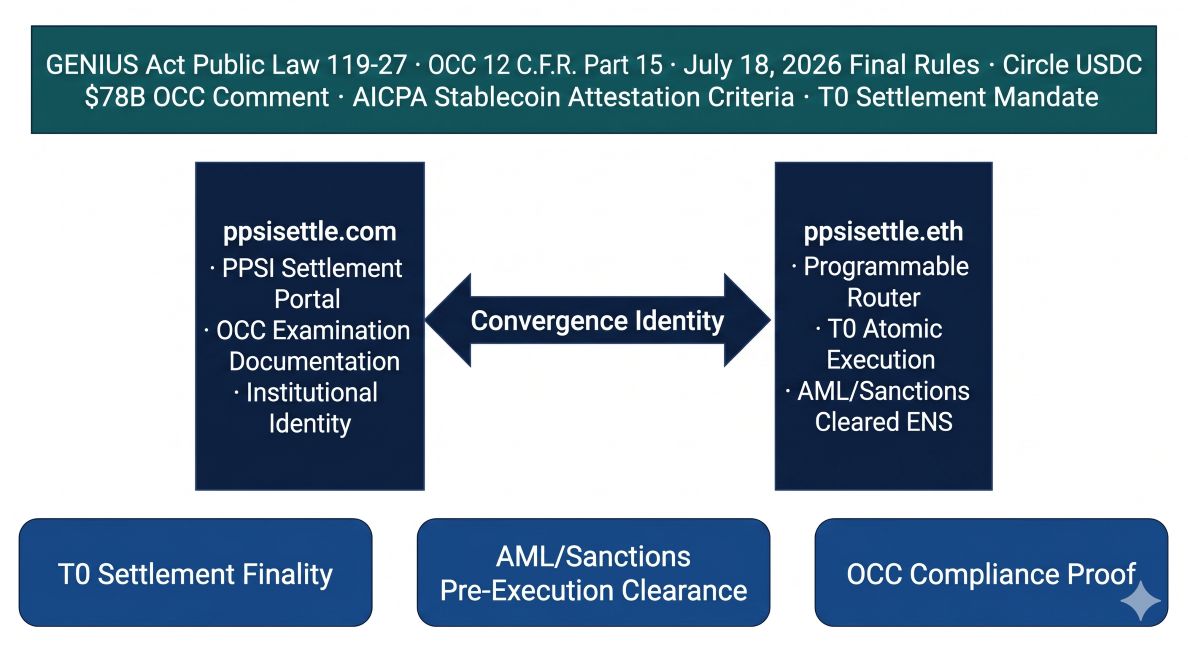
ppsisettle.com is the institutional Web2 portal identity for the PPSI settlement execution standard — the legal brand that appears in OCC examination submissions, GENIUS Act compliance documentation, and institutional PPSI settlement agreements wherever atomic T0 settlement must be referenced. ppsisettle.eth is the programmable on-chain routing identity — the ENS endpoint that software architects embed directly into PPSI settlement protocol logic to execute atomic T0 finality with cryptographic proof of OCC-compliant settlement without intermediary DNS dependency.
Together they form the complete Convergence Identity for the PPSI settlement execution standard that every Circle, Paxos, Ripple and SoFi must establish before the July 18, 2026 OCC Final Rules deadline.
Namespace Acquisition: This Twin-Domain asset is available for institutional acquisition. Inquiries: hq@pillarsx.com
The PPSI Settlement Ecosystem: From Reserve Confirmation to On-Chain Ledger Entry
The GENIUS Act does not merely license stablecoin issuers — it defines the operational standard every licensed PPSI must meet at the moment of settlement execution. Three requirements converge at exactly this point:
T0 Settlement Finality: The OCC’s proposed rules under §15.11 require every PPSI to demonstrate operational capacity for immediate, atomic settlement of payment stablecoin transactions. A PPSI whose settlement infrastructure cannot achieve T0 finality under stress conditions — when redemption volume spikes, when reserve assets must be monetized rapidly, when cross-border flows require simultaneous execution — cannot meet the operational resilience standard the OCC demands. Settlement delay is not a technical inconvenience under the GENIUS Act. It is a compliance failure.
Full Redeemability at Par: Circle’s May 2026 OCC comment letter explicitly states that payment stablecoins must be fully redeemable at par at all times — a standard that requires settlement infrastructure capable of executing redemptions instantaneously, without counterparty delay, and with cryptographic proof of finality. This is not a Circle-specific position. It is the operational floor that every PPSI must meet under the GENIUS Act framework.
Unified Interoperable Settlement: Circle warned against fragmentation, stating that payment stablecoins should function as a single interoperable instrument — fully transferable, fungible, and interoperable across platforms and borders. A fragmented settlement layer — where each PPSI operates a proprietary execution endpoint — directly violates this principle. ppsisettle.com/.eth is the neutral, protocol-native settlement namespace that makes interoperability structurally possible.
ppsisettle.eth — ENS Relevance: 9.5/10
In a regulatory environment where every PPSI must demonstrate T0 settlement capacity to OCC examiners, ppsisettle.eth is the only on-chain identity that permanently reserves “PPSI Settlement” as an institutional namespace. While ppsisettle.com represents the legal identity, API portal, and regulatory compliance interface, ppsisettle.eth is the verifiable on-chain settlement endpoint — the address a PPSI agent targets when a stablecoin redemption must be executed atomically, finally, and with cryptographic proof of OCC-compliant settlement.
Anyone can build a PPSI settlement system. No one can replicate ppsisettle.eth. This ENS identity is the Sovereign Liquidity Rail for the GENIUS Act settlement layer — immutable, censorship-resistant, and directly composable with the smart contract logic that governs stablecoin issuance, redemption, and reserve monetization.
Institutions that take Fiduciary Agentic Responsibility seriously require both layers: .com for the regulatory identity and OCC audit trail, .eth for on-chain Proof of Intent at the exact moment of settlement execution. Together they form the complete Convergence Identity — Front-to-Back PPSI compliance in a single Twin-Bundle.
The Three PPSI Settlement Failure Modes That ppsisettle Eliminates
The operational challenge for PPSIs in 2026 is not the regulatory framework itself. The GENIUS Act is explicit. The OCC proposed rules are detailed. The FinCEN/OFAC joint NPRM is published. The compliance obligations are known. The critical gap is execution infrastructure — the ability to demonstrate, at the moment of every settlement transaction, that the full PPSI compliance stack has been satisfied before finality is achieved.
Three failure modes define the institutional risk landscape:
Redemption Infrastructure Failure: A PPSI that cannot execute instant at-par redemptions under stress conditions faces the most direct compliance failure the GENIUS Act contemplates. The OCC requires stablecoins to be redeemable within 2 business days under normal conditions and up to 7 days under stress scenarios — but the operational infrastructure to meet even the standard threshold requires continuous, automated settlement execution that legacy payment systems cannot provide. Manual redemption processing is architecturally incompatible with PPSI compliance.
AML/Sanctions Gap at Execution: FinCEN and OFAC jointly require PPSIs to maintain AML and sanctions compliance programs — treating PPSIs as financial institutions under the Bank Secrecy Act for the first time. Every settlement flow must be screened before execution, not after. A settlement endpoint that executes first and screens later creates the exact compliance gap that the FinCEN/OFAC Joint NPRM is designed to eliminate. Comments on this rule close June 9, 2026. Cleary Gottlieb
Fragmented Settlement Identity: When a PPSI operates without a standardized, protocol-native settlement namespace, every counterparty interaction requires manual verification of licensing status, reserve adequacy, and AML clearance. In a world where AI agents execute PPSI settlement flows autonomously, this manual verification layer collapses entirely. ppsisettle.com/.eth eliminates this fragmentation — providing a single, machine-readable settlement identity that agents can query at the moment of execution.
ppsisettle.com provides the institutional Web2 portal identity — the legal brand that OCC examiners reference in PPSI settlement examinations, compliance teams document in GENIUS Act audit submissions, and legal departments cite in PPSI settlement agreements.
ppsisettle.eth is the programmable on-chain routing identity — the ENS endpoint that software architects embed directly into PPSI settlement protocol logic to execute atomic T0 finality. Where the GENIUS Act defines what PPSI settlement must achieve regulatorily, ppsisettle.eth provides the machine-readable execution layer that protocol engineers embed into settlement infrastructure to implement that standard — connecting OCC compliance documentation to on-chain atomic execution in a single ENS endpoint.
Together, ppsisettle.com & .eth form the complete Convergence Identity: the legal anchor for compliance teams documenting PPSI settlement execution under GENIUS Act and OCC standards, and the technical routing layer for software architects implementing T0 atomic settlement — the two audiences that every institutional PPSI settlement deployment must simultaneously satisfy.
The PPSI Settlement Ecosystem: From Reserve Confirmation to On-Chain Ledger Entry
Every PPSI settlement transaction requires one confirmed signal before finality: is this issuer licensed, reserve-compliant, AML-cleared, and executing at T0? Within the PillarsX infrastructure, ppsisettle.com/.eth is the execution layer — the atomic settlement endpoint that receives the compliance-cleared mandate and delivers on-chain finality.
ppsisettle is the atomic execution layer of the PillarsX PPSI namespace. It connects directly to ppsisettlement.com & .eth as the full settlement documentation identity that ppsisettle feeds, and to ppsiledger.com & .eth as the on-chain ledger entry layer that records every ppsisettle execution.
Beyond the PPSI cluster, ppsisettle integrates with permittedreserves.com & .eth as the reserve adequacy standard that must be confirmed before ppsisettle executes, verifiablereserve.com & .eth as the continuous reserve attestation identity that ppsisettle draws on at execution, and programmablecompliance.com & .eth as the automated AML/sanctions compliance engine that clears every ppsisettle transaction before finality is achieved.
Strategic Constellation & Bundle Potential
“The PPSI Execution Stack” · For Atomic T0 Settlement Infrastructure
| Domain | Function | Regulatory Hook |
|---|---|---|
| ppsisettle.com/.eth | Atomic T0 execution endpoint | GENIUS Act – T0 Settlement Mandate |
| ppsireserve.com/.eth | Reserve adequacy before execution | OCC §15.11 – Reserve Requirements |
| ppsiledger.com/.eth | On-chain settlement records | OCC §15.14 – Audit & Reporting |
| ppsiinterop.com/.eth | Cross-PPSI interoperability | GENIUS Act – Unified Instrument Standard |
Frequently Asked Questions
What is the difference between ppsisettle.com and ppsisettlement.com?
ppsisettle.com is the atomic execution endpoint — the operational layer where ppsi settlement transactions achieve T0 finality. It is designed for machine-to-machine interaction, agent-to-contract execution, and real-time compliance clearance at the moment of settlement.
ppsisettlement.com is the documentation and compliance proof layer — the full settlement record that satisfies OCC audit requirements under §15.14. Together they cover the complete settlement lifecycle: ppsisettle executes, ppsisettlement documents. Both are required for full GENIUS Act compliance.
How does ppsisettle.eth relate to OCC §15.11 reserve requirements?
OCC §15.11 requires every ppsi to maintain a reserve portfolio with weighted average maturity of no more than 20 days and to demonstrate continuous monetization capacity across all reserve asset types.
ppsisettle.eth is the on-chain settlement endpoint that receives the reserve-cleared execution mandate — the cryptographic signal that reserve adequacy has been confirmed before atomic settlement is initiated. Without this endpoint, the compliance chain from reserve verification to settlement execution has no machine-readable anchor. ppsisettle.eth is that anchor.
Why does a PPSI need both .com and .eth settlement infrastructure?
A ppsi operates in two simultaneous regulatory environments: the traditional banking system under OCC supervision, and the on-chain settlement layer where stablecoin transactions achieve finality.
ppsisettle.com satisfies the first — it is the legal identity, API portal, and regulatory liability address that OCC examiners can access, audit, and verify. ppsisettle.eth satisfies the second — it is the blockchain-native endpoint where settlement instructions are executed atomically with cryptographic Proof of Intent. A PPSI that operates only in one environment cannot achieve the Front-to-Back compliance the GENIUS Act demands.
Regulatory Sources
OCC Proposed Rules — PPSI Settlement Standards 12 C.F.R. Part 15, March 2, 2026
Circle OCC Comment Letter — Full At-Par Redeemability and Unified Settlement Standard, May 2026
AICPA OCC Comment Letter — Stablecoin Attestation Criteria for GENIUS Act Final Rules, May 2026
FinCEN/OFAC Joint NPRM — PPSI AML/CFT Requirements, April 10, 2026
GENIUS Act — Public Law 119-27, PPSI Settlement and Reserve Standards
Explore related PillarsX infrastructure
→ ppsisettlement.com & .eth — PPSI Settlement Documentation Identity
→ ppsiledger.com & .eth — PPSI On-Chain Ledger Identity
→ ppsicustody.com & .eth — PPSI Custody Compliance Identity
→ ppsigateway.com & .eth — PPSI Fed Payment Gateway Identity
→ permittedreserves.com & .eth — Permitted Reserves Identity
→ programmablecompliance.com & .eth — Programmable Compliance Identity
„All content is for informational purposes only and does not constitute financial advice.“