
ppsisettlement.com | PPSI Settlement Legal Identity
🔴 Regulatory Update — June 27, 2026
GENIUS Act Final Rules 21 days out — permitted payment stablecoin settlement framework enters production standard as GENIUS Act takes effect 120 days after final rules — January 18, 2027 compliance deadline confirmed
The GENIUS Act settlement framework — requiring every PPSI to maintain 1:1 reserve backing, real-time redemption capability, and atomic settlement finality for every permitted payment stablecoin — enters its final 21 days of regulatory definition before the July 18, 2026 Final Rules deadline. Paradigm's GENIUS Act Rulemaking Tracker confirms the Act takes effect on the earlier of January 18, 2027, or 120 days after final rules are issued. The settlement standard applies to all payment stablecoins — whether issued by bank subsidiaries under OCC or FDIC supervision, credit union subsidiaries under NCUA, or nonbank entities under OCC FQPSI status. ppsisettlement.com & .eth is the long-form institutional namespace for permitted payment stablecoin settlement identity — the compliance documentation layer for the full settlement framework that every regulated stablecoin issuer must establish before the January 18, 2027 compliance deadline.
→ Source: Paradigm — GENIUS Act Rulemaking Tracker, Settlement Framework, July 18 Deadline, June 2026🔴 Regulatory Update — June 22, 2026
Six federal agencies converge on July 18 Final Rule deadline — PPSI settlement namespace window closes as OCC, FDIC, NCUA, Treasury, FinCEN and OFAC all finalize simultaneously
Between February and May 2026, OCC, FDIC, NCUA, Treasury, FinCEN, and OFAC each issued proposed rules implementing the GENIUS Act — the only primary regulator yet to publish is the Federal Reserve Board. All final rules are required by July 18, 2026, with the GENIUS Act taking effect 120 days after final publication, no later than January 18, 2027. The simultaneous six-agency finalization creates a hard coordination point: every PPSI settlement identity, namespace, and documentation standard must be established before the Final Rules define the compliance baseline. ppsisettlement.com is the institutional settlement namespace for this convergence moment.
→ Source: CryptoTimes — GENIUS Act 10 Months: Six-Agency Rulemaking Status, May 2026🔴 Regulatory Update — June 11, 2026
OCC quarterly forms modeled directly on national bank Call Reports — the full legal terminology of payment stablecoin settlement now anchors a thirteen-schedule federal reporting architecture
The OCC's quarterly reporting forms are modeled on the Call Reports that national banks and federal savings associations must file, comprising an income statement, balance sheet, off-balance-sheet items, capital and operational backstop information, and a memorandum schedule covering branded stablecoin counts, burn data, blockchain information, and custody activities. The OCC has stated its intent to make this quarterly information publicly available to promote transparency regarding PPSI financial condition on an ongoing basis. As the legal longform identity, ppsisettlement.com is the namespace that will appear in the formal documentation accompanying these public quarterly disclosures and the underlying weekly confidential filings alike.
→ Source: OCC — Reporting Forms and Instructions for PPSIs, June 11, 2026Namespace Acquisition: This Twin-Domain asset is available for institutional acquisition. Inquiries: hq@pillarsx.com
The Two-Business-Day Deadline That Defines PPSI Settlement
The GENIUS Act defines a payment stablecoin as a digital asset designed to be used as a means of payment or settlement — the issuer of which is obligated to convert, redeem, or repurchase for a fixed amount of monetary value, representing the reasonable expectation that it will maintain a stable value.
This definition contains a precise settlement obligation that every PPSI must operationalize before July 18, 2026: the issuer is obligated to redeem at par value. Not eventually. Not at market price. At par, on demand, within two business days.
The OCC proposal would provide a maximum of two business days for fulfilling redemption requests from customers — with discretionary limitations imposable by the OCC and for state issuers by the Federal Reserve for redemption requests above certain thresholds.
This two-business-day settlement standard is the most operationally demanding compliance requirement in the entire GENIUS Act framework. It is not a disclosure obligation or a documentation requirement — it is a real-time operational capability that must function under OCC examination standards twenty-four hours after a customer submits a redemption request.
ppsisettlement.com is the institutional Longform identity for the settlement infrastructure that every PPSI must build to satisfy this requirement — the legal namespace that appears in OCC licensing applications, redemption agreement contracts, and FDIC examination submissions wherever the full unabbreviated PPSI Settlement standard is required.
Why Two-Business-Day Redemption Makes PPSI Settlement a Critical Infrastructure Standard / How the PPSI Settlement Architecture Works / The PPSI Settlement Ecosystem
The redemption obligation is the most operationally consequential requirement because it creates a settlement finality commitment at the federal regulatory level. A PPSI that cannot process redemptions within two business days is in default — not merely non-compliant but in breach of its core statutory obligation under the GENIUS Act.
The GENIUS Act provides that a PPSI shall be treated as a financial institution for purposes of the Bank Secrecy Act — subject to all federal laws applicable to a financial institution located in the United States relating to economic sanctions, prevention of money laundering, and countering the financing of terrorism.
This BSA treatment means that every PPSI settlement transaction — every redemption, every issuance, every reserve movement — must simultaneously satisfy OCC settlement timing requirements and FinCEN AML/CFT monitoring requirements. The FDIC BSA Rule of May 22, 2026 made this dual obligation explicit: PPSI settlement infrastructure must be both fast enough to meet the two-business-day standard and thorough enough to satisfy BSA transaction monitoring requirements.
The FDIC has endeavored to align its proposed rule with the OCC’s proposed rule — with the definition of payment stablecoin mirroring the GENIUS Act statutory definition. The combined total par value of different brands of payment stablecoins issued by the PPSI is relevant for requirements related to reserve assets, redemptions, reporting, and audits for larger PPSIs. The reserve asset standard governing this combined par value calculation is documented at permittedreserves.com & .eth.
How the PPSI Settlement Architecture Works
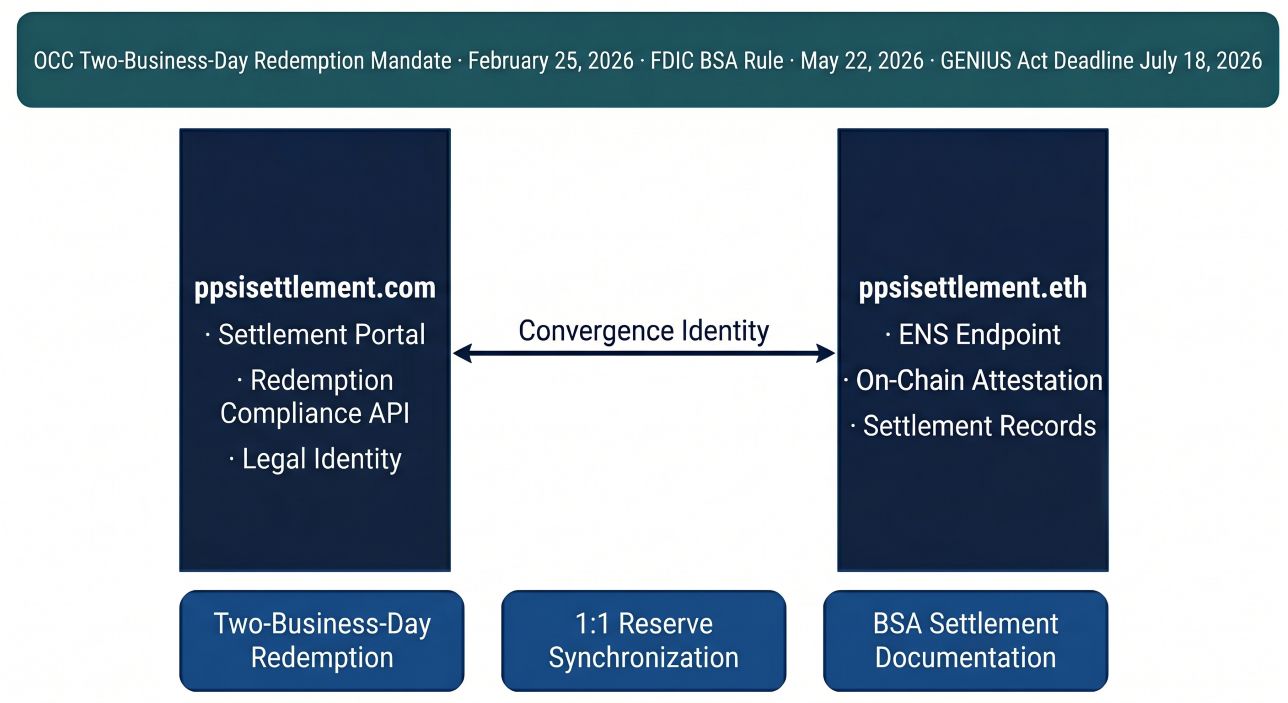
PPSI settlement infrastructure operates through three simultaneous compliance layers that ppsisettlement.com documents directly.
The redemption execution layer processes customer redemption requests within the two-business-day OCC mandate — converting payment stablecoins to fiat at par value with complete settlement finality documentation that satisfies OCC examination standards.
The reserve synchronization layer ensures that reserve assets are always sufficient to cover outstanding redemption obligations — maintaining the 1:1 reserve backing requirement in real time as redemptions reduce outstanding stablecoin supply and reserve deployments adjust accordingly.
The compliance documentation layer generates immutable records of every settlement transaction — redemption terms, execution timing, reserve composition at settlement, and AML/CFT verification results — in the format required by OCC, FDIC, and FinCEN examination standards simultaneously. The orderly redemption standard for large redemptions above OCC discretionary thresholds is governed at orderly-redemption.com.
ppsisettlement.com is the institutional portal for this three-layer architecture — the compliance identity, the PPSI settlement brand, and the legal anchor for any institution building OCC-compliant PPSI settlement infrastructure before the July 18, 2026 deadline.
ppsisettlement.com provides the Web2 portal identity. The longform ppsisettlement signals to OCC examiners, legal counsel, and institutional counterparties that an institution has built the complete settlement infrastructure — not merely the stablecoin issuance capability.
The PPSI Settlement Ecosystem
ppsisettlement is the settlement finality core of the PillarsX PPSI namespace. It connects directly to ppsigateway.com & .eth — the payment gateway that routes PPSI settlement transactions through Federal Reserve payment infrastructure — and to ppsiregistry.com as the OCC licensing registry that validates PPSI status before settlement operations commence.
Beyond the PPSI cluster, ppsisettlement integrates with settlerails.com & .eth as the Fed-compatible settlement rails that PPSI redemption transactions flow across, orderly-redemption.com as the GENIUS Act orderly redemption standard that governs large redemption requests above OCC discretionary thresholds, and permittedreserves.com & .eth as the reserve asset standard that must remain 1:1 backed throughout every settlement cycle.
The complete PPSI settlement stack — ppsisettlement for legal documentation, ppsigateway for Fed connectivity, ppsiregistry for licensing records — provides every PPSI with a complete settlement identity that covers operational execution, legal filing, and on-chain verification simultaneously. The PPSI ledger infrastructure underlying this stack is documented at ppsiledger.com & .eth.
📄 Academic Foundation
Twin-Domain Convergence Identity — The Institutional Framework Behind This Namespace
This Twin-Domain asset is part of the namespace architecture formalized in "Twin-Domain Convergence Identity: A Framework for Institutional Namespace Standards in Regulated Digital Asset Infrastructure" by Rolf Neumayr, PillarsX (SSRN Working Paper, 16 pages, posted June 12, 2026), classified under Monetary Economics — International Financial Flows, Financial Crises, Regulation & Supervision.
→ Read the Paper on SSRNStrategic Constellations & Bundle Potential
Bundle 1 — “The PPSI Settlement Stack” (for Stablecoin Issuers) Target: Circle, Paxos, Ripple — all building GENIUS Act-compliant settlement infrastructure. Domains: ppsisettlement.com + ppsigateway.com/.eth + settlerails.com/.eth. Complete PPSI settlement namespace — legal documentation identity, Fed gateway, and settlement rails.
Bundle 2 — “The GENIUS Act Compliance Stack” (for OCC-Regulated Institutions) Target: National banks, federal savings associations, nonbank PPSIs. Domains: ppsisettlement.com + ppsiregistry.com + permittedreserves.com/.eth. Complete GENIUS Act compliance namespace — settlement identity, registry standard, and reserve documentation.
Bundle 3 — “The Full PPSI Infrastructure” (for Strategic Acquirers) Domains: ppsisettlement.com + fqpsi.com/.eth + sqpsi.com/.eth + ppsigateway.com/.eth + ppsiregistry.com. The complete PillarsX PPSI namespace — settlement identity, federal pathway, state pathway, gateway, and registry. This package exists exactly once.
Related Infrastructure Series
Regulatory Sources
- OCC GENIUS Act NPRM — Federal Register, March 2, 2026
- Sullivan & Cromwell — OCC GENIUS Act Implementation Analysis, March 2026
- Morgan Lewis OCC GENIUS Act Analysis, April 2026
- FDIC GENIUS Act Proposed Rule, April 7, 2026
- FDIC BSA Rule for PPSIs, May 22, 2026
- Alston & Bird — Georgia/Florida PPSI State Law Analysis, May 12, 2026
Explore Related PillarsX Infrastructure
- ppsigateway.com & .eth — PPSI Gateway Identity
- ppsiregistry.com — PPSI Registry Identity
- ppsiledger.com & .eth — PPSI Ledger Identity
- fqpsi.com & .eth — FQPSI Federal Issuer Identity
- sqpsi.com & .eth — SQPSI State Issuer Identity
- settlerails.com & .eth — Settlement Rails Identity
- permittedreserves.com & .eth — Permitted Reserves Identity
- stablecoindisclosure.com & .eth — Stablecoin Disclosure Identity
Strategic Acquisition Inquiry
Initiate secure communication with representatives of the IP holder to evaluate the acquisition of this premium infrastructure namespace or its corresponding strategic asset bundle.