
OCC Compliance & Atomic Settlement: Why Banks Need Twin-Assets
OCC compliance for atomic settlement is no longer a roadmap item — under the GENIUS Act and OCC Proposed Rule § 15, it becomes a legal requirement for U.S. banks in 2026.
THE PROBLEM: What Banks Are Missing
The Office of the Comptroller of the Currency has published 376 pages of proposed rules governing payment stablecoins, digital asset custody, and operational continuity. Buried inside this regulatory architecture is a tension that no bank risk committee has fully resolved yet: the requirement for Atomic Settlement Efficiency on one side, and verifiable Operational Resilience on the other.
These are not the same problem. They require different infrastructure. And critically — they require infrastructure that operates simultaneously on the institutional web layer and the on-chain settlement layer.
Most banks today have one or the other. None have both in a single, sovereign, brand-controlled namespace.
That is the gap PillarsX Twin-Assets are designed to close.
THE TWIN-ASSET THESIS
Why a .com Alone Is Not Enough — And Neither Is a .eth
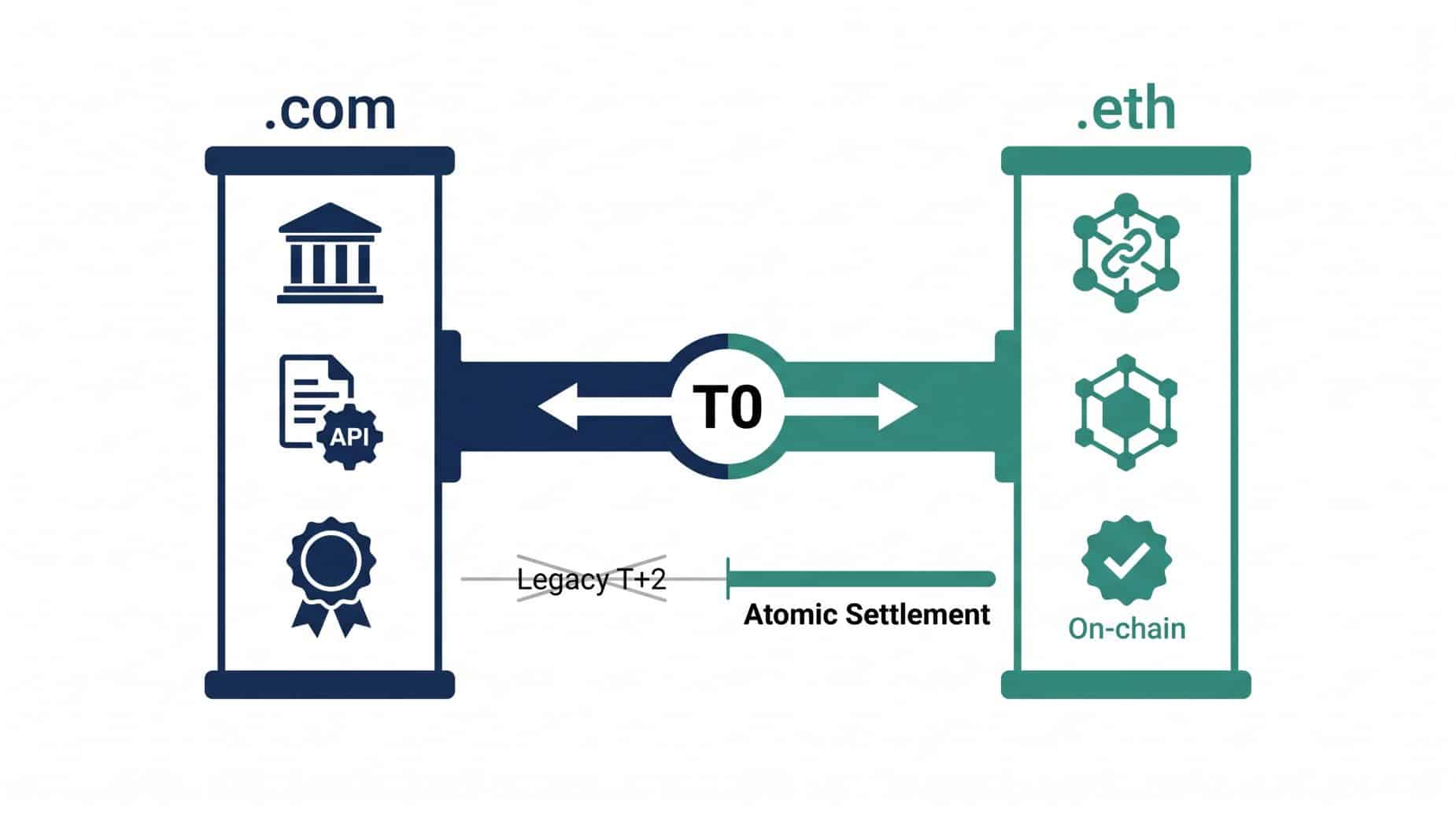
A Twin-Asset pairs is an inseparable pair: one domain representing the institutional web portal, legal identity, and API gateway — paired with its ENS counterpart, which represents the on-chain settlement endpoint, smart contract address, and programmable compliance layer.
Think of it as Front-to-Back Conformity at the namespace level.
atomicclearing.com is the interface your operations team sees. atomicclearing.eth is the address your smart contract calls at 3:47 AM when a cross-border repo trade requires T0 settlement in central bank money.
Without the .com: no institutional credibility, no regulatory identity, no human-readable API documentation. Without the .eth: no on-chain settlement finality, no Programmable Compliance, no verifiable Proof of Intent for regulators.
A bank that owns only one half of this pair has built half a bridge.
DEEP DIVE: ATOMIC CLEARING
atomicclearing.com / atomicclearing.eth — The Herstatt Risk Firewall
The Herstatt Bank failure of 1974 is not ancient history. It is the regulatory trauma that still shapes every cross-currency settlement protocol in use today. The OCC’s proposed Rule § 15.13(a) — and the BIS Innovation Hub’s Project Agorá, which now coordinates seven central banks and over 40 regulated institutions — share a single architectural response: atomic settlement, where messaging, reconciliation, asset transfer, and cash settlement execute as one indivisible operation.
No leg settles. Either everything settles, or nothing does.
This is what T0 means at the infrastructure level. Not “same day.” Not “near-real-time.” Atomic. One transaction. Zero counterparty exposure between the delivery leg and the payment leg.
The atomicclearing Twin-Asset positions your institution at the exact namespace where this happens. The .com domain is your bank’s institutional face — the compliance dashboard, the API documentation, the legal identity recognized by counterparties and regulators. The .eth domain is where the smart contract lives: the on-chain endpoint that a JPMorgan settlement engine or a Goldman Sachs repo desk can call directly, with full Real-Time Recon built into the ledger state.
OCC Reference: Proposed § 15.13(a) — Risk Management requirements for stablecoin issuers mandate operational controls sufficient to prevent settlement failures across payment systems. The BIS Agorá framework makes explicit that this standard requires Unified Ledger Integration, where tokenized reserves and tokenized deposits settle atomically, including in central bank money.
The bank that controls atomicclearing.com/.eth controls the namespace of record for this standard in the U.S. market.
DEEP DIVE: OPERATIONAL BACKSTOP
operationalbackstop.com / operationalbackstop.eth — The Runway That Regulators Demand
The OCC’s proposed rule contains a provision that has received less attention than it deserves. Under the Operational Backstop requirement, every permitted payment stablecoin issuer must maintain a designated pool of highly liquid assets — held separately from reserve assets and capital — sufficient to fund continued operations through a business disruption. The amount is calculated quarterly, based on the issuer’s total actual expenses over the trailing twelve months, including utilities, data processing, and salaries.
This is not a theoretical buffer. The OCC has been explicit: the backstop must be held in U.S. currency at a Federal Reserve Bank, as FDIC-insured demand deposits, or in U.S. Treasuries that can be liquidated immediately. It must be separately identified in every report filed under proposed § 15.14. And in a stress scenario, the OCC can shorten the response window — meaning the backstop must be accessible, addressable, and deployable within hours, not days.
This is a sovereign liquidity problem. And it is a namespace problem.
operationalbackstop.com is the institutional monitoring interface: the real-time dashboard that tracks the backstop pool composition, generates automated OCC § 15.14 quarterly reports, and alerts treasury operations when concentration thresholds approach the 40% per-institution limit mandated by the proposed rule.
operationalbackstop.eth is why this Twin-Asset earns a 10/10 ENS strategic relevance score. In a genuine business disruption — a cyber event, a counterparty failure, a liquidity freeze — the backstop pool must be addressable programmatically. The ENS domain is the only immutable, on-chain anchor point that a smart contract can reference for emergency liquidation of U.S. Treasury backstop assets without requiring a human to manually locate and initiate the transaction. This is the definition of Operational Resilience at the infrastructure layer.
Without a verifiable, sovereign on-chain address for the backstop, a bank’s Operational Resilience plan has a single point of failure: a human being with system access during a crisis.
OCC Reference: Proposed § 15.13(c) Operational Backstop; Proposed § 15.14 Reporting Requirements; GENIUS Act § 6 on liquidity maintenance during disruptions.
THE STRATEGIC CONCLUSION
Namespace Sovereignty Is a Compliance Decision
In 2026, the infrastructure that processes institutional digital asset transactions will have two layers: the institutional web layer, where regulators read reports and counterparties verify identity — and the on-chain layer, where settlement actually happens. Banks that have not established sovereign, brand-controlled presence on both layers will depend on third-party infrastructure for one of them.
The OCC’s risk management framework — specifically its requirements around Third-Party Risk Management under § 15.13(a)(2) — treats dependence on external infrastructure as an audit finding, not a temporary state.
PillarsX Twin-Assets are the architectural answer to this regulatory reality. Not as speculative digital real estate. As Interoperability Standard anchors: the fixed points in a converging financial system where legacy infrastructure and distributed ledger technology must meet, reconcile, and settle without delay.
The question is not whether your institution will need this infrastructure.
The question is whether you will own the namespace when it becomes mandatory. That is the foundational principle behind Architecting Sovereign Infrastructure — and why Twin-Assets are not optional in a two-layer financial system.
OCC compliance atomic settlement