
programmablecompliance.com & .eth | Programmable Compliance Identity
🔴 Regulatory Update — June 28, 2026
BIS Annual Economic Report 2026 confirms programmable compliance as the architectural foundation of the next-generation monetary system — smart contracts enabling central banks to "instantly create and adjust tools" and "improve operational efficiency and promote automation"
BIS Annual Economic Report 2026 Chapter III explicitly defines programmability as the core innovation that tokenization brings to compliance infrastructure: smart contracts that run on a blockchain and automatically trigger when pre-agreed conditions are met, without human intervention, could enable central banks to "instantly create and adjust their tools, such as deploy new facilities and adjust interest rates or collateral requirements." The BIS confirms this makes "tokenisation offer flexibility and speed in monetary policy operations" and "improve operational efficiency and promote automation." For regulated institutions, programmable compliance extends this to the transaction layer — AML/CFT checks, sanctions screening, collateral eligibility, and settlement authorization can all be embedded as programmable conditions that execute automatically before every tokenized transaction. programmablecompliance.com & .eth is the institutional namespace for programmable compliance identity — the automated rule-execution layer that the BIS confirms is the architectural foundation of the next-generation monetary system.
→ Source: BIS Annual Economic Report 2026 — Full Report Published June 28, 2026🔴 Regulatory Update — June 23, 2026
BIS Annual Economic Report 2026 calls for integrity by design in all programmable rails — AML/CFT, KYC, and sanctions compliance must be embedded at the infrastructure layer, not applied as post-hoc controls
The BIS Annual Economic Report 2026, Chapter III, published June 23, establishes integrity by design as a non-negotiable requirement for all programmable financial infrastructure. The BIS warns that stablecoins on public permissionless blockchains face fundamental AML/CFT compliance failures: pseudonymity, unhosted wallets, mixers, and cross-chain bridges undermine KYC and transaction monitoring at scale. The solution the BIS defines is programmable compliance embedded at the network layer — common identity standards, auditable data trails, and governance that respects data sovereignty — allowing institutions to interoperate without exporting vulnerabilities. The BIS confirms that without integrity, lapses propagate as quickly as payments do, eroding trust and fragmenting networks. Jurisdictions moving toward frameworks restricting stablecoin circulation to KYC-verified addresses and requiring AML/CFT standards equivalent to traditional payment systems are aligned with this BIS standard. programmablecompliance.com & .eth is the institutional namespace for this embedded compliance identity — anchored to the BIS integrity-by-design standard published today.
→ Source: BIS Annual Economic Report 2026, Chapter III — Integrity by Design, AML/CFT in Programmable Rails, June 23, 2026Global Layer One published its Programmable Compliance whitepaper on 22 June 2026, with direct contributions from the IMF, Banque de France, Kinexys by J.P. Morgan, the Monetary Authority of Singapore, Standard Chartered, the BIS Innovation Hub, Chainlink Labs, and GLEIF. The framework embeds compliance controls directly into token flows — checking issuer rules and regulatory policy at the transaction level, before transfers, swaps, or settlements occur, using a policy wrapper architecture inspired by MAS Purpose Bound Money and BIS Project Mandala. GLEIF's verifiable Legal Entity Identifier (vLEI) anchors counterparty identity verification within the framework, extending the LEI into a cryptographically verifiable credential model that lets any institution computationally verify the entity on the other side of a transaction. Zero-knowledge proofs enable issuers to demonstrate compliance while keeping transaction amounts, counterparty identities, and asset types confidential. The programmablecompliance namespace anchors the institutional identity for this framework — now directly named and architected by the IMF, BIS, and the world's leading custodial and settlement institutions.
In 2026 every regulated digital asset transaction faces the same structural requirement: compliance rules must be embedded directly into the execution layer — enforced automatically, at the moment of every transaction, without human intervention.
The FDIC BSA Rule of May 22, 2026 made this explicit for PPSIs — automated transaction monitoring systems aligned with FinCEN and OFAC requirements are now mandatory. The CLARITY Act establishes the same standard for every digital asset operator: rules governing transactions must be enforced at the protocol level, not verified retroactively in a post-trade audit cycle.
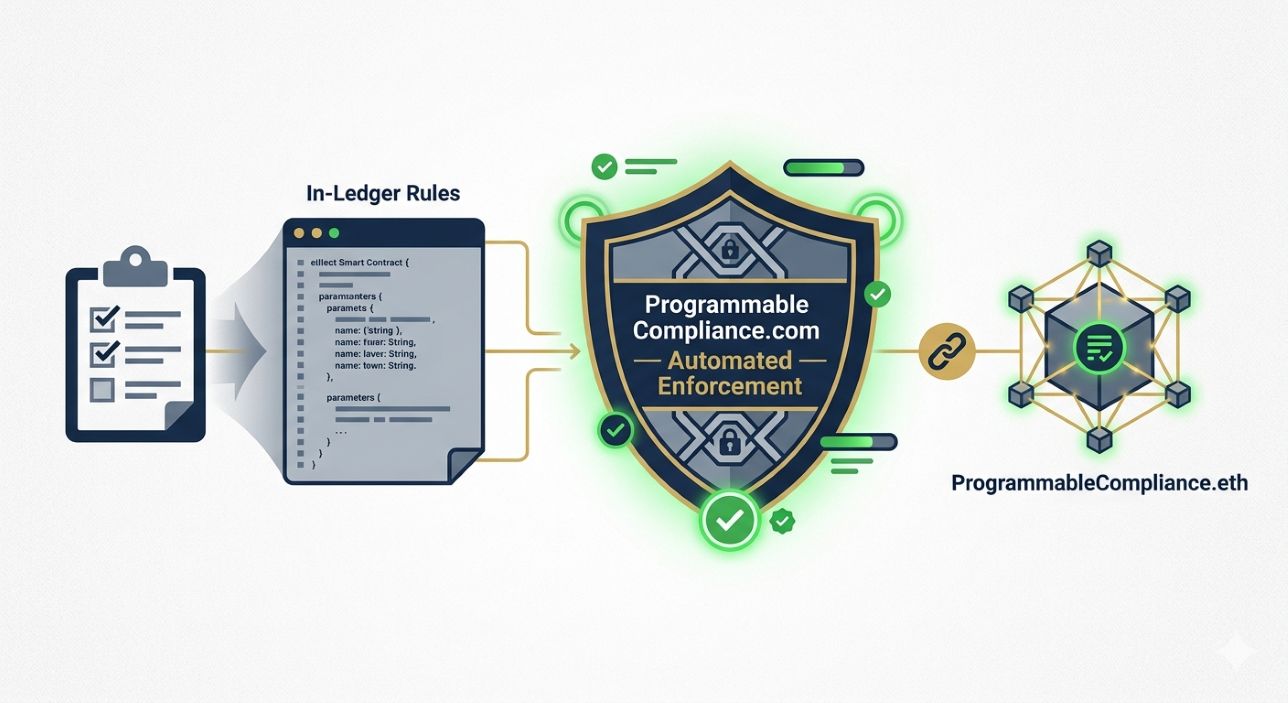
programmablecompliance.com is the institutional Web2 portal identity for this standard — the legal brand that appears in OCC examination submissions, CLARITY Act compliance filings, and institutional rule registry documentation. programmablecompliance.eth is the programmable on-chain routing identity — the ENS endpoint that AI agents, treasury systems, and settlement protocols query directly before initiating any regulated transaction, connecting the compliance rule registry to its on-chain enforcement layer without intermediary DNS dependency.
Together they form the complete Convergence Identity for the programmable compliance standard that every regulated institution must implement before the CLARITY Act July 4 signing makes in-ledger rule enforcement permanent federal law.
Namespace Acquisition: This Twin-Domain asset is available for institutional acquisition. Inquiries: hq@pillarsx.com
The Regulatory Mandate: Why CLARITY Act and GENIUS Act Require In-Ledger Rule Enforcement
Under the CLARITY Act (2026) and the GENIUS Act (12 U.S.C. § 5903), institutions are no longer permitted to treat compliance as a post-trade verification process. The regulatory mandate is unambiguous: rules governing digital asset transactions must be embedded directly into the execution layer — enforced automatically, at the moment of every transaction, without human intervention.
The OCC operationalizes this requirement through two specific obligations:
In-Ledger Rule Enforcement: Every permitted payment stablecoin issuer must demonstrate that compliance rules — asset eligibility, concentration limits, custody requirements, and counterparty restrictions — are enforced at the protocol level. A compliance framework that exists only in policy documents or manual review processes cannot satisfy OCC supervisory standards in a 24/7 automated trading environment.
Continuous Regulatory Synchronization: As regulations evolve — new OCC interpretive letters, updated CLARITY Act provisions, revised Basel IV requirements — compliance rules embedded in the ledger must update in real time. Static rule sets that require manual intervention to update create regulatory gaps that OCC examiners are specifically trained to identify and challenge.
The Programmable Compliance Standard is the direct institutional response: a continuously synchronized, in-ledger regulatory enforcement layer that satisfies both mandates simultaneously — turning compliance from a periodic obligation into an architectural guarantee.
The Three Compliance Failure Modes That Programmable Compliance Eliminates
The operational challenge for compliance teams in 2026 is not a lack of regulatory clarity. The OCC, CLARITY Act, and GENIUS Act provide detailed, actionable requirements. The critical gap is enforcement speed — the ability to apply every applicable rule at the exact moment a transaction is initiated, without human review cycles that cannot keep pace with automated, 24/7 digital asset operations.
Three failure modes define the institutional risk landscape:
Rule Latency: A compliance rule exists in policy but is applied manually — hours or days after the transaction it governs has already executed. In a T0 settlement environment, this latency is not a process inefficiency. It is a regulatory violation. Every transaction that executes before its compliance status is confirmed represents unquantified legal exposure under OCC supervisory standards.
Cross-Jurisdiction Rule Conflict: Institutions operating across multiple regulatory jurisdictions face conflicting compliance requirements that cannot be reconciled manually at execution speed. Without Programmable Compliance at the ledger layer, cross-border transactions execute under ambiguous regulatory conditions — creating legal uncertainty that counterparties, regulators, and AI agents cannot tolerate.
Agentic Compliance Failure: As AI agents execute treasury operations autonomously, they require machine-readable compliance rules at the point of execution. An agent that cannot query a verified, real-time compliance ruleset before initiating a transaction is an agent operating without Fiduciary Agentic Responsibility — exposing the institution to liability for every autonomous decision made without verified regulatory grounding.
→ Understand how AI agents operate within verified compliance boundaries: VerifiableIntent — The Verifiable Intent Standard
This is where ProgrammableCompliance.com operates as the institutional rule registry — a continuously updated, regulation-mapped compliance layer accessible via API to treasury systems, legal departments, and AI agents.
programmablecompliance.com provides the institutional Web2 portal identity — the legal brand that compliance teams reference in OCC examination submissions, CLARITY Act filings, and institutional rule registry documentation. It is the compliance portal where treasury systems, legal departments, and AI agents access the verified regulatory ruleset.
programmablecompliance.eth is the programmable on-chain routing identity — the ENS endpoint that AI agents, atomic settlement protocols, and treasury systems query directly at the moment of every transaction execution. Where programmablecompliance.com provides the legal documentation identity that regulators examine, programmablecompliance.eth provides the machine-readable oracle that protocol engineers embed into settlement infrastructure — connecting the regulatory rule registry to on-chain enforcement in a single ENS endpoint.
Together, programmablecompliance.com & .eth form the complete Convergence Identity: the legal anchor for compliance teams documenting in-ledger rule enforcement under CLARITY Act and GENIUS Act standards, and the technical oracle for software architects implementing real-time compliance verification — the two audiences that every institutional programmable compliance deployment must simultaneously satisfy.
The Programmable Compliance Ecosystem: From Custody Qualification to Agentic Authorization
Every automated transaction in a regulated environment requires one verified input before execution: is this action currently permitted under every applicable regulatory rule? Without a real-time, machine-readable answer to that question, no AI agent can operate safely, no atomic settlement can be legally initiated, and no custody relationship can be maintained within regulatory boundaries.
Within the PillarsX infrastructure, ProgrammableCompliance.com/.eth functions as the rule engine — the layer that every component queries before initiating any regulated action:
Programmablecompliance is the compliance rule engine of the PillarsX infrastructure stack — the layer that verifiableintent.com/.eth queries before authorizing every transaction, that agenticriskstandard.com uses as its regulatory grounding layer, and that coveredcustodian.com feeds with custody qualification signals before every settlement event.
CoveredCustodian.eth         →  Custodian qualification verified
        ↓                       [Qualified Digital Asset Custody]
ProgrammableCompliance.eth   →  Compliance rules verified & enforced
        ↓                       [Programmable Compliance]
VerifiableIntent.eth         →  Transaction intent authorized
                                [Fiduciary Agentic Responsibility]
As part of the complete PillarsX Compliance Stack, ProgrammableCompliance sits at the critical intersection between custody qualification and transaction authorization — ensuring that every action is not only technically possible but also regulatory permitted at the moment of execution.
📄 Academic Foundation
Twin-Domain Convergence Identity — The Institutional Framework Behind This Namespace
This Twin-Domain asset is part of the namespace architecture formalized in "Twin-Domain Convergence Identity: A Framework for Institutional Namespace Standards in Regulated Digital Asset Infrastructure" by Rolf Neumayr, PillarsX (SSRN Working Paper, 16 pages, posted June 12, 2026), classified under Monetary Economics — International Financial Flows, Financial Crises, Regulation & Supervision.
→ Read the Paper on SSRNStrategic Constellation & Bundle Potential
“The Automated Compliance Stack” · For Real-Time Regulatory Enforcement Under CLARITY Act
Designed for institutions requiring machine-speed compliance enforcement across every layer of their digital asset operations — from custody qualification through to intent authorization:
| Domain | Function | Regulatory Hook |
|---|---|---|
| ProgrammableCompliance.com/.eth | In-ledger rule engine & real-time compliance oracle | CLARITY Act – Programmable Compliance Mandate |
| CoveredCustodian.com/.eth | Custodian qualification layer feeding compliance rules | GENIUS Act § 10(a) – Covered Custodian |
| VerifiableIntent.com/.eth | Transaction authorization based on verified compliance status | CLARITY Act – Activity-Based Authorization |
| AgenticRiskStandard.com | Liability framework for AI agents operating on compliance signals | OCC – Fiduciary Agentic Responsibility |
Regulatory Sources
FDIC BSA Rule for PPSIs — May 22, 2026
Paxos SEC Clearing Agency Approval — May 29, 2026
OCC GENIUS Act Proposed Rule — Federal Register, March 2, 2026
BIS — Tokenisation and the Future of Money, 2025
Chainlink Automated Compliance Engine — Institutional Settlement
Explore related PillarsX infrastructure
→ verifiableintent.com & .eth — Verifiable Intent Identity
→ coveredcustodian.com — Covered Custodian Identity
→ agenticriskstandard.com — Agentic Risk Standard Identity
„All content is for informational purposes only and does not constitute financial advice.“