
SolverIntent — The Solver Intent Standard for Verified Execution Routing
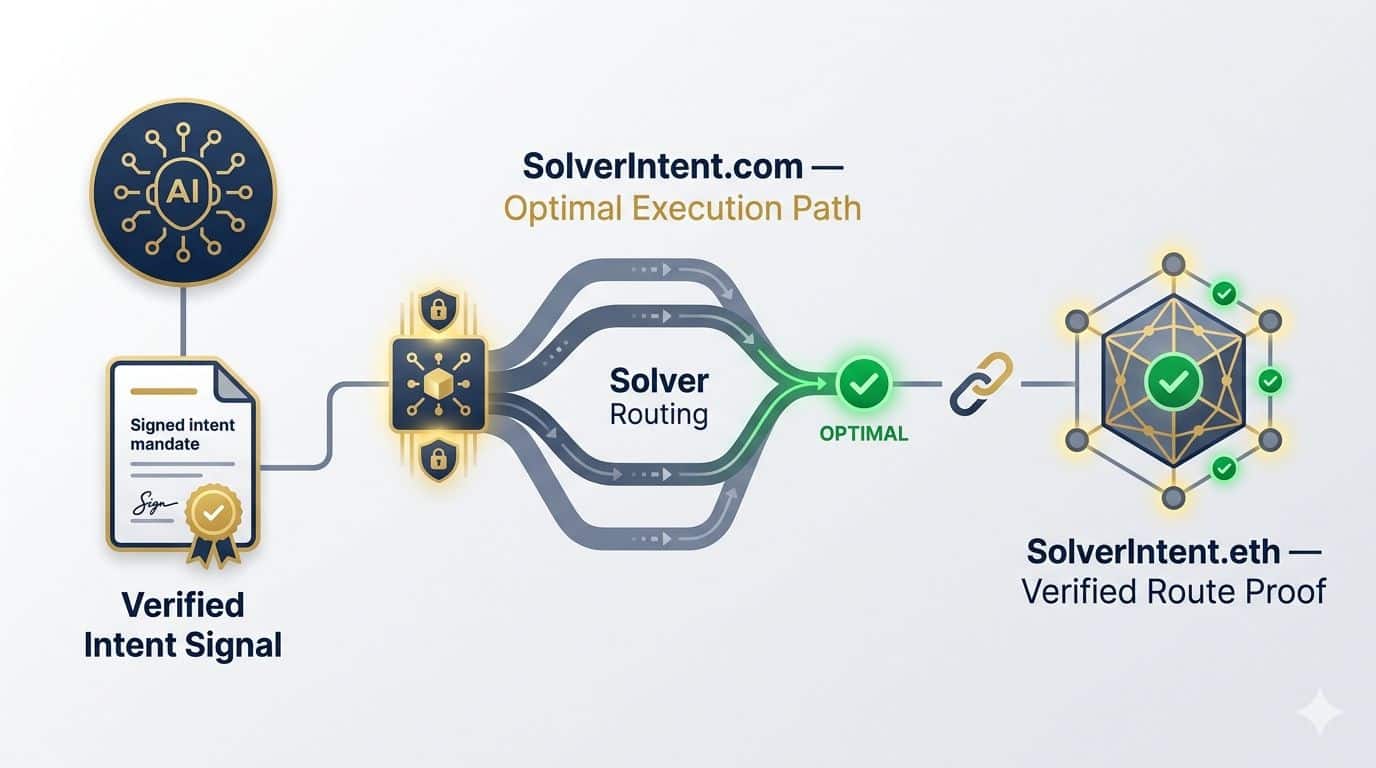
Between a verified mandate and atomic settlement lies one critical layer — the Solver Intent Standard ensures every execution path is optimized, compliant, and cryptographically proven before a single instruction reaches the ledger.
Pillar 1: Why Verified Execution Routing Is Now a Regulatory Obligation
In the automated financial markets of 2026, the path a transaction takes from intent to settlement is no longer a technical detail — it is a regulatory obligation. Under the CLARITY Act (2026) and the latest OCC Supervisory Guidance on Automated Decision Systems, every execution route chosen by an AI agent or solver network must be verifiable, compliant, and traceable to a verified institutional mandate.
The OCC operationalizes this requirement through two specific obligations:
Execution Path Accountability: Every institution deploying solver networks in settlement roles must demonstrate that every execution route was selected based on verified, compliant parameters — not purely algorithmic optimization. A solver that routes transactions through non-compliant counterparties, unverified liquidity pools, or jurisdictionally restricted channels creates regulatory liability for the institution — regardless of whether the final settlement achieved technical finality.
Intent-Execution Binding: Under the CLARITY Act, the intent behind a transaction must remain cryptographically bound to its execution path from mandate to finality. A solver that optimizes execution without maintaining the integrity of the original intent signal creates an authorization gap — where the executed transaction no longer reflects the verified mandate that initiated it. The Solver Intent Standard eliminates this gap by binding every execution route to its originating intent proof.
The Solver Intent Standard is the direct institutional response: a verified, intent-bound execution routing layer that ensures every solver decision is compliant, accountable, and cryptographically traceable from mandate to settlement.
Source: OCC Proposed Rules – Permitted Payment Stablecoin Issuers, Federal Register, March 2, 2026
Pillar 2: The Execution Integrity Gap — When Optimization and Compliance Pull in Opposite Directions
The operational challenge for institutions deploying solver networks in 2026 is not finding optimal execution paths. Modern solver algorithms can identify the most efficient routes across fragmented liquidity pools, cross-chain environments, and multi-jurisdiction markets in milliseconds. The critical gap is compliant optimization — ensuring that the most efficient execution path is also the most legally permissible one, verified at the moment of routing, not discovered to be non-compliant hours after settlement.
Three failure modes define the institutional risk landscape:
Compliance-Blind Optimization: A solver routes a transaction through the most efficient liquidity path — but one counterparty in that path fails Covered Custodian qualification requirements. The transaction settles at optimal speed. The compliance violation is discovered at the next OCC examination. Under Fiduciary Agentic Responsibility doctrine, the institution bears full liability for every non-compliant routing decision — regardless of whether a human or algorithm made it.
Intent Drift: As a transaction passes through multiple solver hops, the original intent signal degrades — execution parameters shift, counterparty conditions change, asset compositions evolve. By the time settlement occurs, the executed transaction no longer reflects the verified mandate that initiated it. Without Proof of Intent binding at every solver hop, the authorization chain is broken — and the institution cannot reconstruct it under examination.
Cross-Network Liability Fragmentation: In multi-solver environments spanning multiple chains and jurisdictions, liability for routing decisions fragments across network participants. Without a standardized Solver Intent Standard applied consistently across every solver in the network, institutions cannot definitively establish which solver made which routing decision — creating audit gaps that OCC examiners are specifically trained to identify.
This is where SolverIntent.com operates as the institutional execution routing registry — a continuously updated, compliance-mapped routing layer that ensures every solver decision is verified against applicable regulatory requirements before execution. And this is where SolverIntent.eth becomes indispensable: binding every routing decision to its originating intent proof on-chain — queryable at the moment of examination, traceable across every solver hop.
Source: BIS — Tokenisation and the future of money, 2025 — The BIS framework identifies intent-bound execution routing as a foundational requirement for compliant solver infrastructure across Unified Ledger environments.
Pillar 3: SolverIntent as the Routing Layer of the PillarsX Execution Stack
Every complex transaction in a regulated settlement environment requires one verified bridge: a compliant, intent-bound connection between the authorized mandate and the optimal execution path. Without that bridge, solver networks optimize for speed at the expense of compliance — creating liability at every routing hop.
Within the PillarsX infrastructure, SolverIntent.com/.eth functions as the routing layer — sitting between intent authorization and atomic execution:
VerifiableIntent.eth    →  Transaction mandate authorized & sealed
        ↓                  [Fiduciary Agentic Responsibility]
SolverIntent.eth        →  Optimal compliant execution path verified
        ↓                  [Proof of Intent / Interoperability Standard]
MCPSettle.eth           →  Atomic T0 execution initiated
                           [Atomic Settlement Efficiency]
As part of the complete PillarsX Execution Stack, SolverIntent sits at the critical intersection between intent authorization and atomic execution — ensuring that every routing decision is not only optimal but also cryptographically bound to its originating mandate and compliant with every applicable regulatory requirement.
→ Every solver route begins with a verified intent signal: VerifiableIntent — The Verifiable Intent Standard
Strategic Constellation & Bundle Potential
“The Compliant Execution Stack” · For Intent-Bound Solver Networks
Designed for institutions deploying solver networks in regulated settlement roles — ensuring every routing decision is compliant, intent-bound, and cryptographically traceable from mandate to finality:
| Domain | Function | Regulatory Hook |
|---|---|---|
| SolverIntent.com/.eth | Compliant execution routing & intent-bound path verification | CLARITY Act – Proof of Intent |
| VerifiableIntent.com/.eth | Originating mandate authorization before solver routing | CLARITY Act – Activity-Based Authorization |
| MCPSettle.com/.eth | MCP-native atomic execution after solver routing | GENIUS Act – T0 Settlement Mandate |
| AgenticRiskStandard.com | Liability framework for solver network routing decisions | CLARITY Act – Fiduciary Agentic Responsibility |
„All content is for informational purposes only and does not constitute financial advice.“