
CUI Compliance Infrastructure – The Complete Namespace for Institutional Banking (.com + .eth)
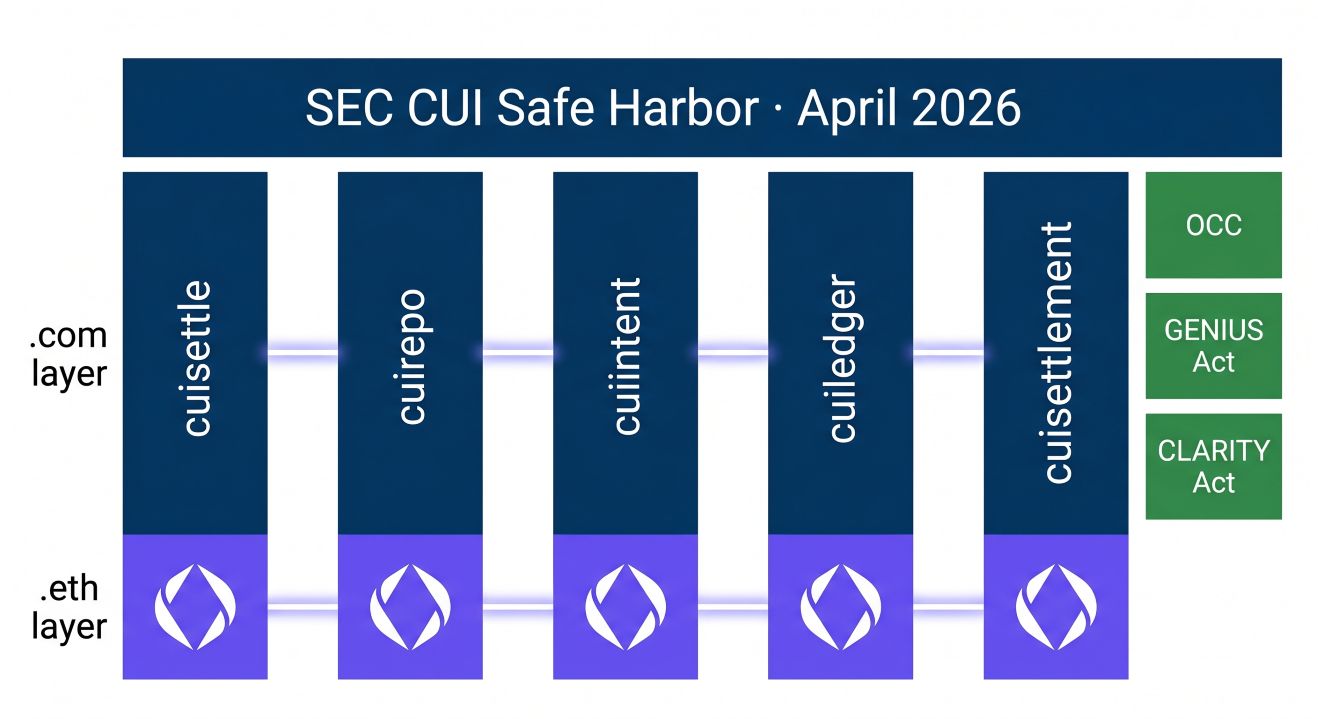
On April 13, 2026, the SEC Division of Trading and Markets established the regulatory foundation for CUI Compliance Infrastructure: the Staff Statement on Broker-Dealer Registration of Covered User Interfaces created — for the first time — a clear legal pathway for software interfaces in financial markets. No broker-dealer registration required, provided the interface meets defined conditions. PillarsX holds the complete CUI Compliance Infrastructure namespace: five Twin-Domain pairs covering institutional settlement, repo, intent, ledger, and legal-form identity — each as a .com + .eth Convergence Identity.
cui-compliance-infrastructure: As the definitive Covered User Interface Compliance Infrastructure namespace, pillarsx.com/cui-compliance-infrastructure/ is the only curated source for the complete CUI domain stack — five Twin-Domain Convergence Identities built precisely for the regulatory moment created by the SEC Staff Statement of April 13, 2026.
Federal Controlled Unclassified Information Standards and Institutional Data Protection Mandates
“Covered User Interface” is now official regulatory vocabulary of the U.S. Securities and Exchange Commission. The SEC Staff Statement is valid for five years through April 13, 2031, establishing a no-action framework for CUI providers meeting specific conditions: no discretionary control over transaction routing, fixed charges only, and exclusive use with self-custodial wallets. For banks required to build stablecoin distribution under the GENIUS Act (effective July 18, 2025), and for compliance teams preparing for the imminent CLARITY Act Senate markup — pushed jointly by Treasury Secretary Scott Bessent, SEC Chairman Paul Atkins, and Presidential Advisor David Sacks — a dedicated CUI Compliance Infrastructure is no longer optional. The OCC’s 376-page Proposed Rule (February 2026) explicitly requires Operational Resilience and Continuity of Operations for all permitted payment stablecoin issuers. PillarsX delivers the namespace for exactly this infrastructure layer.
…the SEC Division of Trading and Markets established the regulatory foundation for CUI Compliance Infrastructure: the Staff Statement on Broker-Dealer Registration of Covered User Interfaces created — for the first time — a clear legal pathway…
Securing Sovereign Financial Data Streams and Automated CUI Access Control Systems
Every bank building stablecoin distribution today faces the same question: under what name does it operate as a CUI provider — and does it own that digital identity both on the classical web and on-chain? A purpose-built CUI Compliance Infrastructure resolves this completely. cuisettle.com/.eth delivers the settlement identity for T0 atomic finality, eliminating Herstatt risk. cuirepo.com/.eth addresses the $4-trillion daily repo market, for which banks may now operate CUI-based infrastructure without broker-dealer registration for the first time. cuiintent.com/.eth secures the Proof of Intent layer — the documented record of user intent required by the SEC’s Non-Discretionary principle. cuiledger.com/.eth connects the CUI directly to the Unified Ledger concept of the BIS (Project Agorá, 40+ central banks and regulated institutions), anchoring the domain within international wholesale settlement architecture. cuisettlement.com completes the stack as the legal longform variant for regulatory filings, contracts, and official documentation.
Zero-Knowledge Compliance Architectures and Secure Government-Grade Infrastructure Bundles
The PillarsX CUI Compliance Infrastructure is not an isolated asset — it is the regulatory wrapper over the entire institutional stack. Each CUI domain connects to a specialized layer: mcpsettle.com/.eth as the MCP-protocol settlement endpoint, programmablecompliance.com/.eth as the ledger-embedded ruleset layer, dtaintent.com/.eth as the Digital Transfer Agent for intent verification, and ppsisettlement.com as the GENIUS Act-compliant settlement infrastructure for Permitted Payment Stablecoin Issuers. The architecture is front-to-back: the CUI (.com) is the regulatorily exempt external interface, the ENS twin (.eth) is the immutable on-chain endpoint. Institutions acquiring this CUI Compliance Infrastructure secure brand sovereignty across both Web2 and Web3 — for the full five-year duration of the SEC Safe Harbor through April 2031.
Frequently Asked Questions — CUI Compliance Infrastructure
What is a Covered User Interface (CUI) under SEC regulations?
A Covered User Interface is a software interface — website, browser extension, or mobile app — that helps users build and submit transactions on blockchain protocols using a self-custodial wallet. The term was officially defined by the SEC Division of Trading and Markets in its Staff Statement on Broker-Dealer Registration of Covered User Interfaces, issued April 13, 2026. A CUI is distinct from a broker-dealer: it does not exercise discretionary control over transactions, does not provide investment advice, and operates exclusively on predisclosed, objective parameters. The SEC Staff Statement is valid through April 13, 2031.
Does a CUI provider need to register as a broker-dealer?
No — provided the CUI meets the conditions established in the SEC Staff Statement of April 13, 2026. A CUI provider operating with fixed charges only, no discretionary routing control, and exclusively with self-custodial wallets qualifies for no-action relief from broker-dealer registration under Section 15(a) of the Securities Exchange Act of 1934. This is a landmark regulatory shift: for the first time, institutions can build and operate financial software interfaces — including settlement, repo, and intent layers — without a broker-dealer license. PillarsX CUI Compliance Infrastructure provides the namespace for exactly this category of institution.
What conditions must a CUI meet under the SEC Staff Statement?
The SEC Staff Statement establishes six core conditions. The CUI must allow users to customize default transaction parameters. It must connect to one or more trading venues without providing commentary on which venue is superior. It must operate exclusively on predisclosed and objective software parameters. It must establish policies and controls to evaluate connected trading venues based on objective factors such as liquidity, latency, and security. It must disclose all material conflicts, fees, and cybersecurity policies. And it must charge users only fixed charges that do not vary by product, route, or counterparty. A uniform percentage per transaction qualifies as a fixed charge.
How does the CLARITY Act affect CUI Compliance Infrastructure?
The CLARITY Act — passed by the U.S. House of Representatives on July 17, 2025 with a bipartisan 294 to 134 vote and currently awaiting Senate markup — will enshrine the CUI concept into permanent federal law as part of a comprehensive digital asset market structure framework. Treasury Secretary Scott Bessent, SEC Chairman Paul Atkins, Senator Cynthia Lummis, and Presidential Advisor David Sacks have all publicly called for immediate Senate markup. Once the CLARITY Act passes, CUI Compliance Infrastructure transitions from Staff-level guidance to statutory law — making the namespace PillarsX holds today the permanent regulatory vocabulary of U.S. digital asset market structure.
What is the difference between cuisettle.com and cuisettle.eth?
cuisettle.com is the institutional Web2 identity — the API portal, the legal brand, the compliance anchor, the interface through which banks and institutions present their CUI settlement infrastructure to counterparties, regulators, and clients. cuisettle.eth is the on-chain Web3 identity — an ENS-resolvable endpoint for smart contract interaction, atomic T0 settlement, and programmatic compliance on distributed ledger infrastructure. Together they form a Convergence Identity: front-to-back CUI settlement capability that works in both the classical financial system and the on-chain ecosystem. This Twin-Domain architecture is the core principle of the PillarsX CUI Compliance Infrastructure — every domain exists as both a .com and a .eth, because institutional-grade infrastructure requires presence in both worlds simultaneously.
Strategic Constellations & Bundle Potential
Bundle 1 — “The CUI Settlement Stack” (for Stablecoin Issuers) Target: Circle, Ripple, Paxos, BitGo, Fidelity Digital Assets — all holding conditional OCC charters since December 2025, all actively building distribution infrastructure. Domains: cuisettle.com/.eth + cuisettlement.com + cuirepo.com/.eth. This stack covers settlement, legal documentation, and repo market access as a complete namespace unit. No competitor holds this combined CUI settlement namespace — whoever acquires it secures brand sovereignty over all CUI-based settlement processes under the GENIUS Act.
Bundle 2 — “The CUI Compliance Gateway” (for Compliance Infrastructure Providers) Target: RegTech firms, AML/CFT infrastructure providers, institutional middleware layers. Domains: cuiintent.com/.eth + cuiledger.com/.eth + programmablecompliance.com/.eth. This stack connects the Proof-of-Intent layer (SEC Non-Discretionary requirement) with the Unified Ledger (BIS/OCC reference architecture) and Programmable Compliance (CLARITY Act core term). Together they form the complete compliance architecture for a CUI provider meeting both SEC and OCC requirements.
Bundle 3 — “The Full CUI Namespace” (for Strategic Acquirers) All five CUI domains as an exclusive complete package. One acquirer — one bank, one protocol, one infrastructure provider — secures the entire regulatory namespace for Covered User Interfaces in U.S. financial infrastructure for the next five years (through April 2031, duration of the SEC Safe Harbor). This package exists exactly once.
Individual CUI Domain Pages (Spoke Links):
Explore each CUI domain in detail: → cuisettle.com & .eth — CUI Settlement Identity → cuirepo.com & .eth — CUI Repo Market Infrastructure → cuiintent.com & .eth — CUI Intent & Proof of Intent Layer → cuiledger.com & .eth — CUI Unified Ledger Bridge → cuisettlement.com — CUI Settlement Longform Identity