
PPSISettlement — The Settlement Infrastructure Standard for Permitted Payment Stablecoin Issuers
PPSI Settlement: Under the GENIUS Act, a payment stablecoin is defined as a digital asset designed to be used as a means of payment or settlement, backed by specified reserve assets. Every PPSI that issues, redeems, and manages these instruments requires a settlement infrastructure layer that satisfies OCC, FDIC, and FinCEN requirements simultaneously — at every point in the transaction lifecycle.
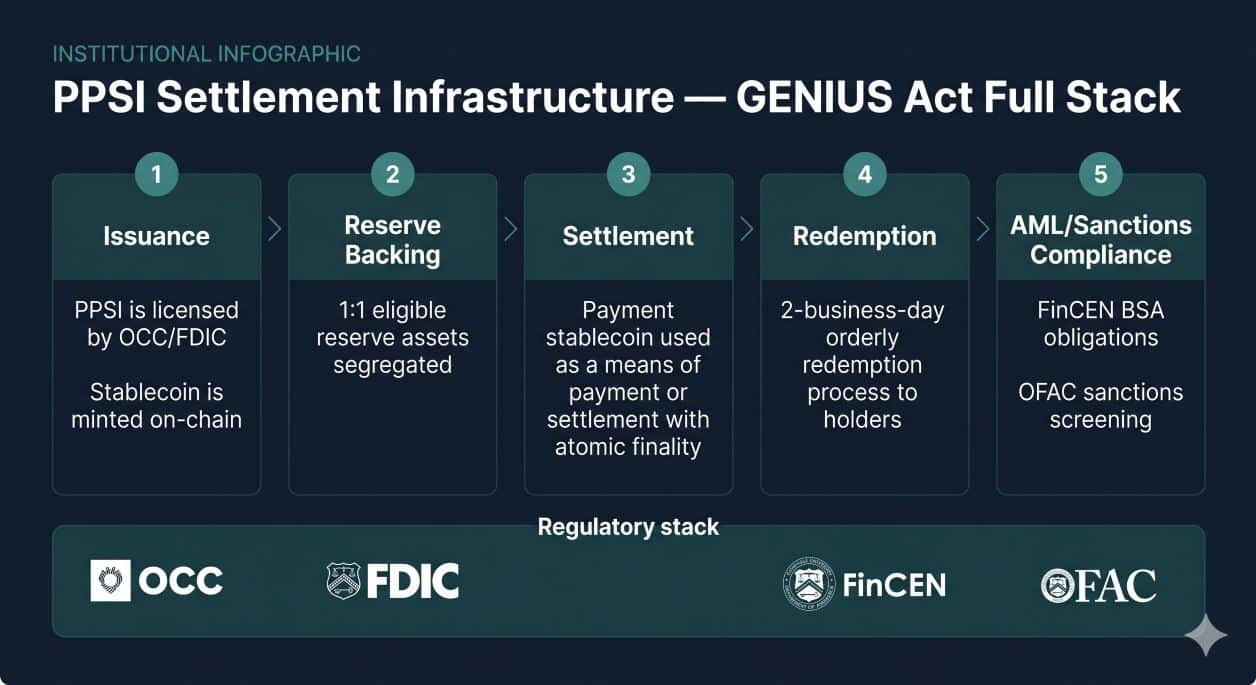
Pillar 1: Why PPSI Settlement Is the Core Function of the Entire GENIUS Act Framework
The GENIUS Act does not regulate stablecoins as investment products — it regulates them as settlement instruments. A payment stablecoin is defined as a digital asset that is, or is designed to be, used as a means of payment or settlement, the issuer of which is obligated to convert, redeem, or repurchase for a fixed amount of monetary value and represents that it will maintain a stable value relative to that fixed amount. Federal Register
This statutory definition places settlement at the center of every PPSI obligation. Three structural requirements define compliant PPSI settlement infrastructure:
Licensed Issuance Only: Only PPSIs licensed under the GENIUS Act may issue payment stablecoins in the United States. PPSIs may issue and redeem stablecoins, manage reserves, and hold stablecoins, reserves, and private keys in custody. Any settlement flow involving an unlicensed issuer is a statutory violation. Nixon Peabody
Reserve-Backed Settlement Finality: Every payment stablecoin used in settlement must be backed 1:1 by eligible reserve assets at all times — segregated, identifiable, and accessible for rapid monetization. Settlement finality is only legally valid when the underlying instrument meets reserve requirements.
Full Regulatory Stack Compliance: The GENIUS Act requires that a PPSI be treated as a financial institution for purposes of the Bank Secrecy Act and be subject to all federal laws applicable to a financial institution relating to economic sanctions and prevention of money laundering. Every PPSI settlement flow must satisfy OCC prudential standards, FDIC custody requirements, and FinCEN/OFAC AML and sanctions obligations simultaneously. Federal Register
Source: OCC Proposed Rules – Permitted Payment Stablecoin Issuers, Federal Register, March 2, 2026 · FinCEN/OFAC Joint NPRM, Federal Register, April 10, 2026
Pillar 2: The Settlement Compliance Gap — Where PPSI Infrastructure Fails
The operational challenge for institutions in 2026 is not the technical ability to move stablecoins. On-chain transfer infrastructure is commoditized. The critical gap is end-to-end settlement compliance — the ability to demonstrate, at every stage of the transaction lifecycle, that each settlement flow satisfies the full regulatory stack the GENIUS Act requires of a PPSI.
Four failure modes define the institutional risk landscape:
Unlicensed Counterparty Risk: Digital asset service providers are prohibited from offering or selling a payment stablecoin to persons in the United States unless the issuer is a permitted payment stablecoin issuer or a qualifying foreign issuer. Any settlement involving a non-PPSI stablecoin after the GENIUS Act effective date constitutes a statutory violation for the service provider — regardless of technical settlement finality. Nixon Peabody
Reserve Dislocation at Settlement: A PPSI whose reserve assets are not continuously accessible and rapidly monetizable cannot guarantee settlement finality under stress conditions. The OCC requires PPSIs to demonstrate operational capability to access and monetize reserves commensurate with their risk profile — at all times, not only at quarter-end.
AML/Sanctions Gap at Execution: FinCEN and OFAC require PPSIs to establish and maintain AML and countering the financing of terrorism programs, and — for the first time — explicitly mandate that a category of US persons maintain an effective sanctions compliance program. Every settlement flow must be screened before execution, not after. Mayer Brown
Agentic Settlement Risk: In automated payment environments, AI agents and smart contracts execute PPSI settlement flows without human intervention. Without a machine-readable, on-chain signal confirming PPSI licensing status, reserve adequacy, and AML/sanctions clearance at the moment of execution, every automated settlement interaction carries unresolved legal exposure.
This is where PPSISettlement.com functions as the institutional settlement compliance registry — continuously updated across OCC, FDIC, and FinCEN/OFAC requirements. And where PPSISettlement.eth translates that registry into a blockchain-native settlement clearance signal, queryable by smart contracts at the exact moment of execution.
Pillar 3: PPSISettlement as the Transaction Layer of the PillarsX Compliance Stack
Every institutional settlement involving a payment stablecoin requires one confirmed signal before execution: is this PPSI licensed, reserve-compliant, and AML/sanctions-cleared at this exact moment?
Within the PillarsX infrastructure, PPSISettlement.com/.eth functions as the transaction clearance layer:
EligibleAsset.eth          →  Asset classification confirmed
        ↓                     [Reserve Compliance]
PermittedReserves.eth      →  Reserve composition validated
        ↓                     [Settlement Clearance]
PPSISettlement.eth         →  PPSI licensing + AML/sanctions confirmed
        ↓                     [Custody Verification]
CoveredCustodian.eth       →  Custodian qualification verified
                              [Programmable Compliance]
→ For the complete GENIUS Act compliance framework: GENIUS Act Compliance Infrastructure
Strategic Constellation & Bundle Potential
| Domain | Function | Regulatory Hook |
|---|---|---|
| PPSISettlement.com/.eth | PPSI licensing & settlement clearance registry | GENIUS Act § 3 – Permitted Issuers Only |
| EligibleAsset.com/.eth | Asset classification before settlement | OCC § 15.11(b) – Eligible Asset Categories |
| PermittedReserves.com/.eth | Reserve validation at settlement | OCC § 15.11(c) – Reserve Composition |
| CoveredCustodian.com/.eth | Custodian qualification for reserve monetization | GENIUS Act § 10(a) – Covered Custodian |
„All content is for informational purposes only and does not constitute financial advice.“