
Programmable Compliance: How FHE Solves the Institutional Privacy Gap
Institutions joining the DTCC tokenization launch in July 2026 face a structural contradiction: the CLARITY Act demands verifiable on-chain transparency, while banking secrecy law and competitive strategy demand that transaction details never appear on a public ledger. Fully Homomorphic Encryption resolves this contradiction — and programmable compliance is how it becomes operational.
The Catalyst: Two Laws That Cannot Both Be Satisfied
The new US regulatory framework requires exchanges, brokers, custodians, and token sponsors to invest in governance, risk management, and technology to support reconciliation, settlement, and regulatory reporting — including audited on- and off-chain records and documented rights.
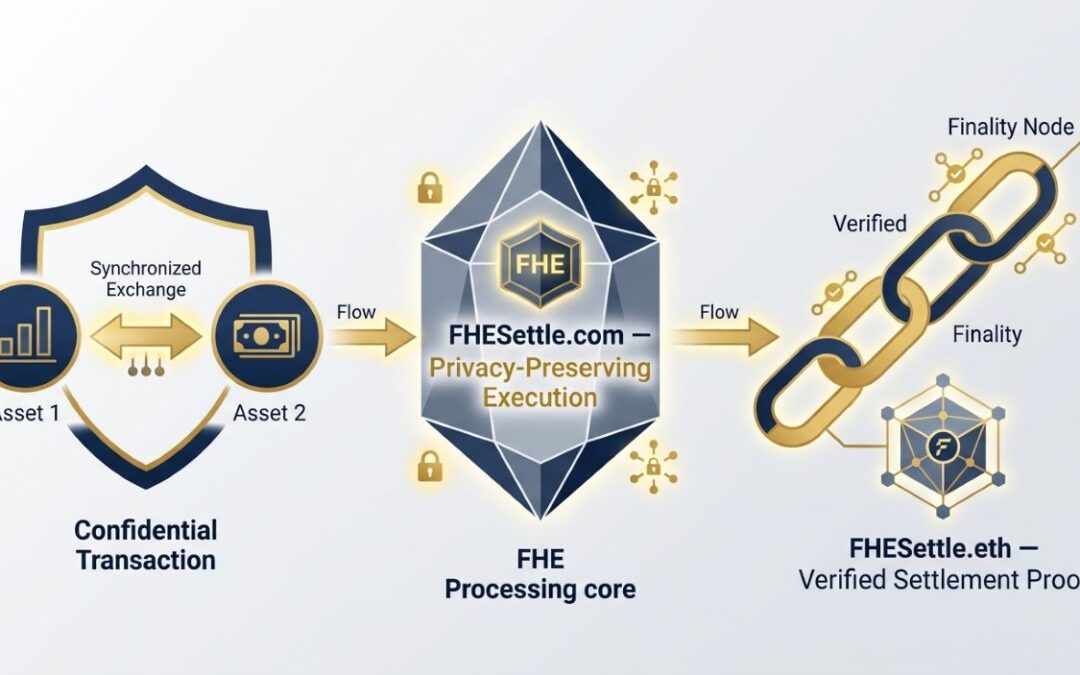
At the same time, institutions cannot expose raw trade data or client information on a public network. The processing server must execute logic on ciphertexts themselves — the result is returned to the institution, which is the only party capable of decrypting the final outcome.
The conflict is structural. The CLARITY Act mandates auditable, verifiable records. Public blockchains expose every transaction to every participant. No institution will migrate $114 trillion in assets to an infrastructure where its balance sheet and trading strategy are permanently visible to competitors.
The Technical Challenge: Why Standard Solutions Fall Short
Zero-Knowledge Proofs prove that a computation is correct — but they do not allow a third party to process encrypted data. While ZKPs prove that a computation is correct, FHE allows you to actually perform that computation on encrypted data. This means a third-party service provider can process sensitive trade data or client information without ever seeing the raw numbers.
For institutional workflows involving multiple counterparties — a custodian, a clearing house, a regulator, and a prime broker all interacting on the same transaction — ZKPs are insufficient. Each party needs to process data it cannot see. That is precisely what FHE enables.
New product categories including tokenized money market funds, tokenized deposits, programmable treasury services, and collateralized stablecoins require compliance assurance embedded directly into the infrastructure — not applied after the fact by a compliance team reviewing public transaction records.
The PillarsX Position: Programmable Compliance as Infrastructure
Programmable compliance is not a software product. It is a namespace — the institutional identity that signals to regulators, counterparties, and auditors that an institution has embedded compliance logic directly into its settlement, custody, and reporting infrastructure.
PillarsX holds programmablecompliance.com & .eth — the institutional identity for this infrastructure layer. When a Qualified Digital Asset Custodian must demonstrate to the CFTC that its settlement operations are both private and compliant simultaneously, programmable compliance is the standard it operates under.
The CLARITY Act created the requirement. FHE provides the technology. Programmable compliance is the institutional identity for the infrastructure that connects both.
Sources
2026 Guide to Blockchain Privacy — ChainSafe
New US Rules Bring Greater Clarity to Digital Assets — CBIZ