
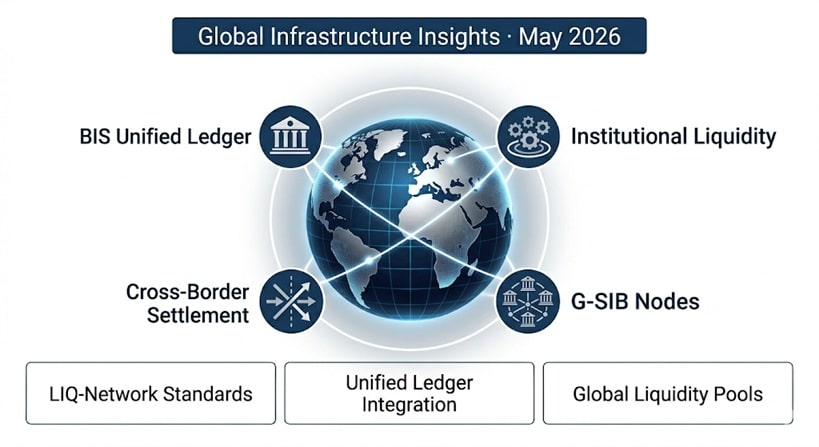
The global financial architecture is undergoing its most consequential structural transformation since Bretton Woods. The Bank for International Settlements has moved from concept to implementation — and the institutions that position their infrastructure within this new architecture today will define the settlement rails of the next decade.
The Catalyst: The BIS Trilogy Takes Shape
The BIS has established the “trilogy” of tokenised central bank reserves, commercial bank money and government bonds as the next logical step to deliver profound change for the financial system — laying the foundations of a tokenised monetary and financial system based on the time-tested principles of sound money: singleness, elasticity and integrity.
Project Agorá — a collaboration led by the BIS with seven central banks and 43 private sector institutions — is already driving this vision from concept to operational reality. The BIS is not just theorising; it is working with central banks to test and develop tokenisation as the backbone of the future monetary and financial system.
This is the infrastructure shift that every institutional settlement, custody, and liquidity operation must now position around. The timeline is no longer theoretical — DTCC begins limited production trades of tokenized securities in July 2026, with a full launch in October.
The Technical Challenge: Fragmentation Is the Enemy
The siloed approach to digital currencies poses unique challenges given the need for interoperability. BIS Head of Research Hyun Song Shin noted: “Bringing together central bank money, commercial money, and different assets on the same platform, all tokenised and interacting, opens up a whole new range of possibilities.”
The core problem is liquidity fragmentation. Institutions operating across multiple DLT networks — Ethereum, XRP Ledger, Canton, Solana — face the same settlement problem in every jurisdiction: liquidity pools are isolated, settlement rails are incompatible, and every cross-chain movement creates counterparty exposure.
Multiple specific-use ledgers can coexist, interconnected through application programming interfaces to ensure interoperability — but the Unified Ledger framework is what makes this technically achievable at institutional scale.
The PillarsX Position: Liquidity Infrastructure as the Strategic Moat
The BIS Unified Ledger does not replace existing liquidity infrastructure — it requires institutions to define their position within the new architecture. Every settlement rail, every liquidity pool, and every repo market needs an institutional namespace that signals Unified Ledger compatibility.
PillarsX holds lLiqpool.com/.eth and unifiedsettle.com/.eth — the institutional liquidity and settlement identities for this convergence layer. In a financial system where liquidity is infrastructure, controlling the namespace for institutional liquidity networks is the strategic moat that determines which institutions lead and which follow.
The BIS General Manager confirmed on May 12, 2026 that Unified Ledgers represent the global reference architecture for institutional finance. The question for every institution is no longer whether to participate — it is which namespace they will operate under when they do.
Sources
BIS Press Release — Next-Generation Monetary and Financial System, June 2025
BIS Annual Economic Report 2025 — Chapter III