
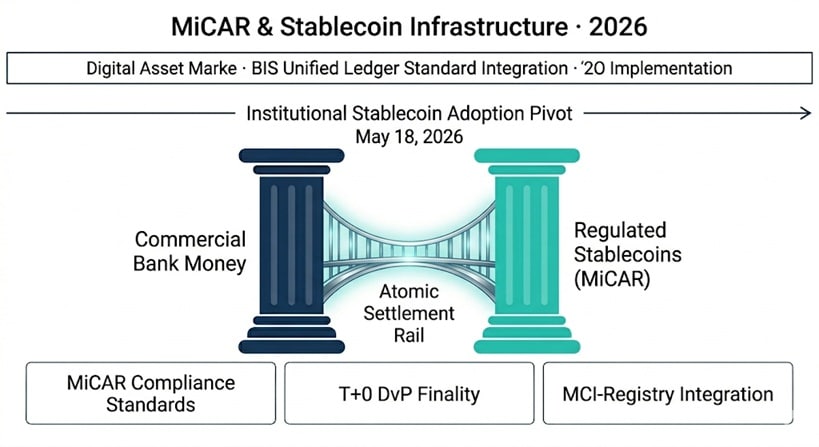
MiCAR and the EMT Standard: Why Institutional Stablecoin Infrastructure Can No Longer Wait
The July 1, 2026 MiCAR deadline ends the transitional period for crypto-asset service providers across the EU. After this point, entities providing crypto-asset services without the required MiCAR authorization may no longer rely on transitional arrangements. For stablecoin issuers, this is not a regulatory formality — it is the moment that determines which institutions survive in the European market and which do not.
The Catalyst: MiCAR Creates Two Classes of Stablecoins
MiCAR responds to systemic stablecoin risk by requiring full reserve backing, imposing strict redemption rights, and introducing transaction and volume thresholds for non-Euro stablecoins used in the EU.
The regulation creates two distinct compliance categories. Electronic Money Tokens represent a single fiat currency and function as regulated e-money on DLT — EMT issuers must meet strict compliance standards and be authorized credit or electronic money institutions. Asset-Referenced Tokens reference multiple assets or non-currency benchmarks and are subject to a separate MiCAR regime.
The institutional consequence is immediate: a consortium of major European banks — ING, UniCredit, CaixaBank, BNP Paribas, and others — is seeking to launch a joint euro stablecoin in H2 2026, explicitly positioning it as a European sovereign alternative to the US-dominated stablecoin market.
The Technical Challenge: Atomic Settlement for Regulated EMTs
MiCAR compliance is not just a licensing requirement — it creates a specific technical problem. EMTs must be issued at par value upon receipt of equivalent fiat funds and must remain fully backed by reserves denominated in the same currency. Holders have a direct legal claim against the issuer and are entitled to redeem EMTs at any time and at face value.
Real-time redemption at par value requires atomic settlement infrastructure. A traditional T+1 or T+2 settlement cycle cannot guarantee par-value redemption on demand — the settlement lag creates a window where the EMT and its reserve backing are momentarily decoupled. MiCAR-licensed firms engaging in EMT payments were instructed to obtain a payment license or EMI — and zerohash secured its EMI license from the Dutch Central Bank today, May 18, 2026, to support stablecoin-powered financial flows for banks, brokerages, fintechs, and enterprise platforms across the European market.
This is the settlement problem that atomic DVP infrastructure solves structurally — asset transfer and payment in a single, indivisible transaction with zero settlement lag.
The PillarsX Position
PillarsX holds emtsettle.com — the institutional settlement identity for MiCAR-compliant E-Money Token infrastructure. When a European bank consortium launches its euro stablecoin in H2 2026 and needs an institutional namespace for its EMT settlement layer, emtsettle provides the identity that connects MiCAR compliance with atomic settlement capability.
The July 2026 deadline is 44 days away. The institutions making their EMT settlement infrastructure decisions today are the ones that will define the European digital euro standard for the next decade.
Sources
MiCA Regulation Explained — Legal Nodes
MiCA Rules for Stablecoins: ART & EMT Compliance — AMLBot