
Agentic Commerce & Compliance Orchestration
Status: Exclusive Infrastructure Monopoly (Strategic Blocking Position)
1. The Strategic Reality: Zero-Sum Domain Sovereignty
In the institutional landscape of 2026/27, the success of AI-driven transaction systems (Agentic Commerce) is no longer a matter of software, but a matter of Namespace Sovereignty.
This portfolio represents the exclusive interface between autonomous agent logic and institutional liability. For a global player, the logic is binary: Any architecture built without these specific anchor terms is fragmented and vulnerable from day one. To not own this standard is to cede the definitional power of the “engine room” to the competition.
2. The Moat: Structural Exclusion of Competitors
Ownership of this bundle enforces a market entry barrier that transcends technical superiority.
-
🚫 Naming Veto: By occupying
verifiableintent.comandregvfy.eth, the most intuitive and regulatorily precise terms are removed from the market. Competitors are forced to use second-tier, convoluted terminology, which fundamentally compromises institutional trust. -
🏗️ Architectural Necessity: In a system where Smart Contracts (
.eth) and user interfaces (.com) must merge seamlessly, this bundle creates a coherent identity. A player holding only fragments cannot demonstrate a consistent “Chain of Trust.”
3. Functional Flow: The Integrated Process Chain
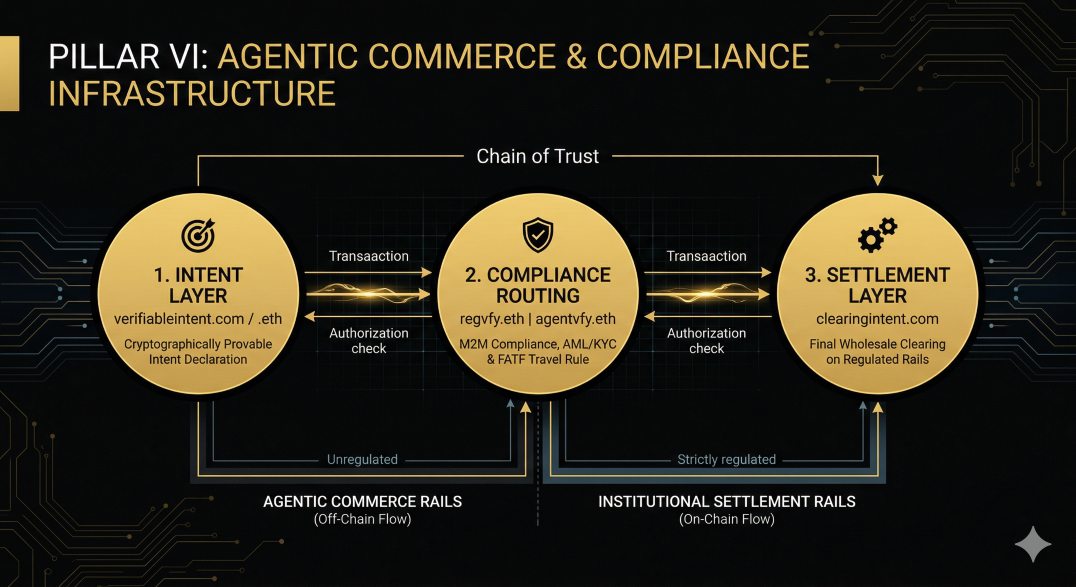
Every institutional transaction in the Agentic Age must pass through these three monopolized phases:
-
📍 Step 1: Intent Declaration (
verifiableintent.com) Before a machine acts, a verifiable intent must be declared. This is the legal foundation for autonomous deals. -
🛡️ Step 2: Compliance Routing (
regvfy.eth|agentvfy.eth) This is where the “Ghost in the Machine” operates. These endpoints are the mandatory routing points for automated AML/KYC. Without these addresses, a competitor cannot establish their logic as an industry standard. -
⛓️ Step 3: Execution Finality (
clearingintent.com) The transfer into regulated liquidity marks the legally binding conclusion.
4. Competitor “Kill-Switch” (Operative Impact)
Acquiring this monopoly ensures that the following key positions are permanently blocked for any other market participant:
-
No Standard API: No competitor can register a standard routing API under
regvfyorpayvfyin the ENS space. -
No First-Mover Brand: The competition loses the ability to build a cross-channel (Web2/Web3) brand for “Verifiable Intent.”
-
Strategic Detours: Any competing infrastructure must accept costly detours in user experience and institutional onboarding because the “straight line” is already owned.
Conclusion: This bundle represents a definitive Strategic Imperative for the next generation of financial infrastructure. The operational and competitive risks of allowing this market-defining position to be secured by a third party represent a strategic opportunity cost that far outweighs the current acquisition value. This is not merely a collection of assets, but a Foundational Guardrail for long-term institutional market dominance.