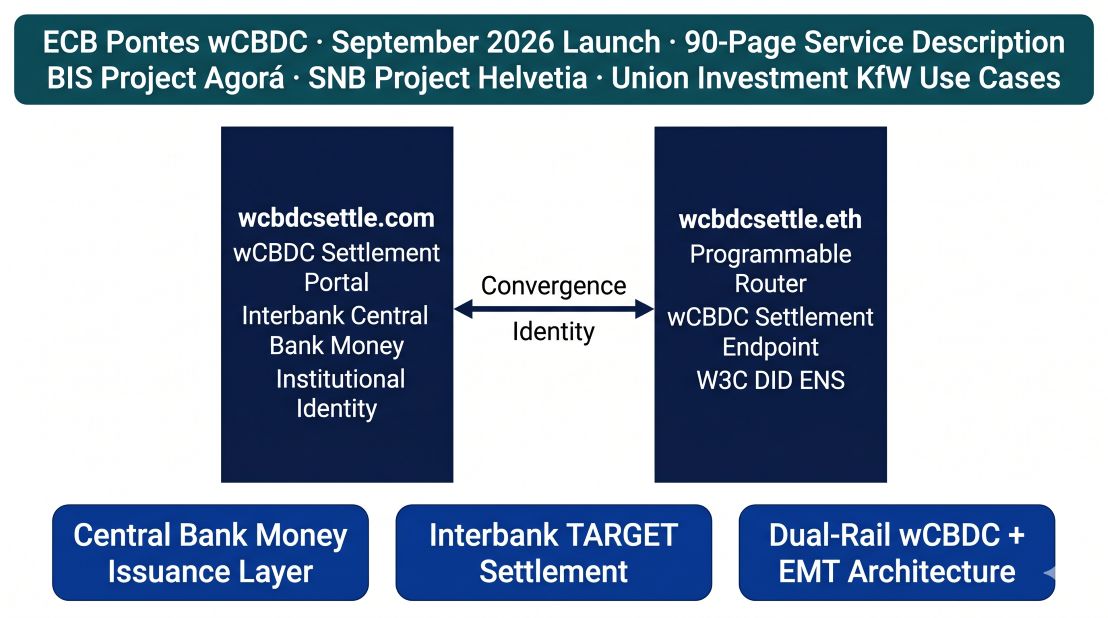
wcbdcsettle.com & .eth | wCBDC Settlement Identity
🔴 Regulatory Update — June 1, 2026
ECB Schnabel confirms central bank money as foundational settlement layer — private assets structurally excluded from monetary anchor role
ECB Executive Board Member Schnabel confirmed at the Bank of Korea Conference June 1, 2026: "Central bank money must continue to serve as an anchor even in a tokenized world. Private assets cannot fulfill the anchor role." Schnabel stated that in a tokenized world, the fundamental structure will mirror traditional finance — with central bank money maintaining its position as the foundational settlement layer. Pontes addresses existing problems with quick implementation from Q3 2026, while Appia is the long-term structural solution.
→ Source: ECB Schnabel — BOK Conference, June 1, 2026🔴 Regulatory Update — Q3 2026 Launch Confirmed
ECB Pontes wCBDC settlement launches September 2026 — 90-page draft service description published, Union Investment and KfW confirm institutional use cases
ECB published the 90-page Pontes draft service description in March 2026 — confirming wholesale CBDC settlement as the operational standard for DLT-based institutional transactions from September 2026. Union Investment and KfW presented concrete institutional use cases at the Digital Euro Conference: weekend bond settlement, T+0 repo transactions, and margin management outside standard banking hours. The ECB confirmed Pontes and Appia are wholesale CBDC projects under its "New Technologies for Central Bank Money Settlement" initiative.
→ Source: Ledger Insights — wCBDC Settlement Use Cases, March 2026Wholesale CBDC settlement is architected for the interbank settlement layer — the net position between regulated financial institutions settling aggregate exposure in central bank money. The Bundesbank Trigger Solution, DL3S bridge, and TIPS Hash-Link all operate at this layer. Pillarsx
A German pharmaceutical company issued a US dollar bond on a Thursday with T+5 settlement and then dropped a profit warning over the weekend. Asset managers who had subscribed were stuck — they could not sell, could not hedge, and had to wait until the settlement window reopened. This is the concrete institutional pain point that wholesale CBDC settlement eliminates: the inability to settle DLT-based transactions in central bank money outside traditional banking hours.
It is consistent with two-tier CBDC architectures favoured by the ECB, the Bank of England, and BIS Project Agorá — in which central banks issue wholesale CBDC to commercial banks, which then issue tokenised deposits to end users. The pattern is consistent: programmable money works at scale when issued at the commercial bank layer, with the central bank providing settlement finality at the wholesale layer. Pillarsx
wcbdcsettle.com is the institutional Web2 portal identity for the wholesale CBDC settlement standard — the legal brand that appears in ECB Pontes integration documentation, BIS Agorá compliance submissions, and institutional interbank settlement agreements wherever wholesale central bank money settlement must be referenced. wcbdcsettle.eth is the programmable on-chain routing identity — the ENS endpoint that software architects embed directly into wCBDC settlement protocol logic to route interbank transactions to central bank money finality without intermediary DNS dependency.
Together they form the complete Convergence Identity for the wholesale CBDC settlement standard that every institution participating in ECB Pontes September 2026 must establish.
The Regulatory Foundation, The wCBDC Settlement Architecture, and The Ecosystem
The ECB approved the launch of two wholesale CBDC projects — Pontes and Appia — developed under the “New Technologies for Central Bank Money Settlement” initiative, designed exclusively for interbank transactions between financial institutions. Pillarsx
Crédit Agricole CIB and CACEIS completed the first wCBDC experiment with the ECB — with settlements conducted using wholesale CBDC. The experiment confirmed the feasibility of a platform-less blockchain protocol where transactions can be securely settled without the need for a centralized platform operator, and confirmed the feasibility of a unified ledger of commercial bank money for the banking industry. Pillarsx
CPMI defines wCBDC as “wholesale tokenized central bank money.” The Swiss National Bank describes Project Helvetia III as piloting “tokenized central bank money for wholesale use, often referred to as wholesale CBDC.” 75% of surveyed central banks showed interest in wCBDC — seeing it as “preserving the role of central bank money as the anchor of the monetary system.” Crypto Times
The IMF April 2026 Tokenized Finance Note confirms the structural importance: wCBDC is less a standalone product than a policy instrument — its primary value lies in anchoring tokenized markets to the safest settlement asset, thereby reducing systemic risk across the entire DLT settlement stack.
The wCBDC Settlement Architecture
A critical operational nuance applies: while the TIPS rail itself is continuous, the central bank money liquidity backing wholesale CBDC transactions is still largely sourced from T2 reserve accounts. An institution requiring T+0 settlement of a DLT-based repo transaction on a Sunday can use a MiCA-compliant EMT. This is not a workaround — it is the intended architecture of a dual-rail settlement environment: central bank money where available, regulated digital cash where central bank money is not. Pillarsx
The wCBDC settlement architecture operates through three simultaneous layers that wcbdcsettle.com documents and wcbdcsettle.eth routes through.
The central bank money issuance layer — where the ECB issues wholesale CBDC to commercial banks through the Pontes bridge — represents the top of the settlement hierarchy. Every DLT transaction that settles in wCBDC is anchored to the safest possible settlement asset: direct central bank liability with zero counterparty risk.
The interbank settlement layer — where commercial banks settle net positions in wholesale CBDC through TARGET Services — is the operational core of the wCBDC architecture. The Bundesbank Trigger Solution, DL3S bridge, and TIPS Hash-Link all operate at this layer.
The dual-rail settlement layer — where wCBDC and MiCA-regulated EMTs operate simultaneously for different use cases — is the practical implementation standard. wCBDC for weekday institutional transactions; MiCA EMT for weekend and 24/7 operations where T2 liquidity is unavailable.
wcbdcsettle.eth is the W3C DID-compliant ENS endpoint for this three-layer wCBDC settlement architecture — the on-chain routing identity that protocol engineers embed into interbank settlement infrastructure to route transactions to central bank money finality across all TARGET Services simultaneously.
The wCBDC Settlement Ecosystem
wcbdcsettle is the central bank money settlement apex of the PillarsX European settlement namespace. It connects directly to pontessettle.com & .eth as the ECB Pontes bridge that delivers wCBDC settlement from September 2026, and to sovereignsettle.com & .eth as the monetary sovereignty identity that wCBDC settlement anchors.
Beyond the wCBDC cluster, wcbdcsettle integrates with depositsettle.com & .eth as the commercial bank deposit settlement layer that wCBDC anchors at the wholesale level, appiasettle.com & .eth as the longer-term Appia ecosystem where wCBDC settlement scales to full European financial infrastructure, and agorasettle.com as the BIS Agorá global wCBDC settlement standard that Pontes implements at the European level. The multichain banking identity for deposit tokens that ultimately reference wholesale CBDC settlement as their central bank money anchor — as JPM Coin’s multi-network expansion across Base and Canton Network illustrates — is documented at multichainbanking.com & .eth.