
fheinterop.com & .eth | FHE Interoperability Identity
Chainlink has established that as institutions adopt hybrid architectures — using private subnets or application-specific blockchains that settle to a public mainnet — the need for a unified privacy standard for interoperability becomes paramount. Without privacy-preserving interoperability solutions, liquidity stays trapped in isolated private silos, hindering the singleness of money across the financial system. MiCA's full enforcement from 1 July 2026 adds a regulatory dimension: CASPs must now demonstrate interoperability across blockchain networks while maintaining GDPR-compliant data protection — a requirement that FHE uniquely satisfies by enabling cross-chain computation on encrypted data without decrypting at the interoperability layer. The fheinterop namespace anchors the institutional identity for FHE-enabled cross-chain interoperability — encrypted settlement flows that maintain confidentiality across network boundaries under simultaneous MiCA and GDPR requirements.
🔴 Infrastructure Update — 2026
Primus launches zkTLS/zkFHE interoperability layer as Chainlink confirms the underlying gap — confidential computing providers do not yet interoperate by default, creating the structural need this namespace anchors
Primus, a Hong Kong-based startup, built a zkTLS and zkFHE interoperability layer specifically for secure Web2, Web3, and AI data exchange — confirming that cross-platform FHE compatibility has emerged as its own commercial category rather than a theoretical concern. Chainlink's own Confidential Compute documentation acknowledges the structural problem this solves: MPC and FHE offer powerful methods for collaborative private computation, but broad, real-time, developer-friendly deployment is still evolving, and private or permissioned blockchains that provide data confidentiality can limit interoperability and composability with the broader onchain ecosystem. With distinct FHE providers — Fhenix on Ethereum, Inco's Web3 confidentiality layer, Zama's encryption libraries — each building independently, an institution operating confidential workflows across more than one stack faces exactly the cross-platform compatibility gap fheinterop.com & .eth is built to document and resolve.
→ Source: StartUs Insights — Top Homomorphic Encryption Companies 2026, Primus zkFHE Interoperability LayerConfidential computing is fragmenting before it has even fully matured. Fhenix brings encrypted computation to Ethereum. Inco builds a confidentiality layer for Web3 with encrypted smart contract execution. Zama provides the underlying FHE libraries multiple platforms build on. Each represents real, independently valuable infrastructure — and none of them are interoperable with one another by default.
Chainlink’s own analysis of the confidential computing landscape confirms the structural consequence: private or permissioned blockchains that provide data confidentiality can limit interoperability and composability with the broader onchain ecosystem — precisely the tradeoff that makes a single-provider FHE deployment a dead end for any institution that needs its confidential computing to interact with infrastructure built on a different stack. Primus’s launch of a dedicated zkTLS and zkFHE interoperability layer confirms this is no longer a theoretical problem — a Hong Kong-based startup has already built a commercial product specifically to bridge Web2, Web3, and AI data exchange across these otherwise siloed confidential computing environments.
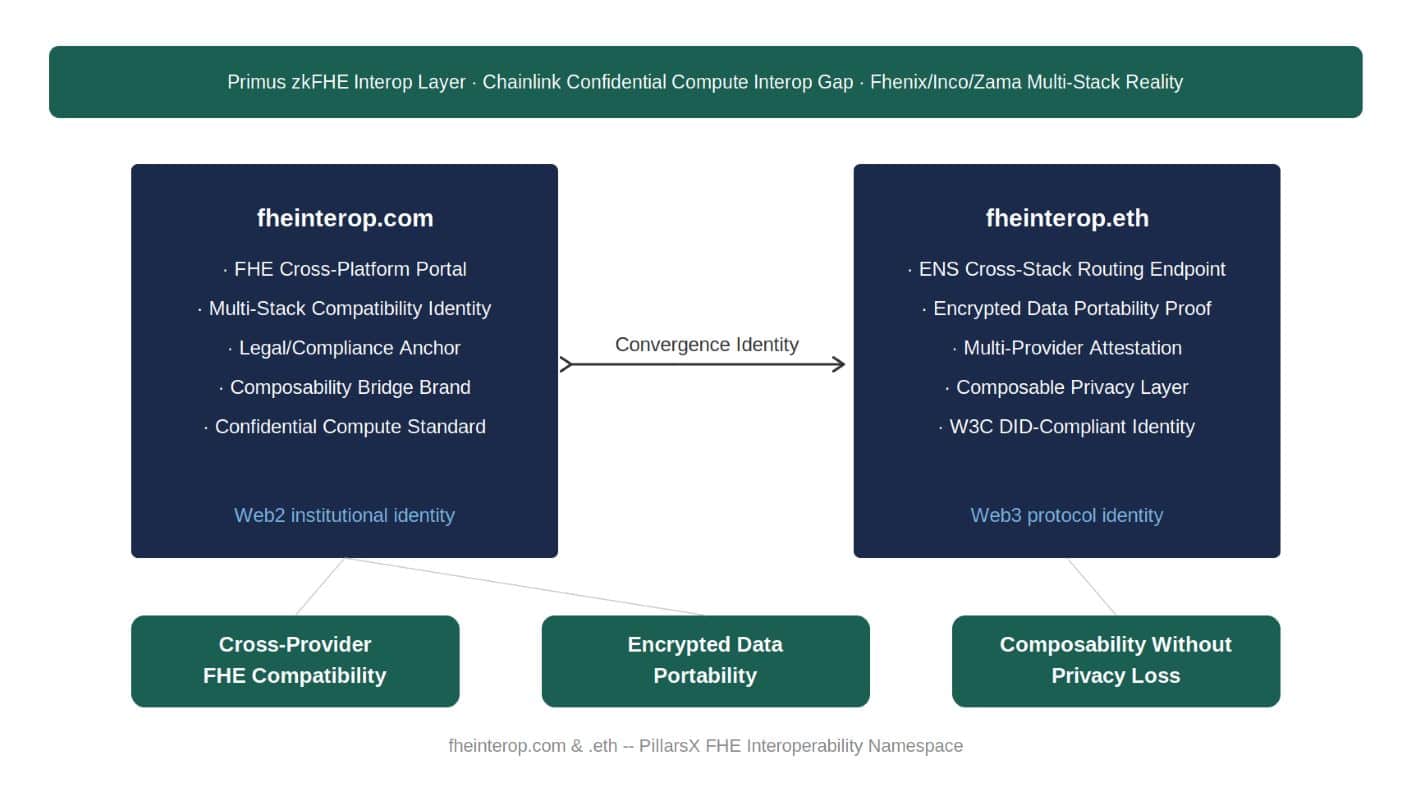
fheinterop.com & .eth is the Convergence Identity for this cross-platform standard — the institutional namespace connecting the documented interoperability gap between FHE providers to the legal and on-chain attestation any institution operating across more than one confidential computing stack requires.
Namespace Acquisition: This Twin-Domain asset is available for institutional acquisition. Inquiries: hq@pillarsx.com
Why Confidential Computing Fragmentation Makes Cross-Platform Interoperability Documentation Necessary
Chainlink’s analysis is precise: secure multiparty computation and fully homomorphic encryption offer powerful methods for collaborative private computation and encrypted data processing, and these technologies are progressing rapidly — but broad, real-time, developer-friendly deployment is still evolving. This is not a criticism of any single FHE provider; it is a structural observation about an industry where multiple independently strong implementations are emerging without a shared compatibility layer.
For institutions, this fragmentation has direct operational consequences: encrypted data computed under one FHE provider’s scheme cannot be directly verified, composed with, or transferred to a workflow built on a different provider’s stack without an explicit bridging layer. The FHE settlement identity for the confidential atomic execution layer that depends on consistent cross-platform compatibility is documented at fhesettle.com & .eth.
Primus’s dedicated zkTLS and zkFHE interoperability product confirms institutional demand for exactly this bridging function already exists at commercial scale — a company built specifically to solve the cross-platform problem, rather than to compete as another standalone FHE implementation. The FHE ledger identity for the confidential accounting layer whose encrypted balances increasingly need to interoperate across multiple FHE providers is documented at fheledger.com & .eth.
How FHE Interoperability Documentation Bridges Independent Confidential Computing Stacks
Every institution operating confidential workflows across more than one FHE provider faces the same documentation requirement: a verifiable record of how encrypted data, computed under one provider’s scheme, can be attested, ported, or composed with workflows built on a different provider’s infrastructure.
fheinterop.com is the institutional Web2 portal identity — the compliance interface and legal documentation anchor for any institution demonstrating that its confidential computing operations satisfy cross-platform compatibility requirements rather than being locked to a single FHE provider. fheinterop.eth is the on-chain complement — the ENS-resolvable endpoint where multi-provider attestations and encrypted data portability proofs are recorded as immutable entries, directly addressable by smart contracts that must verify confidential computation regardless of which underlying FHE stack performed it.
This cross-stack attestation is what distinguishes fheinterop from single-provider FHE documentation: rather than proving compliance with one confidential computing implementation, fheinterop.eth maintains the auditable record of how a given encrypted computation maps to the requirements and guarantees of every FHE stack a workflow touches. The FHE API gateway identity for the secure bridge connecting legacy banking infrastructure to FHE-based confidential ledgers is documented at fheapi.com & .eth.
The FHE Interoperability Ecosystem — From Cross-Platform Compatibility to Settlement, Ledger, and Custody
fheinterop is the cross-platform standards layer within the broader FHE infrastructure namespace. It connects directly to fhesettle.com & .eth as the confidential settlement identity within which cross-platform compatibility must operate, and to fheledger.com & .eth as the confidential accounting layer whose encrypted balances increasingly span multiple FHE providers.
Beyond this immediate cluster, fheinterop integrates with fheapi.com & .eth as the secure gateway bridging legacy infrastructure to FHE-based confidential systems, fhefx.com & .eth as the confidential FX settlement identity requiring cross-platform position privacy across jurisdictions, and dltinterop.com & .eth as the broader DLT interoperability standard within which FHE-specific cross-platform compatibility is one specialized layer.
📄 Academic Foundation
Twin-Domain Convergence Identity — The Institutional Framework Behind This Namespace
This Twin-Domain asset is part of the namespace architecture formalized in "Twin-Domain Convergence Identity: A Framework for Institutional Namespace Standards in Regulated Digital Asset Infrastructure" by Rolf Neumayr, PillarsX (SSRN Working Paper, 16 pages, posted June 12, 2026), classified under Monetary Economics — International Financial Flows, Financial Crises, Regulation & Supervision.
→ Read the Paper on SSRNSTRATEGIC CONSTELLATIONS & BUNDLE POTENTIAL
Bundle 1, “The FHE Cross-Platform Core”, für Confidential-Computing-Anbieter. Target: Fhenix, Inco, Zama, Chainlink. Domains: fheinterop.com/.eth + fhesettle.com/.eth + fheledger.com/.eth. Complete FHE-Interop-Namespace, Cross-Platform-Standard, Confidential-Settlement, und Confidential-Accounting.
Bundle 2, “The Confidential Infrastructure Bridge Stack”, für Banken mit Multi-Provider-FHE-Bedarf. Target: Globale Banken mit verteilten Privacy-Tech-Stacks. Domains: fheinterop.com/.eth + fheapi.com/.eth + dltinterop.com/.eth. Complete Bridge-Namespace, API-Gateway, und DLT-Interoperabilität.
Bundle 3, “The Full FHE Infrastructure Namespace”, für Strategic Acquirers. Domains: fheinterop.com/.eth + fhesettle.com/.eth + fheledger.com/.eth + fheapi.com/.eth + fhefx.com/.eth. The complete PillarsX FHE namespace. This package exists exactly once.
Regulatory Sources
- StartUs Insights — Top Homomorphic Encryption Companies 2026, Primus zkFHE Interoperability Layer
- Chainlink — Confidential Compute Unlocks Private Smart Contracts, Interoperability Limitations
- Fhenix — FHE-Powered Confidential DeFi Infrastructure, 2026
- Chainlink — Trusted Execution Environments in Blockchain, Privacy Paradox Analysis
Explore Related PillarsX Infrastructure
Strategic Acquisition Inquiry
Initiate secure communication with representatives of the IP holder to evaluate the acquisition of this premium infrastructure namespace or its corresponding strategic asset bundle.