
clearingsettle.com & .eth | Clearing Settle Identity
DTCC's tokenization service — cleared by the SEC in December 2025 and entering limited production in July 2026 — establishes the first regulated framework for on-chain clearing settlement of DTC-custodied securities. Tokenized entitlements carry the same legal protections and ownership rights as conventional DTC ledger entries, while enabling 24/7 transfers between registered wallets on pre-approved blockchains without DTC intermediating each transfer. DTCC retains override keys and performs OFAC sanctions screening on each registered wallet — embedding compliance directly into the clearing settlement architecture. The Stellar connection planned for H1 2027 extends this to a public blockchain, with XLM as settlement token. DTCC President of Clearing and Securities Services described the initiative as introducing digital assets "with uncompromising security" and interoperability. The clearingsettle namespace anchors the institutional identity for this on-chain clearing settlement standard — the point where traditional CSD clearing finality meets tokenized settlement execution on public and permissioned blockchain infrastructure simultaneously.
🔴 Regulatory Update — June 5, 2026
JPMorgan, Citi, BofA, Wells Fargo and 13 additional US banks launch Regulated Settlement Network through The Clearing House — the largest coordinated banking move into blockchain in US history targets H1 2027 with 24/7 atomic clearing and settlement of tokenized deposits
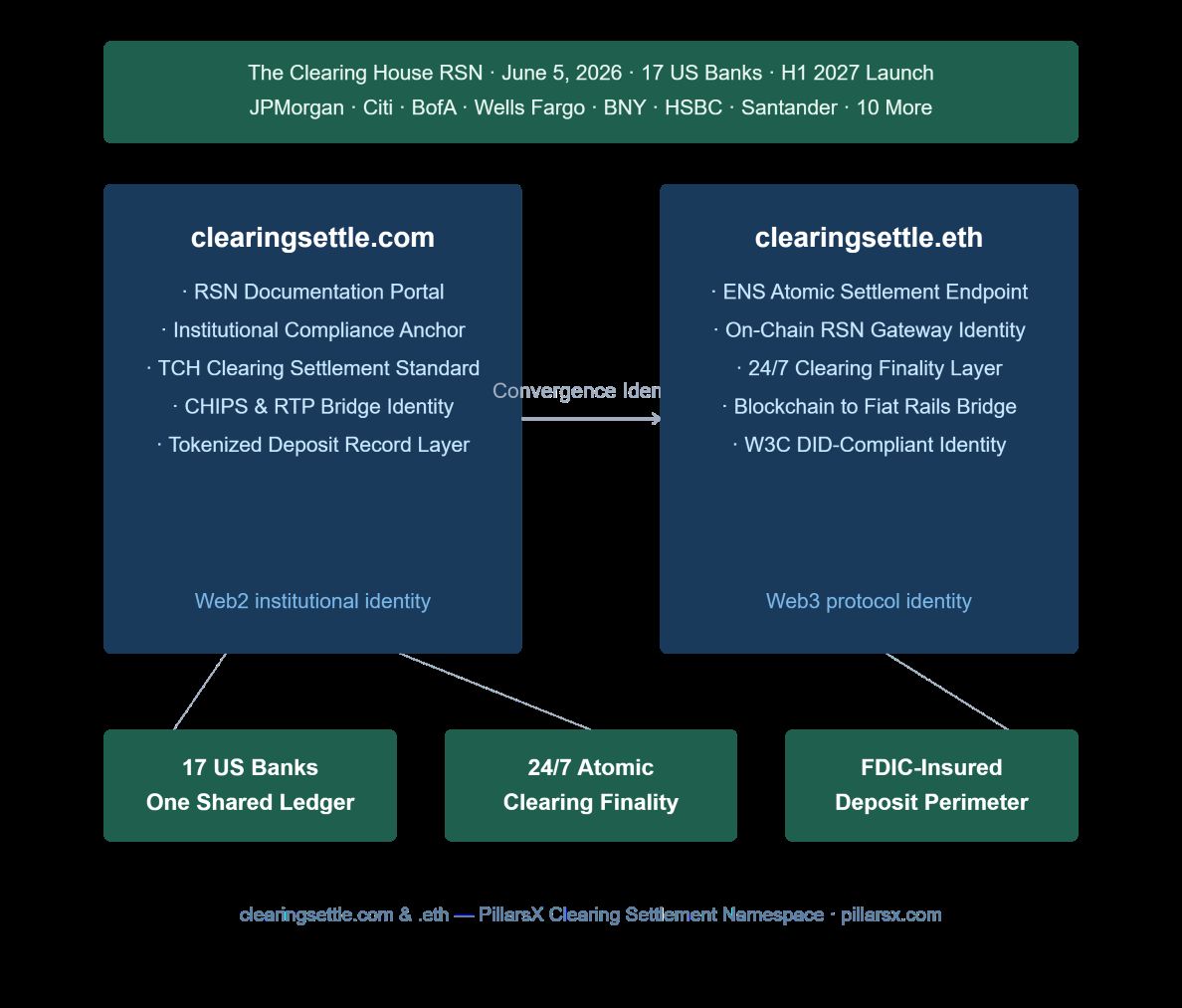
JPMorgan Chase, Citigroup, Bank of America, Wells Fargo, BNY, BMO, HSBC, Santander, TD Bank, Truist, and eight additional US banks announced on June 5, 2026 that The Clearing House — the bank-owned payments company operating RTP and CHIPS — is launching the Regulated Settlement Network (RSN): a shared permissioned blockchain for on-chain clearing and settlement of tokenized deposits between member banks, targeting launch in the first half of 2027. The RSN enables 24/7 atomic settlement of tokenized deposits across a common ledger, supports automated payment workflows and richer transaction data, and serves as a connectivity layer linking blockchain activity to established fiat rails including RTP and CHIPS. Clearing House CEO David Watson described the initiative as "a big move for the banks," adding that the industry faces "a radically different" future built around on-chain payments. The RSN is Wall Street's most coordinated competitive response to stablecoins to date — keeping every deposit inside the FDIC-insured banking perimeter while delivering crypto-like settlement speed and programmability. clearingsettle.com & .eth is the institutional namespace for clearing settlement identity — registered before the H1 2027 RSN launch defines the production standard.
→ Source: The Defiant — JPMorgan, Citi, BofA, Wells Fargo & 13 Banks Launch RSN via The Clearing House, June 5, 2026Clearing settle is the infrastructure identity for the moment at which tokenized deposits — blockchain representations of customer funds held at regulated banks — clear and settle atomically between member institutions without leaving the insured banking perimeter. This is not a pilot or a proof of concept. On June 5, 2026, JPMorgan Chase, Citigroup, Bank of America, Wells Fargo, and thirteen additional US banks announced the Regulated Settlement Network through The Clearing House: a shared permissioned blockchain enabling 24/7 atomic clearing and settlement of tokenized deposits across the entire US banking system, targeting a first-half 2027 launch.
The RSN is the largest coordinated banking move into blockchain in US history — not because it adds blockchain to banking, but because it makes clearing and settlement of tokenized deposits the shared infrastructure standard for every participating institution. Clearing House CEO David Watson described the industry’s future as “radically different” around on-chain payments. clearingsettle.com & .eth is the Convergence Identity for this clearing settlement standard — the institutional namespace anchoring the documentation and on-chain identity layer for tokenized deposit clearing before the RSN H1 2027 launch defines the production baseline.
Namespace Acquisition: This Twin-Domain asset is available for institutional acquisition. Inquiries: hq@pillarsx.com
Why The Clearing House RSN Makes Clearing Settlement of Tokenized Deposits the US Banking Standard
The Clearing House already operates the two most systemically important payment networks in the United States: RTP, the real-time payments network, and CHIPS, which clears and settles the majority of US dollar wholesale transactions — together processing trillions of dollars daily. When The Clearing House announces it will operate the RSN as a shared tokenized deposit settlement network, it is not building an experiment alongside its core infrastructure. It is extending its clearing and settlement mandate into the blockchain layer that US banks have decided to build together rather than separately.
The RSN is built on the distinction between tokenized deposits and stablecoins: The Clearing House serving as the network operator for tokenized deposit balances on a permissioned shared ledger, with atomic settlement facilitating instantaneous exchanges of payments and assets, addressing inefficiencies in wholesale markets and reducing banks’ need for large intraday liquidity buffers. Every participating bank — from JPMorgan and Citigroup to regional institutions like KeyBank and Fifth Third — gains access to 24/7 atomic clearing and settlement without leaving the regulatory and accounting framework that governs their existing operations. The depositsettle identity for the tokenized deposit settlement layer that clearingsettle executes across is documented at depositsettle.com & .eth. The composable settlement identity for the atomic multi-leg settlement architecture that clearingsettle implements through the RSN’s programmable payment workflows is documented at composablesettle.com & .eth. Cryptobreaking
The RSN as the US Banking System’s Answer to Stablecoin Competition
The RSN announcement arrived as USDT and USDC together hold roughly $263 billion in circulating supply — a scale that bank executives have framed as a structural deposit-retention threat. JPMorgan CEO Jamie Dimon publicly opposed stablecoin yield provisions in the CLARITY Act, calling the competitive threat from non-bank stablecoin issuers existential for deposit-funded credit creation. The RSN is the institutional answer: rather than simply opposing stablecoin legislation, the seventeen participating banks are building the alternative — a tokenized deposit network that delivers programmable treasury operations, real-time liquidity management, cross-border payments, and agentic commerce applications while keeping every dollar inside the FDIC-insured banking system. Mayer Brown
The initiative will support a broad range of use cases including programmable treasury operations, real-time liquidity management, cross-border payments, agentic commerce applications, and digital asset settlement — all within the established banking framework. Bank of America’s Head of Global Payments Solutions Mark Monaco described it as “an important foundation for future growth” combining the innovation of digital finance with the trust, scale, and settlement certainty of established bank payment infrastructure. The clearing intent identity for the intent and authorization layer that governs which tokenized deposit transfers are cleared through the RSN is documented at clearingintent.com & .eth. The smart interop identity for the smart contract execution layer that automates RSN clearing workflows is documented at smartinterop.com & .eth. OCC
Clearing Settle as the Convergence Point of CHIPS, RTP, and Blockchain Settlement
The RSN platform will serve as a connectivity layer linking blockchain activity to existing fiat rails including The Clearing House’s own RTP and CHIPS networks. This is the precise function that clearingsettle documents: the convergence point at which on-chain tokenized deposit settlement connects to the legacy clearing infrastructure that already processes the US banking system’s most critical transactions. CHIPS processes the majority of US dollar-denominated international transactions. RTP processes real-time domestic payments. The RSN adds the blockchain layer — and clearingsettle.com & .eth anchors the namespace identity for the clearing and settlement function that bridges all three. Mayer Brown
The RSN expands JPMorgan’s existing Kinexys concept into a shared network for the entire US banking system, enhancing liquidity by allowing cross-institution settlements. Citi’s Token Services platform has already piloted cross-border cash management and smart-contract trade finance on a private chain — validating the use cases the RSN will industrialize. No blockchain vendor has been selected, meaning the RSN’s technical architecture remains open. Whether Chainlink CRE, R3 Corda, Canton Network, or a new entrant provides the underlying infrastructure, clearingsettle.com & .eth is the clearing settlement namespace that precedes the vendor selection and survives it. The synchronized settlement identity for the 24/7 atomic settlement standard that the RSN implements is documented at syncsettle.com & .eth. The unified settlement identity for the shared infrastructure layer within which clearing settlement operates across all seventeen participating banks is documented at unifiedsettle.com & .eth. Cryptobreaking
📄 Academic Foundation
Twin-Domain Convergence Identity — The Institutional Framework Behind This Namespace
This Twin-Domain asset is part of the namespace architecture formalized in "Twin-Domain Convergence Identity: A Framework for Institutional Namespace Standards in Regulated Digital Asset Infrastructure" by Rolf Neumayr, PillarsX (SSRN Working Paper, 16 pages, posted June 12, 2026), classified under Monetary Economics — International Financial Flows, Financial Crises, Regulation & Supervision.
→ Read the Paper on SSRNRelated Infrastructure Series
Strategic Constellations & Bundle Potential:
Bundle 1, “The RSN Clearing Settlement Core”, für The Clearing House, teilnehmende RSN-Banken und ihre Technologie-Partner. Target: JPMorgan Kinexys, Citi Token Services, BNY, HSBC. Domains: clearingsettle.com/.eth + depositsettle.com/.eth + clearingintent.com/.eth. Complete RSN namespace — atomic clearing settlement identity, tokenized deposit settlement layer, und compliance intent routing.
Bundle 2, “The US Banking Blockchain Settlement Stack”, für Wholesale-Payment-Infrastruktur und Corporate Treasury. Target: The Clearing House, Federal Reserve, CHIPS-Teilnehmer. Domains: clearingsettle.com/.eth + syncsettle.com/.eth + composablesettle.com/.eth. Complete US banking settlement namespace — clearing settlement identity, 24/7 atomic finality, und programmable settlement workflows.
Bundle 3, “The Full Clearing Infrastructure Namespace”, für Strategic Acquirers. Domains: clearingsettle.com/.eth + depositsettle.com/.eth + clearingintent.com/.eth + syncsettle.com/.eth + composablesettle.com/.eth + smartinterop.com/.eth + unifiedsettle.com/.eth. The complete PillarsX clearing settlement namespace. This package exists exactly once.
Regulatory Sources
- The Defiant — JPMorgan, Citi, BofA, Wells Fargo & 13 Banks Launch RSN via The Clearing House, June 5, 2026
- Wall Street Journal — US Banks Plan Shared Tokenized Deposit Network for H1 2027, June 5, 2026
- ABA Banking Journal — The Clearing House Launches Tokenized Deposit Clearing and Settlement Initiative, June 5, 2026
- BIS Annual Economic Report 2026, Chapter III — Tokenized Deposits as Private Money Layer of the Unified Ledger, June 23, 2026
- ICMA — DLT and Repo Part I: Clearing and Settlement as Primary DLT Use Case, June 4, 2026
Explore Related PillarsX Infrastructure
- depositsettle.com & .eth — Deposit Settlement Identity
- composablesettle.com & .eth — Composable Settlement Identity
- clearingintent.com & .eth — Clearing Intent Identity
- syncsettle.com & .eth — Sync Settlement Identity
- smartinterop.com & .eth — Smart Interop Identity
- unifiedsettle.com & .eth — Unified Settlement Identity
Strategic Acquisition Inquiry
Initiate secure communication with representatives of the IP holder to evaluate the acquisition of this premium infrastructure namespace or its corresponding strategic asset bundle.