
fhetokenize.com & .eth — FHE Tokenize Identity
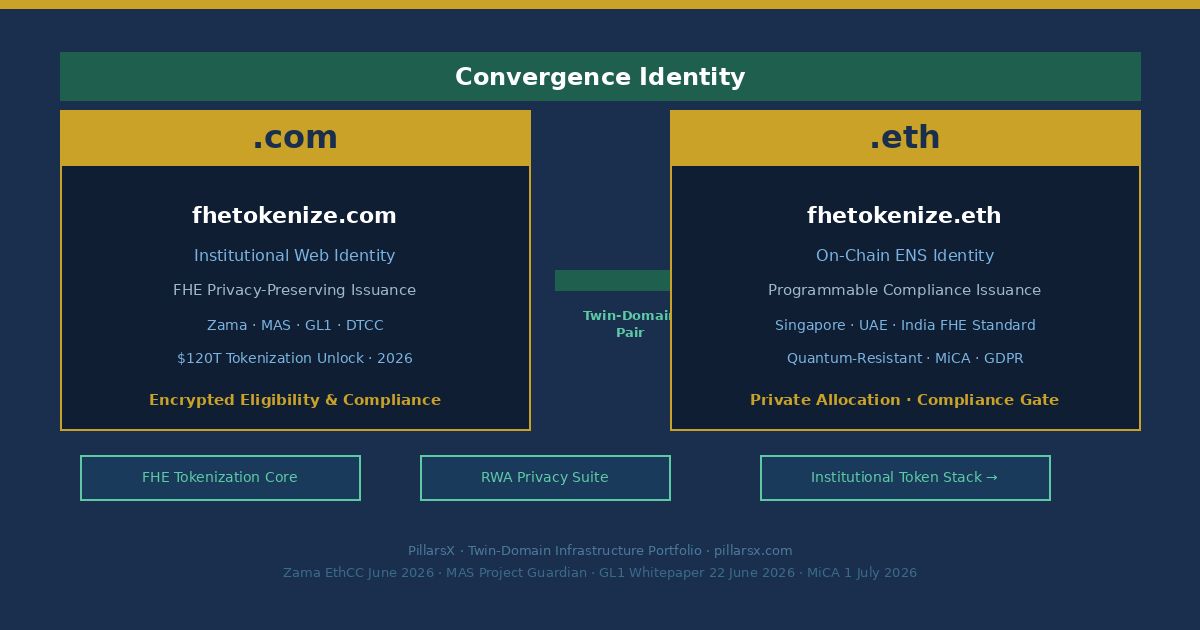
Zama CEO Dr. Rand Hindi confirmed at EthCC 2026 that FHE is the missing piece for unlocking a $120 trillion institutional tokenization market — enabling token issuers to define exactly who can access transaction data and under what conditions, while keeping position sizes, counterparty identities, and asset compositions confidential. Standards bodies in Singapore, UAE, and India are progressively mandating cryptographic standards aligned with post-quantum security requirements — lattice-based FHE schemes are already considered quantum-resistant, providing meaningful future-proofing for tokenization platforms. MiCA's full enforcement from 1 July 2026 requires MiCA-compliant white papers for tokenized asset offerings while simultaneously mandating GDPR-compliant data protection for investor position data — a dual requirement that FHE tokenization infrastructure uniquely satisfies. The fhetokenize namespace anchors the institutional identity for FHE-enabled tokenization infrastructure — where asset issuance, investor eligibility verification, and compliance-gated transfers operate on encrypted data without exposing underlying position or ownership information.
Tokenization promises to bring the world’s $120 trillion in institutional assets onto programmable ledgers — making real estate, bonds, equities, private credit, and commodities accessible, transferable, and composable in ways that legacy infrastructure cannot support. The promise is structural: faster settlement, fractional ownership, 24/7 liquidity, automated compliance. The obstacle is equally structural: institutions that manage these assets operate under fiduciary obligations, regulatory mandates, and competitive constraints that make the transparency of public blockchain infrastructure commercially impossible.
A fund manager cannot tokenize a $10 billion bond portfolio on a public ledger where every position is visible to competitors, arbitrageurs, and market participants who can front-run every rebalancing trade. A private equity firm cannot tokenize LP interests on infrastructure where every investor’s allocation, entry price, and current valuation is publicly readable. A corporate cannot tokenize treasury assets where every counterparty can observe the full treasury composition before negotiating terms. The transparency that makes public blockchains powerful for open financial applications is precisely what makes them unsuitable for institutional asset tokenization at scale.
Fully Homomorphic Encryption removes this barrier at the architectural level. FHE RWA systems can keep selected data encrypted while still allowing controlled smart contract logic — supporting private allocation logic, compliance-gated transfers, encrypted collateral checks, and limited disclosure models that satisfy regulatory requirements without exposing the underlying asset, investor, or position data to unauthorized parties. To bring a $120 trillion industry on-chain, the market needs more than just encryption — it needs programmable compliance. fhetokenize.com and fhetokenize.eth anchor the namespace for the FHE tokenization infrastructure that makes this commercially viable — where the tokenization process itself operates on encrypted data, producing compliant tokenized assets without exposing the underlying asset or investor information to the tokenization platform.
The RWA Tokenization Privacy Problem
Real-world asset tokenization has grown from a base in 2022 to over $33 billion in tokenized assets by 2025 — excluding stablecoins — with bonds accounting for the largest share, followed by precious metals and private credit. Institutions including BlackRock, JPMorgan, and KKR have launched tokenized fund products, and platforms from Ondo Finance to Securitize have demonstrated institutional-grade tokenization infrastructure. Yet the market remains far below the potential that McKinsey projects at $4–5 trillion in digital securities issuance by 2030.
The gap between current adoption and projected scale reflects a structural barrier that technical tokenization infrastructure has not yet solved: most serious RWA deployments today are either partially on-chain or heavily permissioned, restricted to a small circle of known counterparties — because the institutional requirements of privacy, compliance, and confidentiality cannot be satisfied on transparent public infrastructure. FHE tokenization changes this: if an investor loses access, or a compliance check is triggered, or a transfer restriction is applied — all of this logic executes on encrypted position data, with only the binary compliance output visible to the network.
MAS, Singapore and the Institutional FHE Tokenization Standard
Singapore’s Monetary Authority has emerged as the leading regulatory jurisdiction for institutional FHE tokenization standards. Standards bodies in Singapore, along with UAE and India, are progressively moving toward mandating cryptographic standards aligned with post-quantum security requirements — lattice-based FHE schemes are already quantum-resistant, making FHE tokenization infrastructure a meaningful long-term compliance choice for institutions operating under Singapore’s Payment Services Act and MAS stablecoin framework.
MAS Project Guardian continues to test institutional DeFi models including tokenized collateral, automated settlement, and regulated liquidity pools — with cross-chain settlement solutions powered by Chainlink demonstrated between ANZ, China AMC, and Fidelity International. The European Investment Bank’s 2025 issuance of tokenized green bonds across multiple chains confirmed that interoperability is not just a retail DeFi need but an institutional requirement. FHE tokenization infrastructure that satisfies MAS standards while maintaining GDPR compliance under MiCA is the complete solution for institutions operating across Singapore and EU regulatory perimeters simultaneously. fhetokenize.eth is the on-chain resolution address for this cross-jurisdictional FHE tokenization standard.
fhetokenize in the Complete Tokenization Infrastructure Stack
fhetokenize is the issuance and compliance layer of the PillarsX FHE tokenization namespace — the privacy-preserving infrastructure where assets are tokenized, investor eligibility is verified on encrypted data, and compliance-gated transfers are enforced through programmable FHE smart contracts. It connects directly to fheclearing as the clearing layer that processes tokenized asset transactions, fhecollateral as the collateral verification layer for tokenized asset-backed positions, fheverify as the compliance verification layer that confirms investor eligibility on encrypted KYC data, and tokenizesettle as the settlement layer where tokenized asset transfers achieve finality.
Beyond the FHE cluster, fhetokenize integrates with tokenizesettle as the settlement standard for tokenized asset transfers, composablesettle as the composable settlement layer for multi-asset tokenized transactions, and programmablecompliance as the GL1 whitepaper standard for compliance embedded in tokenized smart contracts. Together these form the complete institutional tokenization namespace — from FHE-encrypted issuance through composable settlement to programmable compliance — covering every layer of the $120 trillion tokenization opportunity that Zama, MAS, and the GL1 initiative are building simultaneously.
Related PillarsX Infrastructure
fheclearing.com & .eth — FHE Clearing Identity
FHE-enabled privacy-preserving clearing for tokenized asset transactions
tokenizesettle.com & .eth — Tokenize Settle Identity
settlement execution layer for tokenized asset transfers under DTCC and MAS standards
programmablecompliance.com & .eth — Programmable Compliance Identity
GL1 whitepaper standard for embedded compliance in tokenized smart contracts
composablesettle.com & .eth — Composable Settlement Identity
composable settlement for multi-asset tokenized transactions across chains
Strategic Constellations & Bundle Potential
Bundle 1 — FHE Tokenization Corefhetokenize + fheclearing + fhecollateral — the complete FHE privacy stack for tokenized asset issuance, clearing, and collateral verification. Targets: BlackRock, Ondo Finance, Securitize, institutions building privacy-preserving RWA tokenization infrastructure under SEC and MAS standards.
Bundle 2 — RWA Privacy Suitefhetokenize + tokenizesettle + programmablecompliance + fheverify — the complete privacy-preserving RWA namespace from FHE issuance through programmable compliance to settlement. Targets: GL1 whitepaper implementers, MiCA-authorized tokenization platforms, institutions building GDPR-compliant RWA infrastructure.
Bundle 3 — Institutional Tokenization Stackfhetokenize + composablesettle + fheclearing + dvpsettle — the complete institutional tokenization namespace from FHE-encrypted issuance through composable settlement to DVP finality. Targets: DTCC, Euroclear, European Investment Bank, institutions building multi-asset FHE tokenization infrastructure across MAS, MiCA, and GENIUS Act frameworks.
· Zama — "$120 Trillion Unlock: Programmable Compliance via FHE" (EthCC June 2026)
· MAS Project Guardian — FHE Tokenization Standards for Institutional DeFi (2026)
· Singapore/UAE/India — Post-Quantum Cryptographic Standards (Lattice-Based FHE, 2026)
· MiCA (EU) 2023/1114 — White Paper Requirements for Tokenized Asset Offerings (1 July 2026)
· DTCC / SEC No-Action Letter — Privacy-Preserving Tokenized Securities Architecture (July 2026)
· Global Layer One Whitepaper — FHE Programmable Compliance for Tokenized Assets (22 June 2026)
Explore Related
· fheclearing.com & .eth — FHE Clearing Identity
· tokenizesettle.com & .eth — Tokenize Settle Identity
· fhecollateral.com & .eth — FHE Collateral Identity
· programmablecompliance.com & .eth — Programmable Compliance Identity
· Portfolio Acquisition → /acquire/
Disclaimer:PillarsX is a domain portfolio business. Nothing on this page constitutes legal, financial, or regulatory advice. Domain names do not confer regulatory status, licensing, or compliance certification of any kind. All content is for informational purposes only and does not constitute financial advice.