
The Institutional Solvency Suite: Defending the Federal Floor
The GENIUS Act Final Rules take effect January 2027. The OCC comment period closed May 1, 2026. The FDIC comment deadline is June 9, 2026. Every Permitted Payment Stablecoin Issuer that has not yet established its custody identity, operational continuity framework, and redemption protocol namespace is operating without institutional-grade compliance infrastructure in the most consequential regulatory window in stablecoin history.
The Institutional Solvency Suite addresses the three obligations that define PPSI survival under the federal framework: who holds the reserves (CoveredCustodian), what keeps operations running under stress (OperationalBackstop), and how holders exit at par when it matters most (OrderlyRedemption).
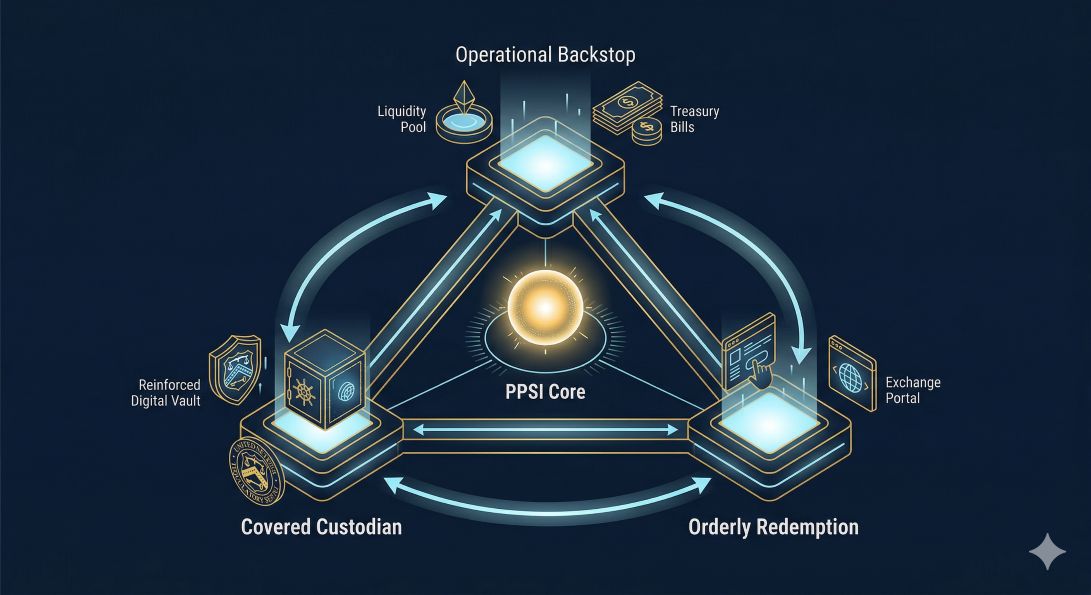
The Institutional Solvency Suite
The Institutional Solvency Suite is a strategic domain portfolio developed by PillarsX | Encrypted Settlement Infrastructure 2026 ↗ — specializing in institutional-grade domain assets aligned with emerging regulatory frameworks in digital finance. The Suite represents three statutory-anchored namespace positions at the core of GENIUS Act compliance architecture.
Institutional Solvency Suite: With the enactment of the GENIUS Act and the OCC's comprehensive 376-page rulemaking framework (12 C.F.R. Part 15), the era of regulatory ambiguity is over. Permitted Payment Stablecoin Issuers (PPSIs) must now demonstrate to OCC and FDIC how they address three distinct operational obligations — each anchored by a precise statutory definition.
The Institutional Solvency Suite comprises the three domain assets that name these obligations directly: the custody identity, the liquidity buffer, and the redemption protocol. Together, they represent the linguistic infrastructure of institutional resilience under the new federal stablecoin framework.
- 01 / Custody — "Where are the reserves held, and who controls the private keys?" → CoveredCustodian.com
- 02 / Liquidity — "What happens to operations when markets freeze?" → OperationalBackstop.com
- 03 / Exit — "How do holders redeem at par value under stress?" → OrderlyRedemption.com
I. CoveredCustodian.com — Custody & Safekeeping
Section 10 of the GENIUS Act and the OCC's proposed 12 C.F.R. Part 15 (Subpart C) establish a precise legal category: the covered custodian. This is not a generic custody designation — it is a statutory-defined entity subject to explicit OCC obligations for accounting, control, and safekeeping of a likewise statutory-defined asset catalogue.
Covered assets under 12 C.F.R. Part 15 include: payment stablecoin reserves, payment stablecoins used as collateral, private keys used to issue payment stablecoins, and any cash or other property received in connection with the provision of custodial or safekeeping services for such assets. Covered custodians — national banks, federal savings associations, federal branches, and OCC-supervised PPSIs engaging in custody activities — must separately account for covered assets as customer property, implement written policies protecting those assets from creditor claims, and maintain possession or control at all times, including over digital wallets and private keys.
Where a covered custodian delegates to a sub-custodian, it retains full supervisory responsibility for the sub-custodian's compliance with applicable requirements. The OCC's reserve diversification framework additionally requires that no single eligible financial institution hold more than 40% of a PPSI's reserve assets — a structural constraint that effectively mandates a multi-custodian architecture for any issuer operating at scale.
Institutions seeking to position themselves as anchor custodians in the GENIUS Act ecosystem — national banks, federal trust companies, OCC-licensed nonbanks, Big-4 attestation practices — require a brand identity that speaks the precise language of the regulator. CoveredCustodian.com names this regulatory category directly.
- Regulatory Anchor — GENIUS Act §10 · OCC NPRM 12 C.F.R. Part 15, Subpart C
- Statutory Definition — OCC-supervised institutions providing custodial or safekeeping services for covered assets
- Covered Assets Include — Reserve assets · Collateral stablecoins · Private keys · Cash received in custody
- Sub-Custodian Oversight — Covered custodian retains full supervisory liability for sub-custodian compliance
- Primary Buyer Profile — National banks · Federal trust companies · OCC-licensed nonbanks · Big-4 attestation practices
- OCC Comment Deadline — May 1, 2026 · FDIC: May 18, 2026
- Effective Date — January 18, 2027 (or 120 days after Final Rule)
II. OperationalBackstop.com — Liquidity & Operational Continuity
The OCC's proposed 12 C.F.R. Part 15 introduces a mandatory prudential requirement with no precedent in prior stablecoin regulation: the operational backstop. This is a segregated pool of highly liquid assets — independent of both reserve requirements and regulatory capital — sized to cover twelve months of the issuer's total operating expenses, calculated quarterly on the basis of the four most recent quarterly reports.
The operational backstop is not a capital buffer in the Basel III sense. It is not CET1 capital, not a Liquidity Coverage Ratio, and not part of reserve assets. It is a standalone operational continuity mechanism: its sole function is to ensure that a PPSI can maintain core business operations — technology infrastructure, compliance functions, staffing, contractual obligations — during periods of market stress, reserve volatility, or regulatory intervention, without drawing on customer reserves. For de novo issuers, the initial backstop is based on projected expenses and adjusted quarterly as actual figures become available.
This requirement reflects a fundamental regulatory insight: reserve adequacy and operational continuity are two distinct problems. A PPSI can hold fully compliant reserves and still face operational failure if it cannot fund its own operations during a stress event. The OCC's backstop requirement closes this gap explicitly — and the FDIC's April 7, 2026 proposed rule aligns closely with this framework.
CFOs and treasury teams structuring PPSI capital stacks, compliance platforms building GENIUS Act readiness tools, and risk management consultancies modelling stress scenarios will converge on precisely this terminology as the Final Rule approaches. OperationalBackstop.com names this mandatory regulatory construct directly.
- Regulatory Anchor — OCC NPRM 12 C.F.R. Part 15 · FDIC Proposed Rule April 7, 2026
- Requirement — Highly liquid assets covering 12 months of operating expenses · Calculated quarterly · Separate from reserves and capital
- Not To Be Confused With — CET1 capital · Reserve assets · Liquidity Coverage Ratio (LCR)
- De Novo Issuers — Initial backstop based on projected expenses, adjusted quarterly on actuals
- Rulemaking Authority — OCC (primary) · FDIC (aligned, April 2026)
- Primary Buyer Profile — CFOs & treasury teams at PPSIs · Compliance SaaS platforms · Risk management consultancies · Fintech infrastructure providers
III. OrderlyRedemption.com — Redemption & Crisis Protocol
The FDIC's April 7, 2026 proposed rule and the OCC's 12 C.F.R. Part 15 jointly establish an explicit redemption standard: PPSIs must redeem payment stablecoins within two business days at par value under normal conditions. Beyond this baseline, issuers are required to maintain documented contingency plans for significant redemption requests — defined scenarios in which redemption volume exceeds normal parameters and threatens to impair reserve integrity or operational continuity.
The orderly redemption framework addresses the fundamental systemic risk of stablecoin markets: the bank-run dynamic. If holders believe that others will redeem before them, the rational response is immediate redemption — a self-fulfilling cascade that can destabilize even a fully-reserved issuer. The OCC's requirement that PPSIs maintain documented, tested redemption protocols for stress scenarios is the regulatory mechanism designed to make this equilibrium less likely to emerge.
Redemption at par value — the guarantee that one dollar of stablecoin returns one dollar — is the foundational promise of the payment stablecoin model. In the event of insolvency, stablecoin holders receive first-priority claims against reserve assets, which presupposes that reserves are identifiable, segregated, and not commingled. Every element of a PPSI's operational design ultimately serves this guarantee.
Platform operators building PPSI-compliant redemption interfaces, liquidity providers structuring stress-scenario facilities, and legal teams drafting redemption policies under 12 C.F.R. Part 15 will use precisely this terminology. OrderlyRedemption.com names this redemption protocol category directly.
- Regulatory Anchor — FDIC Proposed Rule April 7, 2026 · OCC 12 C.F.R. Part 15
- Baseline Standard — Redemption within 2 business days at par value under normal conditions
- Contingency Standard — Documented plans for significant redemption requests · Tested execution capacity required
- Bankruptcy Protection — First-priority claims for stablecoin holders against reserve assets in insolvency
- Prerequisite — Reserves must be identifiable, segregated, and not commingled to enable ratable distributions
- Primary Buyer Profile — Stablecoin platform operators · Liquidity providers · Legal & compliance teams · Crisis management infrastructure vendors
Bundle Acquisition
The three domains address structurally interdependent but regulatorily distinct obligations. An issuer that controls the custody layer but not the redemption protocol presents an incomplete compliance identity. The Suite transfers as a unit, providing the acquiring institution with namespace control across all three pillars of operational compliance under 12 C.F.R. Part 15.
OCC and FDIC are required to issue Final Rules by July 18, 2026. The GENIUS Act becomes effective January 18, 2027. Institutions building compliance infrastructure — product names, platform branding, regulatory documentation — must complete namespace decisions prior to Final Rule publication. The window for pre-rulemaking acquisition closes in weeks, not months.
- Individual or Bundle — Each domain is available individually. Bundle pricing on request.
- .eth Pairs Available — Corresponding .eth domains available for all three assets.
- Due Diligence — Clean ownership history · WHOIS verification · Escrow via GoDaddy or Escrow.com
- Key Deadline — OCC Final Rule expected July 2026 · GENIUS Act compliance obligation from January 2027
All regulatory references on this page are drawn directly from official U.S. federal rulemaking documents. The terminology used — covered custodian, operational backstop, and orderly redemption — is statutorily defined under the GENIUS Act and operationalized in the OCC and FDIC proposed rules currently open for public comment.
Primary sources: FDIC Proposed Rule — GENIUS Act Implementation, April 7, 2026 ↗ · OCC Notice of Proposed Rulemaking — 12 C.F.R. Part 15, February 25, 2026 ↗
Disclaimer: This page is for informational purposes only and does not constitute financial, legal, or investment advice. PillarsX is a domain portfolio operator and does not provide regulatory compliance services.
© Institutional Solvency Suite 2026 PillarsX