
amlintent.com & .eth | CLARITY Act AML Intent Identity
🔴 Regulatory Update — June 1, 2026
CLARITY Act on Senate Calendar — AML and in-ledger compliance obligations for distributed ledger application layers enter final legislative phase
The Digital Asset Market Clarity Act was placed on the US Senate Legislative Calendar on June 1, 2026 — codifying Section 302 AML and compliance obligations for distributed ledger application layers as permanent federal statute. Galaxy Digital placed a $10 million institutional prediction market bet on CLARITY Act passage in 2026. Senate floor vote expected this week — August 3 signing target.
→ Source: CoinPedia — CLARITY Act Senate Calendar, June 2, 2026🔴 Regulatory Update — May 22, 2026
FDIC BSA rule establishes proactive AML intent standard for all PPSI transactions
The FDIC proposed rule shifts the regulatory approach from retrospective enforcement to proactive prevention — requiring PPSIs to maintain transaction monitoring systems that detect suspicious activities before settlement, making AML intent documentation the definitive pre-transaction compliance standard under federal law.
→ Source: FDIC.gov, May 22, 2026🔴 Regulatory Update — May 11, 2026
Grassley-Lummis deal establishes demonstrable AML intent as the definitive federal prosecution standard
Senators Grassley and Lummis reached a landmark compromise establishing that AML prosecution under the CLARITY Act applies only to demonstrably culpable actors — making verifiable, on-chain AML intent documentation the core compliance mechanism for every digital asset operator, software developer, and stablecoin issuer under federal law.
→ Source: CoinDesk, May 14, 2026AMLintent is the AML compliance identity built for the regulatory standard that Senators Chuck Grassley and Cynthia Lummis formalized on May 11, 2026. The Grassley-Lummis compromise — the final provision that cleared the path for the CLARITY Act Senate Banking Committee markup — establishes that anti-money laundering prosecution under federal law applies only to demonstrably culpable actors in the digital asset ecosystem.
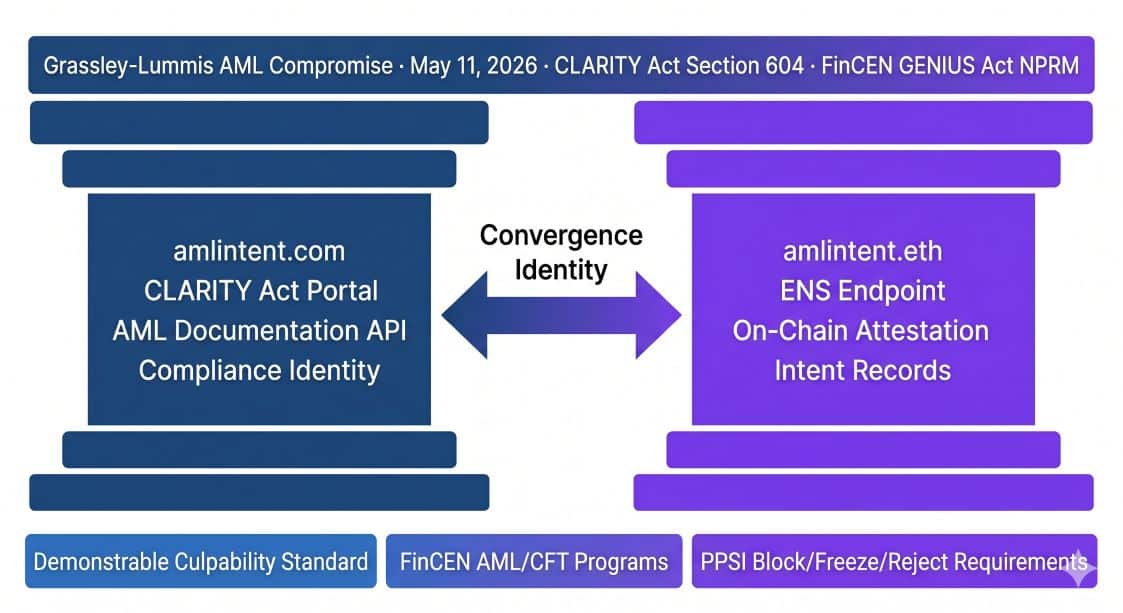
This is not merely a legal nuance: it is the foundational principle that separates compliant software developers, neutral infrastructure operators, and good-faith digital asset participants from bad actors engaged in willful illicit finance. amlintent.com/.eth is the Convergence Identity for the institutional infrastructure that produces verifiable, on-chain AML intent documentation — the namespace that connects the Grassley-Lummis culpability standard with the FinCEN AML/CFT program requirements that every PPSI, digital commodity exchange, and digital asset intermediary must implement under the CLARITY Act and GENIUS Act frameworks.
The Grassley-Lummis Culpability Standard and Federal AML/CFT Compliance Program Requirements
The Grassley-Lummis AML Compromise (May 11, 2026) established the demonstrable culpability standard as the definitive threshold for AML prosecution under the CLARITY Act — protecting software developers, neutral infrastructure operators, and non-custodial service providers from liability while enabling law enforcement to target genuinely culpable actors.
The Digital Asset Market Clarity Act Section 604 reinforces this standard by confirming that developers of open-source blockchain software without unilateral control over user funds are not money transmitters — making AML intent the boundary between protected development activity and prosecutable illicit finance.
The FinCEN/OFAC GENIUS Act NPRM (April 28, 2026) establishes that every PPSI must maintain a formal AML/CFT program with Board-level approval, independent testing, ongoing training, and a designated AML/CFT officer — creating the institutional AML framework within which intent documentation operates.
The Morrison Foerster GENIUS Act Analysis (May 7, 2026) confirmed that PPSIs must maintain technical capabilities to block, freeze, and reject transactions — with AML intent documentation as the compliance record that distinguishes lawful from unlawful transaction decisions. Together these four regulatory events define the AML intent standard that amlintent.com/.eth holds the namespace for.
Cryptographic Proof of Compliant Intent in Digital Asset Intermediary Infrastructure
Every digital asset operator, stablecoin issuer, and infrastructure provider faces the same fundamental AML compliance challenge after the Grassley-Lummis compromise: how does it demonstrate — to FinCEN, the DOJ, and institutional counterparties — that its transaction decisions reflect legitimate AML intent and not willful facilitation of illicit finance?
amlintent.com is the institutional answer — the compliance portal, the AML documentation brand, and the legal identity for any entity that must produce verifiable AML intent records under the CLARITY Act and GENIUS Act frameworks. amlintent.eth is the on-chain complement — an ENS-resolvable endpoint where AML intent attestations, transaction screening records, and culpability-exclusion documentation can be stored as immutable distributed ledger entries.
The demonstrable culpability standard creates a precise evidentiary requirement: an entity must be able to produce documentation showing that its transaction decisions were made in good faith under a legitimate AML/CFT program — not merely that it had a compliance policy on paper. On-chain AML intent documentation is the most credible form of this evidence.
No existing domain combines the Grassley-Lummis culpability standard with institutional on-chain AML documentation infrastructure as directly and institutionally as amlintent.
Layered AML Intent Documentation Across Programmable Governance and Verification Frameworks
amlintent is the AML compliance core of the PillarsX CLARITY Act namespace. It connects directly to relatedperson.com/.eth — Related Persons who engage in demonstrably culpable illicit finance activities are subject to AML prosecution under the Grassley-Lummis standard — and to ancillaryoriginator.com/.eth as the token issuer category whose AML/CFT program requirements are governed by the same standard. Beyond the CLARITY Act cluster, amlintent integrates with programmablecompliance.com/.eth as the automated ruleset that enforces AML intent documentation at the smart contract layer, verificationcontrol.com as the verification governance layer that validates AML intent records on-chain, and stablecoindisclosure.com/.eth as the disclosure standard that complements AML intent documentation for PPSI compliance.
An institution acquiring amlintent.com/.eth secures the namespace for the most legally consequential AML compliance standard introduced by the CLARITY Act — the one that determines whether a digital asset operator is a protected infrastructure provider or a prosecutable illicit finance facilitator under federal law.
Strategic Constellations & Bundle Potential
Bundle 1 — “The CLARITY Act AML Compliance Stack” (for Digital Asset Operators) Target: Every crypto exchange, stablecoin issuer, and DeFi protocol subject to CLARITY Act AML requirements. Domains: amlintent.com/.eth + programmablecompliance.com/.eth + verificationcontrol.com. Complete AML compliance namespace — intent documentation identity, programmable enforcement layer, and verification governance in one acquisition.
Bundle 2 — “The GENIUS Act PPSI Compliance Stack” (for Stablecoin Issuers) Target: Circle, Paxos, Ripple — all subject to FinCEN GENIUS Act AML program requirements. Domains: amlintent.com/.eth + stablecoindisclosure.com/.eth + ppsigateway.com/.eth. Complete PPSI AML compliance namespace — intent documentation, disclosure regime, and Fed payment gateway in one acquisition.
Bundle 3 — “The Full CLARITY Act Infrastructure” (for Strategic Acquirers) Domains: amlintent.com/.eth + relatedperson.com/.eth + ancillaryoriginator.com/.eth + qdacverify.com/.eth + stablecoindisclosure.com/.eth. The complete PillarsX CLARITY Act namespace — every new regulatory category introduced by the Act in a single acquisition. This package exists exactly once.
Related PillarsX Infrastructure
relatedperson.com & .eth — the Related Person insider compliance standard governed by the Grassley-Lummis culpability threshold
programmablecompliance.com & .eth — the automated compliance layer enforcing AML intent requirements at the smart contract layer
Strategic Acquisition Inquiry
Initiate secure communication with representatives of the IP holder to evaluate the acquisition of this premium infrastructure namespace or its corresponding strategic asset bundle.