
DvPLedger — The Institutional DVP Ledger Standard for Tokenized Securities Settlement (Twin-Bundle: .com + .eth)
Every atomic DVP settlement transaction requires one final proof: an immutable, time-stamped, on-chain ledger entry that confirms the simultaneous exchange of asset and payment legs. dvpledger is the institutional namespace for that proof — the distributed ledger identity where DVP settlement records achieve cryptographic permanence, OCC auditability, and real-time verifiability across all counterparties.
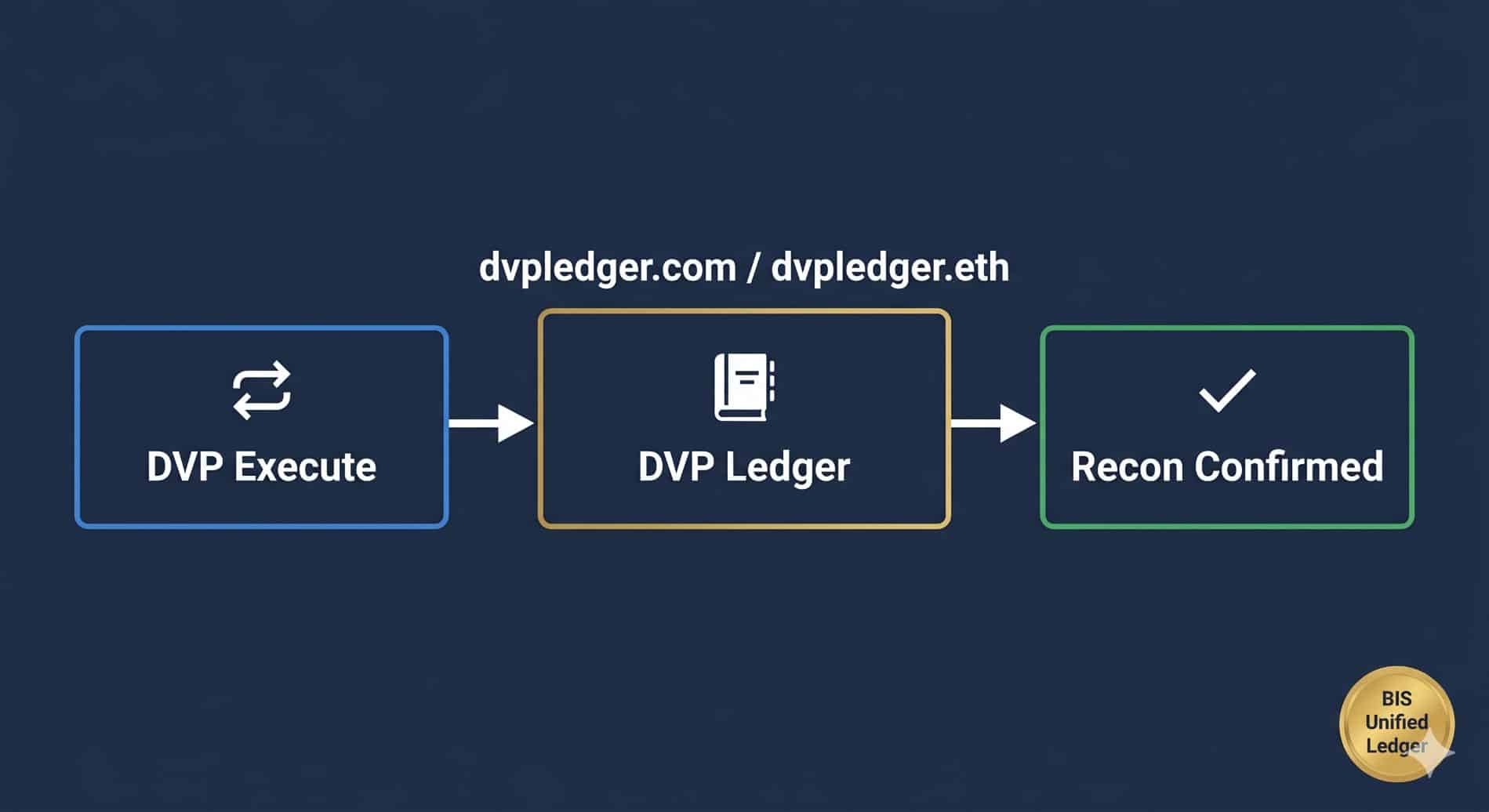
Pillar 1: Why the DVP Ledger Is the Critical Missing Layer in Institutional Settlement
The institutional adoption of atomic DVP settlement in 2026 has solved the execution problem. JPMorgan Kinexys executes. LSEG DiSH executes. Canton Network executes. But execution without an immutable, institution-neutral ledger record creates a new compliance gap: who owns the authoritative settlement record, and how does it survive system failures, protocol upgrades, and regulatory examinations?
Three structural requirements define the DVP Ledger mandate in 2026:
Immutable Settlement Records: Every DVP transaction must generate a time-stamped, cryptographically sealed ledger entry that cannot be retroactively modified, selectively presented, or reconstructed from incomplete data. The OCC’s proposed rules under §15.14 require PPSIs to maintain comprehensive audit trails for every settlement transaction — a requirement that demands a dedicated, protocol-native DVP ledger layer separate from the execution infrastructure.
Cross-Platform Interoperability: JPMorgan keeps its ledger sovereign while plugging into LSEG for atomic DVP settlements — but this architecture creates a fragmentation problem: each institution maintains its own proprietary settlement ledger, with no neutral, institution-agnostic record that all counterparties can query simultaneously. dvpledger.com/.eth is the neutral namespace that bridges proprietary institutional ledgers into a single, queryable DVP settlement record standard. Fintechanddigitalassets
Real-Time Regulatory Verification: The BIS Unified Ledger framework, operationalized through Project Agorá with seven central banks and 40+ regulated financial institutions, establishes the principle that settlement records must be verifiable by regulators in real time — not reconstructed from batch files after the fact. dvpledger.eth is the on-chain endpoint that makes real-time regulatory verification operationally achievable at DVP transaction speed.
Source: BIS — Project Agorá: Exploring Tokenisation of Cross-Border Payments, October 2025 · OCC Proposed Rules §15.14 – Audit and Reporting Requirements, March 2, 2026
dvpledger.eth — ENS Relevance: 9.5/10
dvpledger.eth is the only on-chain identity that permanently reserves “DVP Ledger” as an institutional namespace. While dvpledger.com represents the legal identity, API portal, and compliance interface for DVP settlement record-keeping, dvpledger.eth is the verifiable on-chain DVP ledger endpoint — the ENS address where settlement records are written, sealed, and queried by counterparties, regulators, and reconciliation agents after every atomic DVP execution.
The distinction from a generic settlement database is fundamental: anyone can maintain a DVP settlement database. No institution can replicate dvpledger.eth. This ENS identity is the Sovereign Settlement Record of institutional DVP infrastructure — immutable, censorship-resistant, and directly composable with the smart contract logic that governs cross-chain asset transfers, repo agreements, and tokenized securities settlement.
Pillar 2: The DVP Ledger Gap — Where Settlement Records Fail Compliance
Three failure modes define the current DVP ledger landscape:
Proprietary Ledger Fragmentation: Every major DVP platform — JPMorgan Kinexys, LSEG DiSH, Canton Network, Goldman Sachs DAP — maintains a proprietary settlement ledger. When a DVP transaction crosses platform boundaries, the settlement record exists in two separate proprietary systems with no neutral, institution-agnostic reference. For OCC examiners and counterparties requiring a single authoritative settlement record, this fragmentation creates the exact compliance gap that the BIS Unified Ledger framework is designed to eliminate. dvpledger.com/.eth is the neutral namespace that provides this single reference point.
Post-Settlement Reconciliation Failure: Broadridge’s Distributed Ledger Repo platform processes $8 trillion monthly — but even at this scale, post-settlement reconciliation between counterparties requires manual intervention when ledger records across systems don’t align. A protocol-native DVP ledger layer that writes settlement records simultaneously across all counterparty systems eliminates this reconciliation gap by design. dvpledger.eth is the on-chain anchor for this simultaneous record-writing — the endpoint that all counterparty systems query to verify settlement finality. SEC.gov
Audit Trail Discontinuity: Under OCC §15.14, every PPSI must maintain comprehensive audit trails for all settlement transactions — with records that can be produced to OCC examiners on demand, without manual reconstruction. DVP settlement systems that rely on proprietary batch-cycle ledgers cannot produce continuous, real-time audit trails at the examination standard the OCC requires. dvpledger.com is the compliance portal where audit-ready DVP settlement records are maintained; dvpledger.eth is the on-chain root where the cryptographic proof of each record’s integrity is permanently stored.
Source: Broadridge — DLR Platform Processes $8 Trillion Monthly, March 2026 · LSEG — Digital Settlement House (DiSH) Launch, 2026
Pillar 3: dvpledger as the Record Layer of the PillarsX DVP Stack
Every DVP transaction requires one confirmed final state: an immutable ledger entry that all counterparties, regulators, and reconciliation agents can query simultaneously. Within the PillarsX infrastructure, dvpledger.com/.eth is the record layer:
dvpintent.eth        →  DVP mandate authorized
        ↓               [Proof of Intent]
dvpsettle.eth        →  Atomic T0 execution
        ↓               [DVP Finality]
dvpledger.eth        →  Immutable ledger record sealed
        ↓               [OCC §15.14 – Audit Trail]
dvprecon.eth         →  Reconciliation confirmed
                        [Operational Resilience]
→ For the atomic DVP execution layer: dvpsettle.com & .eth → For the complete DVP infrastructure overview: PillarsX dFMI Architecture
dvpledger Within the PillarsX DVP Series
dvpledger is the Record Layer — the immutable settlement record endpoint within a complete institutional DVP infrastructure series:
| Layer | Domain | Function |
|---|---|---|
| Intent | dvpintent.com/.eth | DVP mandate & authorization |
| Execution | dvpsettle.com/.eth | Atomic T0 DVP settlement |
| Record | dvpledger.com/.eth | Immutable DVP settlement ledger |
| Custody | dvpcustody.com/.eth | Asset custody before execution |
| Collateral | dvpcollateral.com/.eth | Collateral management |
| Reconciliation | dvprecon.com/.eth | Post-settlement reconciliation |
Strategic Constellation & Bundle Potential
“The DVP Settlement Record Stack” · For Institutional Tokenized Securities
| Domain | Function | Regulatory Hook |
|---|---|---|
| dvpledger.com/.eth | Immutable DVP settlement records | OCC §15.14 – Audit Trail |
| dvpsettle.com/.eth | Atomic T0 execution | BIS CPMI – DVP Standard |
| dvpintent.com/.eth | Pre-execution mandate | OCC – Fiduciary Agentic Responsibility |
| collateralledger.com/.eth | Unified collateral ledger | BIS Unified Ledger Framework |
“The Unified Ledger Bundle” · For BIS-Aligned Settlement Infrastructure
| Domain | Function | Regulatory Hook |
|---|---|---|
| dvpledger.com/.eth | DVP-specific settlement ledger | BIS Project Agorá |
| repoledger.com/.eth | Repo settlement ledger | Broadridge DLR – $8T Monthly |
| collateralledger.com/.eth | Unified collateral ledger | BIS Unified Ledger |
| fheledger.com/.eth | Privacy-preserving ledger | CLARITY Act – Confidential Computing |
Frequently Asked Questions
What is the difference between dvpledger.com and dvpledger.eth?
dvpledger.com is the institutional Web2 layer — the legal identity, API portal, compliance interface, and audit trail address for DVP settlement record-keeping operations. It is the address OCC examiners access, compliance teams document, and legal departments reference when verifying settlement records.
dvpledger.eth is the on-chain Web3 layer — the ENS endpoint where DVP settlement records are cryptographically sealed after atomic execution, providing immutable proof of settlement finality that all counterparties can query simultaneously without manual reconciliation. Together they deliver the complete Front-to-Back audit trail that OCC §15.14 requires.
Why does institutional DVP settlement need a dedicated ledger layer?
Atomic DVP execution solves the settlement risk problem — asset and payment exchange hands simultaneously. But execution without a dedicated, institution-neutral ledger record creates a new problem: fragmented, proprietary settlement records that cannot be reconciled across counterparty systems without manual intervention.
The DVP ledger layer solves this by providing a single, protocol-native settlement record that all counterparties write to and read from simultaneously — eliminating post-settlement reconciliation failures and providing the continuous audit trail that OCC examiners require.
How does dvpledger relate to the BIS Unified Ledger framework?
The BIS Unified Ledger framework, operationalized through Project Agorá with seven central banks and 40+ regulated financial institutions, establishes the principle that settlement records must exist on a shared, unified ledger accessible to all participants simultaneously.
dvpledger.com/.eth is the institutional namespace that operationalizes this principle for DVP settlement specifically — providing the neutral, institution-agnostic ledger identity that bridges proprietary institutional systems into a single, BIS-aligned settlement record standard.
„All content is for informational purposes only and does not constitute financial advice.“