
EligibleAsset — The Convergence Identity for Regulatory-Grade Reserve Classification
Eligible Asset Standard: Twin-Bundle: EligibleAsset.com + EligibleAsset.eth
| EligibleAsset.com | EligibleAsset.eth | |
|---|---|---|
| Layer | Web2 / Institutional Portal | Web3 / On-Chain Oracle |
| Function | API Gateway, Classification Registry, Legal Identity | Smart Contract Endpoint, DLT Verification, Agent Query Layer |
| Primary User | Compliance Officers, Treasury Desks, OCC Examiners | AI Agents, Settlement Protocols, Stablecoin Issuers |
| Core Question Answered | “Which assets are legally permitted?” | “Is this asset’s eligibility verifiable on-chain, right now?” |
🔴 Regulatory Update — June 9, 2026
FDIC comment deadline closes — every institution must now make an explicit eligible asset classification decision before January 18, 2027
The FDIC GENIUS Act comment period closed June 9, 2026 — establishing that deposits held as stablecoin reserves are insured as corporate deposits of the PPSI, not on a pass-through basis. Every institution must now explicitly classify its reserve structure: stablecoin, tokenized deposit, or payments program. The compliance infrastructure to support that classification must be operational before January 18, 2027.
→ Source: FDIC GENIUS Act Proposed Rule, Federal Register April 10, 2026🔴 Regulatory Update — March 5, 2026
Fed, OCC and FDIC confirm tokenized securities receive identical capital treatment — on-chain classification becomes the only viable compliance approach at scale
Joint guidance from the Federal Reserve, OCC, and FDIC confirms that eligible tokenized securities receive identical capital treatment to their non-tokenized equivalents — regardless of blockchain type. The determining factor is the underlying legal structure, not the technology. For Category 7 tokenized reserve assets under OCC § 15.11(b), this means machine-readable on-chain classification is the only operationally viable compliance approach at institutional scale.
→ Source: FDIC/Fed/OCC Joint Guidance — Capital Treatment of Tokenized Securities, March 5, 2026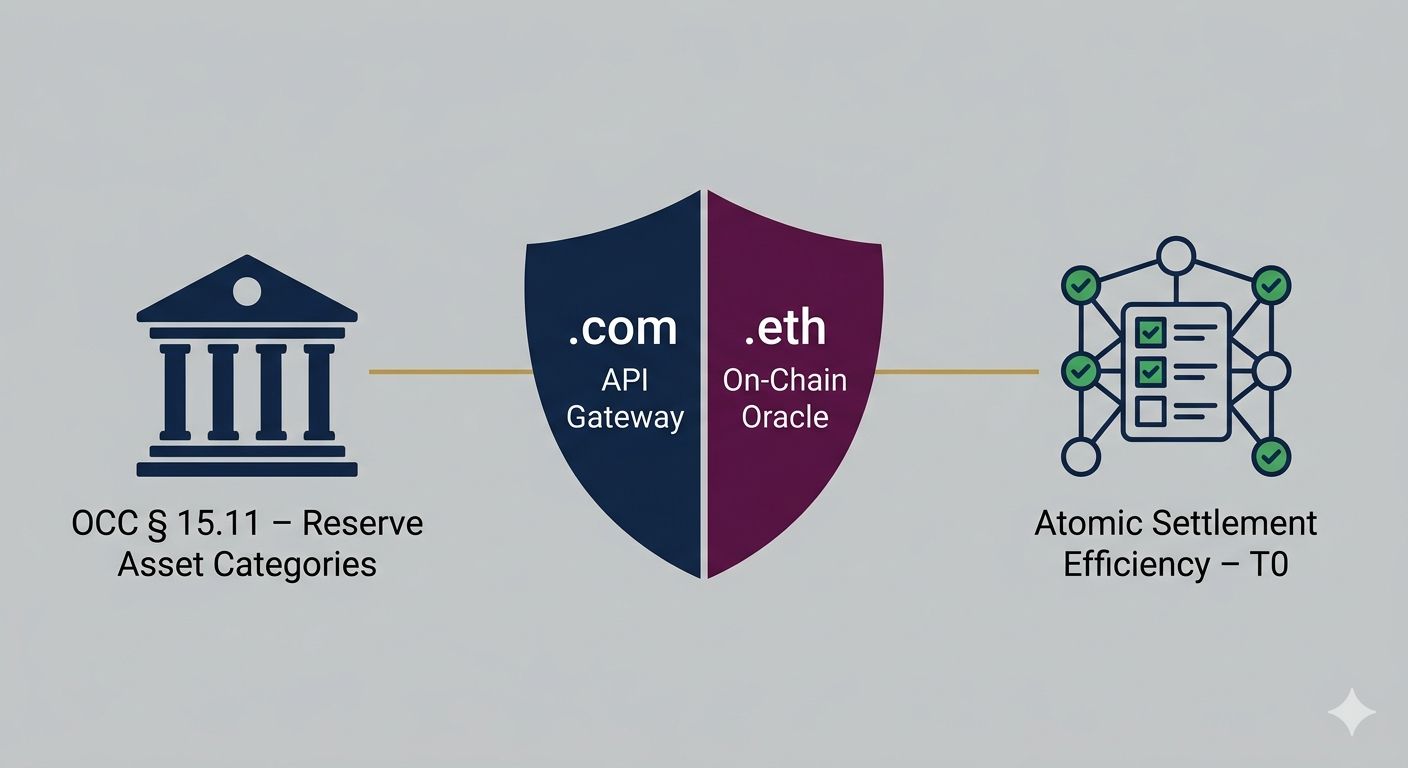
Why the OCC’s Eight Exclusive Reserve Categories Make Real-Time Eligible Asset Classification a Legal Obligation
The term Eligible Asset is not marketing language. Under the GENIUS Act (12 U.S.C. § 5903) and the OCC Proposed Rules (Federal Register Vol. 91, No. 40, March 2, 2026), it is a legally binding classification that determines which assets a Permitted Payment Stablecoin Issuer may hold as reserves. The OCC defines eight exclusive categories:
- Federal Reserve balances
- U.S. Treasury bills, notes, or bonds with a remaining maturity of 93 days or less
- Overnight repurchase agreements backed by T-Bills (93-day maturity)
- Tri-party or centrally cleared reverse repurchase agreements
- Registered Government Money Market Funds
- Any similarly liquid federal government asset approved by the OCC
- Tokenized versions of categories 1–6 — subject to full regulatory compliance and OCC pre-approval (§ 15.11(b)(8))
Category 7 is the inflection point for the entire digital asset industry. The OCC explicitly states that institutions seeking clarity on whether a specific tokenized asset qualifies must request a formal opinion. Without a machine-readable, on-chain source of truth for this classification, Programmable Compliance is impossible — and every automated treasury decision carries unquantified legal risk.
Source: OCC Proposed Rules – Permitted Payment Stablecoin Issuers, Federal Register, March 2, 2026
The Eligibility Verification Gap That Exposes Every Automated Treasury Decision to Unquantified Legal Risk
The operational challenge for banks and stablecoin issuers in 2026 is not a lack of regulation. It is the speed and verifiability of compliance. A treasury system must know in real time: Is this asset still eligible?
The answer depends on remaining maturity, counterparty credit rating, tokenization status, and OCC approval — parameters that can change daily. Without a dedicated eligibility identity layer, three critical failure modes emerge:
Settlement Failure: An AI agent accepts an asset as collateral that no longer meets OCC § 15.11(b) criteria. The result: cascading Atomic Settlement Efficiency breakdown and exposure to Herstatt risk.
Audit Gap: An examiner cannot trace the eligibility chain on-chain. Real-Time Recon fails. The institution cannot demonstrate compliance at the moment of transaction — a direct violation of OCC supervisory expectations.
Fiduciary Breach: An autonomous agent executes a treasury allocation without a verified eligibility signal. Under the emerging doctrine of Fiduciary Agentic Responsibility, the institution — not the algorithm — bears the liability.
EligibleAsset.com provides the institutional API layer: a continuously updated, OCC-mapped classification registry accessible to compliance teams and treasury systems. EligibleAsset.eth translates this registry into an on-chain oracle — queryable by smart contracts, stablecoin protocols, and AI agents at the moment of execution, with cryptographic proof of the eligibility state at that exact block timestamp.
Source: BIS — The role of tokenisation in the monetary system, 2024/2025 — The BIS framework confirms: atomic settlement processes require machine-readable asset classification as a precondition for Unified Ledger Integration.
Why EligibleAsset Is the Mandatory Gateway Before Any Reserve Position Can Be Legally Established
No asset can be atomically settled, tokenized, or posted as collateral before its eligibility is established. Within the PillarsX architecture, EligibleAsset.com/.eth is the mandatory first checkpoint — the gate through which every institutional transaction must pass.
EligibleAsset.eth        →  Eligibility verified [Qualified Digital Asset Custody]
        ↓
fhecollateral.com/.eth   →  Privacy-preserving collateral lock [Confidential Computing / FHE]
        ↓
mcpsettle.com/.eth       →  Atomic T0 execution [Atomic Settlement Efficiency]
        ↓
liqrecon.com/.eth        →  Instant position reconciliation [Real-Time Recon]
        ↓
dtaverify.com            →  Audit trail & proof of eligibility [Digital Transfer Agent]
This is Operational Resilience by design: every node in the chain has a verified identity in both Web2 and Web3.
Remove EligibleAsset from this stack and every downstream process operates on unverified inputs — a condition no
regulated institution can accept.
Strategic Constellations & Bundle Potential
Bundle A — “The Compliance Stack” · For Permitted Payment Stablecoin Issuers (OCC § 15.x)
Designed for banks and fintech institutions pursuing a stablecoin issuance license under the GENIUS Act. Each domain addresses a discrete regulatory checkpoint:
| Domain | Function | OCC Requirement |
|---|---|---|
| EligibleAsset.com/.eth | Eligibility gate & classification oracle | § 15.11(b) Reserve Asset Categories |
| permittedreserves.com/.eth | Reserve status dashboard & Proof-of-Reserve | § 15.11(c) Diversification & Concentration |
| coveredcustodian.com/.eth | Custody verification for eligible financial institutions | GENIUS Act § 10(a) Custody Agreements |
| programmablecompliance.com/.eth | In-code ruleset for automated compliance enforcement | CLARITY Act – Operational Resilience |
Bundle B — “The Agentic Treasury” · For AI-Driven Treasury Systems
Addresses the emerging requirement for Fiduciary Agentic Responsibility: AI agents allocating capital on behalf of institutions must prove every decision was based on verified, eligible assets — at the exact moment of execution.
| Domain | Function |
|---|---|
| EligibleAsset.eth | Real-time on-chain eligibility query layer (Proof of Intent) |
| agenticriskstandard.com | Liability framework for autonomous treasury operations |
| dtaintent.com/.eth | Verified intent signal per transaction |
| fhecollateral.com/.eth | Privacy-preserving collateral verification via Confidential Computing |
Bundle C — “The Tokenization Gateway” · For RWA Tokenization under OCC § 15.11(b)(8)
The OCC explicitly permits tokenized reserve assets — but requires a formal pre-approval process. This bundle positions PillarsX as the reference infrastructure for that workflow:
| Domain | Function |
|---|---|
| EligibleAsset.com/.eth | Classification gateway: does this token qualify as an eligible reserve asset? |
| fhetokenize.com/.eth | Privacy-preserving tokenization for OCC-compliant RWAs |
| verifiablereserves.com/.eth | Proof-of-Reserve for tokenized assets |
| repoledger.com/.eth | Repo transaction ledger with T-Bill collateral proof |
→ Related: PillarsX / PermittedReserves — EligibleAsset defines the category. PermittedReserves manages the live status. → Related: PillarsX / ProgrammableCompliance — When EligibleAsset establishes the truth, ProgrammableCompliance ensures it is automatically enforced.
Strategic Acquisition Inquiry
Initiate secure communication with representatives of the IP holder to evaluate the acquisition of this premium infrastructure namespace or its corresponding strategic asset bundle.