
fhesettle.com & .eth | FHE Settlement Identity
🔴 Infrastructure Update — June 10, 2026
FHE crosses the production-readiness threshold for confidential stablecoin settlement — real deployments now handle encrypted transfers at usable speed as GENIUS Act compliance documentation requirements approach July 18, 2026
Fully Homomorphic Encryption matured in 2026 into a foundational tool enabling public blockchains to compute on encrypted data — powering confidential DeFi, secure AI agents, and tokenized assets while preserving on-chain composability. Real deployments now handle confidential stablecoin transfers and private order matching at usable speeds, with developers writing standard smart contract code using encrypted variable types that are computed on directly without ever being decrypted on-chain. NIST continues work on standards for privacy-preserving cryptography, providing a framework institutions can implement with confidence. For PPSIs approaching the GENIUS Act's July 18, 2026 compliance deadline, this creates a concrete capability: settlement that generates the audit trail OCC examiners require while keeping counterparty identities, transaction sizes, and treasury positions invisible to competitors and other network participants. fhesettle.com & .eth is the institutional namespace for this confidential settlement standard.
→ Source: Chainwire — What Is FHE: Fully Homomorphic Encryption in Blockchain Explained, June 10, 2026🔴 Regulatory Update — May 14, 2026
CLARITY Act markup confirms GENIUS Act PPSI framework as permanent federal law
The Digital Asset Market Clarity Act Senate markup integrates the GENIUS Act PPSI framework into the broader US digital asset market structure — with the GENIUS Act implementation deadline of July 18, 2026 now 65 days away, all PPSIs must have compliance infrastructure in place.
→ Source: Digital Asset Market Clarity Act, Senate Markup May 14, 2026Settling transactions without revealing them — the FHE Settlement Standard makes confidential, cryptographically proven atomic execution a practical reality for institutions in 2026, not merely a theoretical future state.
Blockchain’s transparency is a feature for auditability and a problem for everything else. Every transaction, every wallet balance, every contract interaction is public by default — for institutional players managing billions in treasury positions, this level of transparency creates a competitive liability that makes naive on-chain settlement architecturally incompatible with institutional operations. Fully Homomorphic Encryption resolves this directly: it allows a third party to run computations on encrypted data without ever decrypting it, with results that remain mathematically correct when the data owner decrypts them. The computing party never sees the underlying values — yet the computation, and the proof that it was performed correctly, is fully verifiable.
For PPSIs operating under the GENIUS Act’s reserve documentation and audit requirements, this resolves what has been an apparent contradiction: full regulatory auditability and full counterparty confidentiality, simultaneously, at the moment of settlement. fhesettle.com & .eth is the Convergence Identity for this confidential settlement standard — the institutional namespace connecting FHE-based atomic execution to the GENIUS Act compliance documentation every PPSI must produce.
Namespace Acquisition: This Twin-Domain asset is available for institutional acquisition. Inquiries: hq@pillarsx.com
Why Confidential Computing Resolves the Audit-Privacy Conflict Institutions Have Faced Since Blockchain Settlement Began
OCC examiners require full transaction audit access. Public ledgers provide full visibility to everyone. Without confidential computing at the settlement layer, institutions face an apparent choice: satisfy audit requirements by exposing sensitive data, or protect confidential information and risk falling short of regulatory transparency expectations.
FHE eliminates this tradeoff structurally rather than through a workaround. A developer writes ordinary smart contract code declaring variables as encrypted types — the contract receives ciphertexts, performs additions or multiplications on them using FHE libraries, and returns a new ciphertext, with only the rightful key-holder able to decrypt the final output. The computation happened, the result is provably correct, and no party other than the data owner ever saw the underlying values. The MCI custody identity for the qualified custody framework within which FHE-secured reserve positions sit is documented at mcicustody.com & .eth.
Enterprise privacy infrastructure providers including Fhenix, building on FHE libraries from Zama, have moved this from research into deployable infrastructure for confidential DeFi — protecting stablecoin treasuries, enabling tokenization without exposing holder identities, and running encrypted logic without trusted hardware or zero-knowledge workarounds. As GENIUS Act compliance documentation requirements take effect by July 18, 2026, PPSIs managing reserve positions across multiple counterparties have a concrete need for settlement infrastructure that documents compliance without exposing the treasury operations themselves. The repo intent verification standard for BSA-compliant documentation of the repo transactions that FHE settlement can execute confidentially is documented at repointent.com & .eth.
How FHE Settlement Resolves the Three Failure Modes of On-Chain Transparency
Proprietary strategy exposure is the first failure mode: traditional on-chain settlement reveals counterparty identities, transaction sizes, timing patterns, and asset compositions to every network participant. For institutions managing large treasury positions, naive on-chain settlement is not merely a privacy concern — it makes positions and strategies visible to anyone watching the chain, including competitors. fhesettle.com & .eth addresses this directly: the settlement executes under encryption, with only the cryptographic proof of validity made available for examination.
Audit-privacy conflict is the second: confidential computing resolves the apparent conflict between OCC audit access and institutional confidentiality by making both simultaneously true — the proof of compliance is verifiable without the underlying data being readable by anyone other than the institution and its examiners. The DLT settlement categorical namespace anchoring the broader settlement infrastructure within which FHE-based confidential execution operates is documented at dltsettle.com & .eth.
Cross-border privacy fragmentation is the third: different jurisdictions impose different data privacy requirements, and a settlement layer that exposes full transaction details by default cannot simultaneously satisfy every applicable privacy regime a cross-border transaction touches. FHE-based settlement — where the underlying data is never exposed regardless of jurisdiction, only the proof of validity — sidesteps this fragmentation structurally rather than requiring jurisdiction-by-jurisdiction compliance engineering.
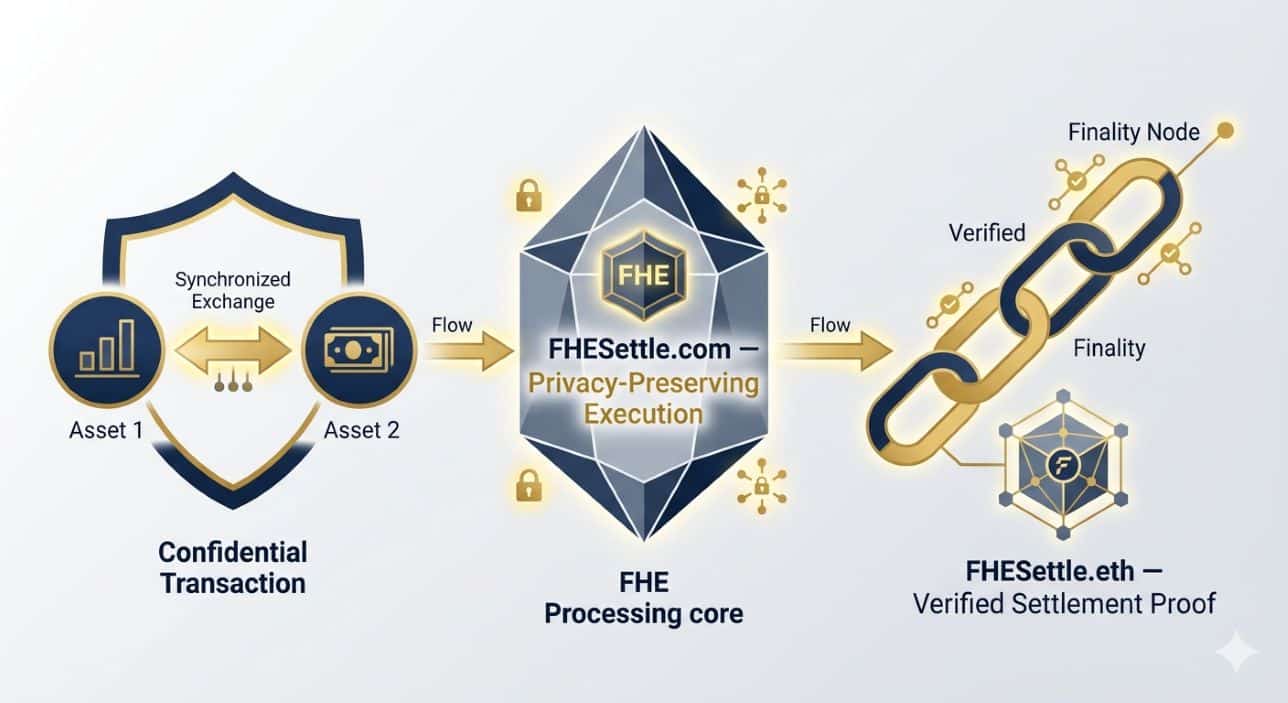
fhesettle.com is the institutional Web2 portal identity — the compliance interface and legal documentation anchor for any institution operating confidential settlement infrastructure under GENIUS Act audit requirements. fhesettle.eth is the on-chain complement — the ENS-resolvable endpoint where confidential atomic execution occurs and where the cryptographic finality proof is generated, verifiable by regulators and invisible to competitors.
The FHE Settlement Ecosystem — From Intent Authorization to Confidential Execution and Finality
Every atomic transaction in a regulated settlement environment generates two simultaneous requirements: cryptographic proof of validity for regulators, and cryptographic protection of content from unauthorized parties. fhesettle functions as the confidential execution layer sitting between intent authorization and final settlement proof — the layer where both requirements are satisfied at once.
fhesettle connects directly to verifiableintent.com & .eth as the verifiable intent standard where transaction mandates are authorized and sealed before confidential execution begins, and to verifiablesettle.com & .eth as the final cryptographic finality confirmation that follows confidential execution.
Beyond this immediate stack, fhesettle integrates with fhecollateral.com & .eth as the privacy-preserving collateral verification and locking layer for assets posted before confidential execution, mcicustody.com & .eth as the qualified custody standard governing the reserve positions FHE settlement protects, repointent.com & .eth as the repo intent verification standard for confidential repo transactions executed through fhesettle, and dltsettle.com & .eth as the categorical DLT settlement namespace within which confidential execution operates as one settlement modality among several.
STRATEGIC CONSTELLATIONS & BUNDLE POTENTIAL
Bundle 1 — “The Confidential Settlement Stack” (for Privacy-Preserving Institutional Execution) Target: PPSIs and MCIs requiring simultaneous regulatory transparency and institutional confidentiality across settlement operations. Domains: fhesettle.com/.eth + verifiableintent.com/.eth + fhecollateral.com/.eth. Complete confidential settlement namespace — confidential execution layer, pre-execution mandate authorization, and privacy-preserving collateral verification.
Bundle 2 — “The Confidential Treasury Stack” (for Institutions Managing Large Reserve Positions) Target: Circle, Paxos, BlackRock BUIDL, Ondo Finance. Domains: fhesettle.com/.eth + mcicustody.com/.eth + repointent.com/.eth. Confidential treasury namespace — confidential execution, qualified custody standard, and BSA repo intent verification.
Bundle 3 — “The Full FHE Privacy Namespace” (for Strategic Acquirers) Domains: fhesettle.com/.eth + verifiableintent.com/.eth + verifiablesettle.com/.eth + fhecollateral.com/.eth + fheledger.com/.eth. The complete PillarsX FHE privacy namespace — every layer from intent authorization through confidential execution to finality and ledger documentation. This package exists exactly once.
Regulatory Sources
- Chainwire — What Is FHE: Fully Homomorphic Encryption in Blockchain Explained, June 10, 2026
- KuCoin — FHE 2026: Private Blockchains and Encrypted Data, May 3, 2026
- NIST — Standards for Post-Quantum and Privacy-Preserving Cryptography, 2026
- GTM 8020 — Best Enterprise On-Chain Privacy Solutions, 2026
- OCC GENIUS Act NPRM — Reserve Documentation and Examination Standards, February 2026
Explore Related PillarsX Infrastructure
- verifiableintent.com & .eth — Verifiable Intent Identity
- verifiablesettle.com & .eth — Verifiable Settlement Identity
- fhecollateral.com & .eth — FHE Collateral Identity
- fheledger.com & .eth — FHE Ledger Identity
- mcicustody.com & .eth — MCI Custody Identity
- repointent.com & .eth — Repo Intent Identity
- dltsettle.com & .eth — DLT Settlement Namespace
- clearingintent.com & .eth — Clearing Intent Identity
„All content is for informational purposes only and does not constitute financial advice.“