
fhegold.com & .eth — FHE Gold Identity
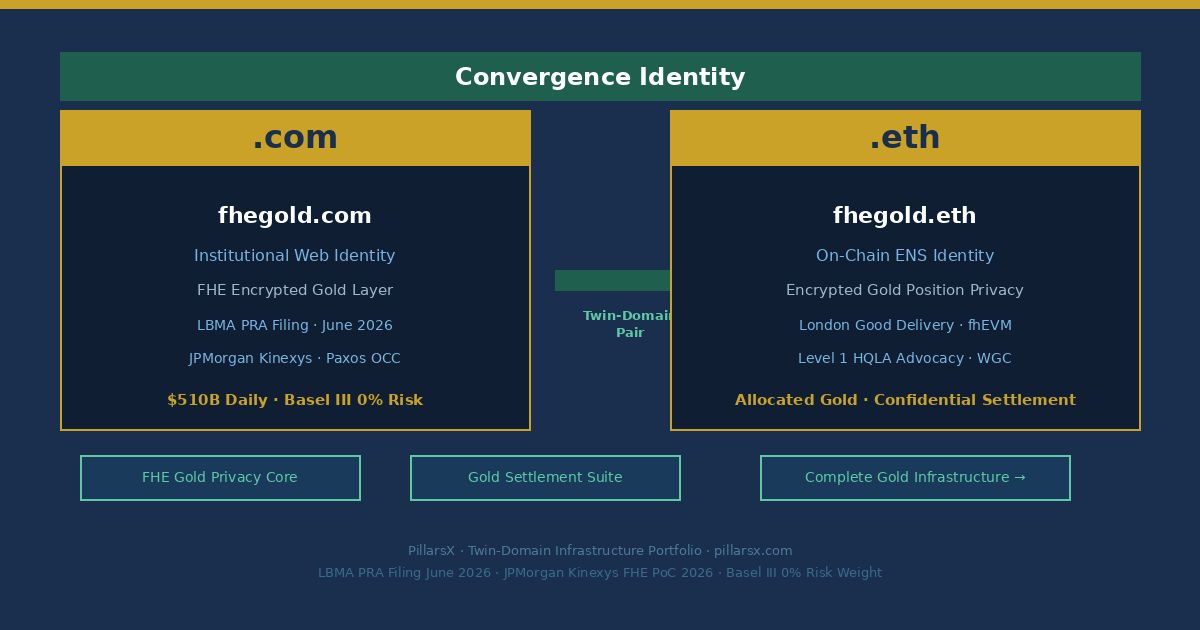
The London Bullion Market Association filed with the Bank of England's Prudential Regulation Authority in June 2026 — the most direct institutional push yet for gold to be reclassified as Level 1 High-Quality Liquid Asset, citing $510 billion in average daily global gold trading volume and comparing gold's bid-ask spreads to major sovereign bond markets. Physical bars at the Bank of England are transferable between accounts in a single book entry — by every practical measure of liquidity, gold behaves like a Tier 1 asset. Gold currently holds a 0% risk weight under Basel III capital rules for allocated physical bullion — the same treatment as cash — and LBMA is advocating for the final HQLA reclassification that would allow banks to use gold even more flexibly for liquidity coverage ratios. JPMorgan's Kinexys simultaneously published a proof of concept using Zama's fhEVM for institutional tokenized finance privacy — directly applicable to gold position confidentiality. Paxos, now OCC-regulated as a national trust institution, uses monthly attestations linking holdings to allocated London Good Delivery gold. The fhegold namespace anchors the institutional identity for FHE-enabled gold settlement infrastructure — where allocated gold positions, reserve compositions, and settlement flows are verified on encrypted data without exposing institutional gold holdings to unauthorized parties.
Gold has been the foundation of institutional reserve management for five thousand years. It has survived the collapse of the Bretton Woods system, the introduction of fiat currency, the rise of derivatives markets, and the digitization of financial infrastructure. Today, in 2026, it sits at another inflection point — one that is not about gold’s value as an asset, but about its regulatory recognition as liquidity. The London Bullion Market Association filed with the Bank of England in June 2026 citing $510 billion in average daily trading volume — comparable to major sovereign bond markets — arguing that by every practical measure of liquidity, gold behaves like a Tier 1 asset, and that banking regulation should finally reflect this reality.
The regulatory architecture around gold is already partly there. Under Basel III capital rules, allocated physical gold has carried a 0% risk weight since Basel I in 1988 — the same treatment as cash, the same treatment as sovereign bonds of the highest credit quality. What LBMA is now advocating for is the final step: Level 1 High-Quality Liquid Asset classification that would allow banks to use allocated gold to fulfill liquidity coverage ratios without haircuts. This is not a minor regulatory adjustment — it is the formal completion of gold’s transition from commodity to institutional reserve asset within the banking framework that governs $50+ trillion in bank balance sheets.
The tokenization of gold accelerates this transition at the infrastructure level. Paxos — now OCC-regulated as a national trust institution — links PAXG tokens to allocated London Good Delivery gold with monthly attestations. WisdomTree, Sprott, and CACHE Gold are building similar infrastructure on multiple chains. The $510 billion daily gold market is beginning to move on-chain — and the privacy requirements for institutional gold positions are acute. Every gold position, every reserve composition, every custody allocation is commercially sensitive intelligence that institutions cannot afford to expose on transparent ledgers. Fully Homomorphic Encryption provides the architectural solution: gold positions verified and settled on encrypted data, producing only the compliance outputs that regulators and counterparties need without exposing the underlying holdings.
fhegold.com and fhegold.eth anchor the namespace for this FHE gold infrastructure — at the convergence of LBMA’s HQLA advocacy, JPMorgan Kinexys FHE validation, Paxos OCC-regulated tokenization, and the Basel III regulatory framework that is completing gold’s formal recognition as institutional reserve infrastructure.
LBMA, Basel III and the Gold HQLA Reclassification
The distinction between gold’s current regulatory status and the LBMA’s advocacy target is precise and consequential. Gold currently holds a 0% risk weight under Basel III capital rules — meaning banks hold it at zero capital cost, the same as cash. What gold does not currently have is Level 1 HQLA status, which would allow it to fulfill liquidity coverage ratios — the post-2008 requirement that banks hold sufficient liquid assets to survive a 30-day stress scenario.
The LBMA’s June 2026 PRA filing cited $510 billion in daily global gold trading volume and argued that gold’s bid-ask spreads are comparable to major sovereign bond markets. Physical bars at the Bank of England are transferable between accounts in a single book entry — the operational definition of a liquid asset. The regulatory gap between what the data shows and what the rules say has been narrowing for a decade, and the LBMA’s June 2026 filing is the most direct institutional push yet. The direction of regulatory travel is clear: greater recognition of allocated physical gold as institutional liquidity infrastructure.
For FHE gold infrastructure specifically, the HQLA reclassification creates a direct compliance requirement: if banks are to use allocated gold to fulfill LCR requirements, they must be able to verify reserve compositions and demonstrate compliance to regulators — while simultaneously protecting the confidentiality of their gold positions from competitors. FHE gold verification resolves this: reserve sufficiency and HQLA eligibility are confirmed on encrypted gold position data, with only the compliance output reported to the PRA or Basel supervisors. fhegold is the namespace for this compliance verification infrastructure.
Paxos, JPMorgan and the Institutional Tokenized Gold Standard
The institutional tokenized gold infrastructure is now operating at production scale across two parallel tracks. Paxos — previously regulated under NYDFS and now OCC-regulated as a national trust institution — links PAXG tokens to allocated London Good Delivery gold with monthly attestations. Each PAXG token is backed by one fine troy ounce of allocated gold held in Brink’s vaults, with the OCC regulatory framework providing the institutional credibility that large banks and asset managers require for custody and settlement infrastructure.
JPMorgan Kinexys published a proof of concept using Zama’s fhEVM coprocessor for institutional tokenized finance privacy — validating FHE as the cryptographic approach for institutional asset settlement confidentiality. This validation applies directly to tokenized gold: an institution holding PAXG or similar tokens on a shared settlement ledger requires that its gold position size, custody allocation, and reserve composition remain confidential from competitors and market participants. FHE gold infrastructure enables this: token balances are stored as encrypted ciphertext handles, settlement logic executes on encrypted values, and only authorized parties can access the underlying position data. fhegold.eth is the on-chain resolution address for this encrypted gold settlement infrastructure.
fhegold in the Complete Gold Infrastructure Stack
fhegold is the FHE privacy layer of the PillarsX Gold namespace — the encrypted verification and settlement infrastructure for tokenized gold positions and reserves. It connects directly to verifiablegold as the cryptographic verification standard for gold reserve attestations, golddvp as the DVP settlement layer for atomic tokenized gold delivery, goldintent as the intent formation layer for agentic gold settlement transactions, and fhebullion as the LBMA-focused institutional bullion privacy layer.
The complete Gold Infrastructure Stack spans every layer of the institutional gold lifecycle: goldintent establishes the mandate for gold settlement. fhegold verifies positions on encrypted data. golddvp executes atomic delivery-versus-payment. verifiablegold produces cryptographic reserve attestations. proofgold.eth anchors the proof-of-reserve standard. reservegold.eth manages the reserve portfolio. atomicgold.eth ensures all-or-nothing settlement finality. zkgold.eth provides zero-knowledge proof verification. tokenizegold.eth anchors the issuance layer. goldsettle.eth provides the LBMA settlement identity. goldverify.eth confirms compliance attestations. Together these form the most comprehensive institutional gold namespace in the tokenized finance domain space — covering every layer from FHE-encrypted privacy through ZK verification to atomic settlement finality.
Related PillarsX Gold Infrastructure
verifiablegold.com & .eth — Verifiable Gold Identity
cryptographic gold reserve verification and proof-of-reserve attestation standard
golddvp.com & .eth — Gold DVP Identity
atomic delivery-versus-payment settlement for tokenized gold under LBMA standards
fhebullion.com & .eth — FHE Bullion Identity
FHE-enabled institutional bullion privacy for LBMA Good Delivery gold settlement
goldintent.com & .eth — Gold Intent Identity
intent formation and mandate anchoring for agentic gold settlement transactions
Strategic Constellations & Bundle Potential
Bundle 1 — FHE Gold Privacy Corefhegold + fhebullion + verifiablegold — the complete FHE and verifiable gold privacy namespace. Targets: Paxos, WisdomTree, CACHE Gold, institutions building OCC-regulated tokenized gold infrastructure with FHE privacy layer.
Bundle 2 — Gold Settlement Suitefhegold + golddvp + goldsettle.eth + atomicgold.eth — the complete gold settlement namespace from FHE privacy through DVP execution to atomic finality. Targets: LBMA members, London Good Delivery vault operators, institutions building Basel III HQLA-eligible tokenized gold settlement infrastructure.
Bundle 3 — Complete Gold Infrastructurefhegold + verifiablegold + golddvp + goldintent + fhebullion + proofgold.eth + reservegold.eth + zkgold.eth + atomicgold.eth + tokenizegold.eth — the complete PillarsX Gold namespace. The most comprehensive institutional gold infrastructure acquisition available. Targets: Central banks, sovereign wealth funds, LBMA member institutions building complete tokenized gold infrastructure under Basel III HQLA reclassification.
· LBMA — Filing to Bank of England PRA for Gold Level 1 HQLA Reclassification · $510B Daily Volume (June 2026)
· JPMorgan Kinexys — FHE Tokenized Finance Privacy Proof of Concept using Zama fhEVM (June 2026)
· Basel III / BCBS — 0% Risk Weight for Allocated Physical Gold under Capital Rules (since Basel I 1988)
· Paxos — OCC National Trust Institution · PAXG London Good Delivery Gold Monthly Attestations (2026)
· World Gold Council — Gold HQLA Advocacy · Meeting with BIS Basel Committee (2024–2026)
· Coinbase Institutional 2026 Outlook — FHE as Core Institutional Privacy Infrastructure
Explore Related
· verifiablegold.com & .eth — Verifiable Gold Identity
· golddvp.com & .eth — Gold DVP Identity
· fhebullion.com & .eth — FHE Bullion Identity
· goldintent.com & .eth — Gold Intent Identity
· Portfolio Acquisition → /acquire/
Disclaimer:PillarsX is a domain portfolio business. Nothing on this page constitutes legal, financial, or regulatory advice. Domain names do not confer regulatory status, licensing, or compliance certification of any kind. All content is for informational purposes only and does not constitute financial advice.