
mcirisk.com & .eth | MCI Risk Management Identity
MiCA's CASP authorization regime requires documented governance structures, fit-and-proper management, robust AML/CFT controls, ICT security under DORA, and formal risk management frameworks as mandatory conditions for EU-wide passporting. The IMF confirmed in Notes 2026/001 that tokenization shifts the locus of risk from institutions to infrastructure — making supervisory frameworks focused solely on capital adequacy insufficient when failures can originate in algorithms or data feeds. Stress events in tokenized systems are likely to unfold faster, leaving less time for discretionary intervention. Operating without MiCA authorization after 1 July 2026 exposes firms to fines up to EUR 5 million, public censure, and withdrawal of authorization. The mcirisk namespace anchors institutional identity for the risk management and operational resilience infrastructure that MCI-classified intermediaries must now maintain under simultaneous MiCA, DORA, and GENIUS Act risk requirements.
🔴 Regulatory Update — June 11, 2026
CLARITY Act Senate floor vote imminent — MCI risk management framework moves toward binding law as Galaxy Research assigns 75% passage probability and 200+ institutions demand immediate Senate action
The CLARITY Act was placed on the Senate Legislative Calendar on June 1, 2026 following a 15-9 bipartisan committee vote. Galaxy Research raised its 2026 passage probability to 75% with a floor vote expected within 30 days. The CLARITY Act establishes risk management frameworks for digital asset intermediaries — directly aligned with BIS FSI Paper No. 27 prudential requirements for MCIs. Simultaneously the OCC GENIUS Act Final Rules deadline of July 18, 2026 makes capital, liquidity, and operational resilience requirements binding law in 37 days. Every MCI building risk infrastructure under both frameworks must document its risk management identity before both deadlines converge.
→ Source: Galaxy Research — CLARITY Act 75% Passage Probability, June 2026mcirisk is the risk management identity built for the regulatory moment the BIS created on April 23, 2026. The BIS FSI Occasional Paper No. 27 formally identified credit risk, liquidity risk, and maturity risk as the three core vulnerabilities of Multifunction Cryptoasset Intermediaries — institutions that accept customer assets, fund lending and market making, and manage financial intermediation without the prudential safeguards that apply to traditional banks.
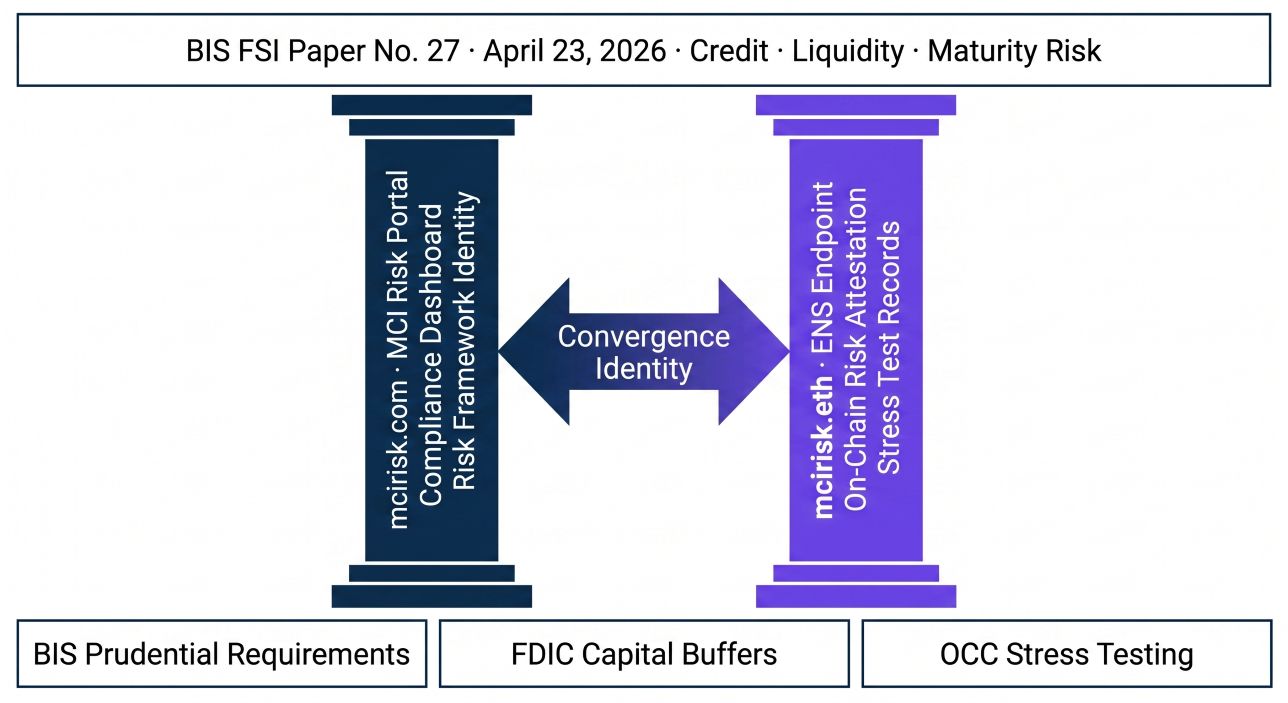
mcirisk.com & .eth is the Convergence Identity that addresses this regulatory gap directly: the institutional namespace for MCI risk management infrastructure, and a core component of the Multifunction Cryptoasset Intermediary domain stack. As the authoritative Multifunction Cryptoasset Intermediary risk identity, mcirisk.com & .eth sets the standard for how regulated institutions brand and document their MCI risk management frameworks under the emerging global MCI regulatory architecture.
Namespace Acquisition: This Twin-Domain asset is available for institutional acquisition. Inquiries: hq@pillarsx.com
The Regulatory Foundation
The BIS FSI Occasional Paper No. 27 establishes that MCIs engaged in financial intermediation — accepting customer assets, funding lending and market making, managing credit and liquidity risk — must be subject to prudential requirements equivalent to those applied to traditional financial intermediaries.
The paper identifies three specific risk categories that define MCI vulnerability: credit risk from margin lending and derivatives exposure, liquidity risk from short-term redeemable earn products that function economically as deposits, and maturity risk from the mismatch between short-term customer liabilities and longer-term asset deployments. The paper explicitly cites the failures of Celsius Network and FTX in 2022 and the cryptoasset flash crash of October 2025 — which liquidated $19 billion in leveraged positions and destroyed $350 billion in market capitalization within 24 hours — as direct evidence that unmanaged MCI risk creates systemic vulnerability.
The FDIC Proposed Rule implementing the GENIUS Act reinforces this at the federal level with explicit capital and liquidity buffer requirements. The OCC Proposed Rule requires Operational Resilience and stress testing — both directly dependent on a robust MCI risk management framework. The PPSI settlement infrastructure that executes after MCI risk clearance is documented at ppsisettlement.com.
The MCI Risk Architecture
Every Multifunction Cryptoasset Intermediary building risk management infrastructure under the BIS and FDIC frameworks faces the same institutional challenge: under what name does it present its risk framework to regulators, counterparties, and clients — and does it own that identity both on the classical web and on-chain?
mcirisk.com is the institutional answer — the compliance dashboard, the risk framework portal, the legal brand that signals BIS-aware prudential risk management in a single, memorable name. mcirisk.eth is the on-chain complement — an ENS-resolvable endpoint for risk attestations, stress test results, and algorithmic risk monitoring records stored as immutable distributed ledger entries. Together they deliver what no generic domain can: a Convergence Identity that signals BIS risk awareness, prudential compliance capability, and on-chain auditability simultaneously.
The BIS paper identifies Binance, Bybit, Coinbase, Crypto.com, MEXC and OKX as MCI examples — each of these institutions requires a risk management namespace that meets the prudential standard the BIS now demands. The MCI ledger infrastructure documenting risk records as immutable entries is documented at mciledger.com & .eth.
The MCI Risk Ecosystem
mcirisk is the risk governance core of the MCI namespace. Every settlement event requires a prior risk assessment — mcirisk connects directly to mcisettle.com & .eth as the settlement layer that executes after risk clearance, and to mcicollateral.com & .eth as the collateral management layer that provides the risk buffer.
Beyond the MCI cluster, the MCI risk layer integrates with agenticcollateral.com & .eth as the agentic collateral management standard, fhemargin.com & .eth as the privacy-preserving margin risk layer, and programmablecompliance.com & .eth as the automated ruleset that enforces risk limits on-chain. An institution acquiring mcirisk.com & .eth secures the namespace for the most regulatorily urgent layer of MCI infrastructure — the one that the BIS identifies as the primary source of systemic vulnerability in the cryptoasset intermediary market.
Strategic Constellations & Bundle Potential
Bundle 1 — “The MCI Risk & Settlement Core” (for Crypto Exchanges) Target: Binance, Bybit, Coinbase, OKX — all named in the BIS paper. Domains: mcirisk.com/.eth + mcisettle.com/.eth + mcicollateral.com/.eth. Risk assessment, settlement execution, and collateral management in one acquisition — the three most operationally urgent MCI compliance requirements.
Bundle 2 — “The MCI Prudential Stack” (for Institutional Risk Managers) Target: Risk management software providers, stress testing platforms, prudential compliance consultancies. Domains: mcirisk.com/.eth + mcicustody.com/.eth + agenticcollateral.com/.eth. Complete prudential risk namespace — MCI risk framework, qualified custody standard, and agentic collateral management layer.
Bundle 3 — “The Full MCI Infrastructure” (for Strategic Acquirers) Domains: mcirisk.com/.eth + mcisettle.com/.eth + mcisettlement.com/.eth + mciledger.com/.eth + mcicustody.com/.eth. The complete PillarsX MCI stack — one acquirer secures the entire Multifunction Cryptoasset Intermediary namespace under the BIS and FDIC frameworks. This package exists exactly once.
Regulatory Sources
- BIS FSI Occasional Paper No. 27 — MCI Credit, Liquidity and Maturity Risk, April 23, 2026
- CLARITY Act H.R. 3633 — Digital Asset Risk Management Framework, Senate Calendar June 1, 2026
- FDIC GENIUS Act Proposed Rule — Capital and Liquidity Requirements, April 7, 2026
- OCC Proposed Rule — Operational Resilience and Stress Testing, February 2026
Explore Related MCI Infrastructure
- mcisettle.com & .eth — MCI Settlement Identity
- mcisettlement.com & .eth — MCI Settlement Longform Identity
- mciledger.com & .eth — MCI Unified Ledger Identity
- mcicustody.com & .eth — MCI Custody Identity
- mcilayer.com & .eth — MCI Infrastructure Layer Identity
- mcicollateral.com & .eth — MCI Collateral Management Identity
- programmablecompliance.com & .eth — Programmable Compliance Identity
- agenticcollateral.com & .eth — Agentic Collateral Management Identity
„All content is for informational purposes only and does not constitute financial advice.“