
MCPSettle — The MCP Settlement Standard for AI-Native Financial Execution
The Model Context Protocol has become the universal language of agentic finance — MCP Settlement is the institutional standard that makes AI-native, T0 atomic execution compliant, verifiable, and legally binding.
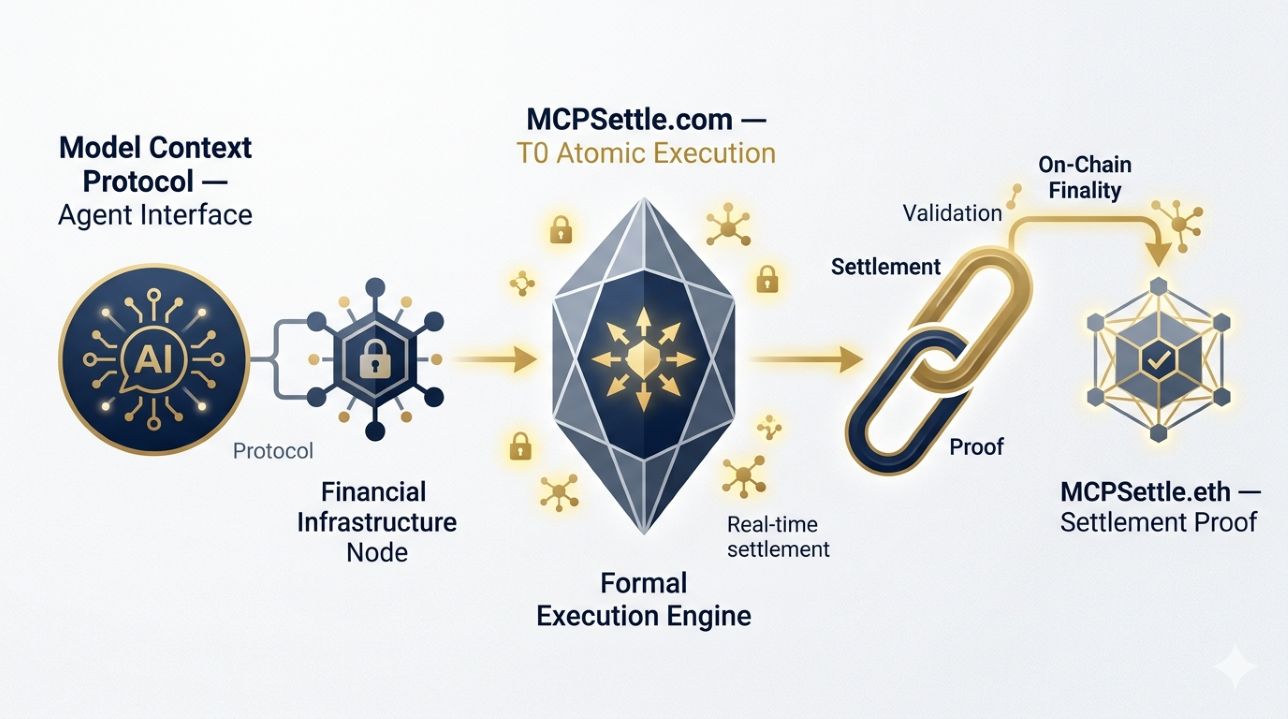
Pillar 1: Why MCP Settlement Is the Defining Infrastructure Standard of Agentic Finance
The Model Context Protocol (MCP), established by Anthropic and adopted as the de facto standard for AI agent communication in 2025, has fundamentally changed how financial institutions must architect their settlement infrastructure. Under the CLARITY Act (2026) and the latest OCC Supervisory Guidance on Automated Decision Systems, institutions deploying AI agents in settlement roles must ensure that every agent-initiated transaction meets the same regulatory standards as human-authorized operations.
The OCC operationalizes this requirement through two specific obligations:
Machine-Readable Settlement Standards: Every settlement instruction initiated by an AI agent via MCP must be traceable, verifiable, and compliant with applicable regulatory requirements at the moment of execution. An institution whose settlement infrastructure cannot natively communicate with MCP-based agent systems is an institution that cannot participate in the next generation of institutional finance — where AI agents are the primary market participants.
Atomic Settlement Efficiency: Under the GENIUS Act, every permitted reserve asset transaction must achieve T0 finality. In an MCP-driven environment, where AI agents execute thousands of settlement instructions per second, manual or batch settlement processes are architecturally incompatible with regulatory requirements. The MCP Settlement Standard ensures every agent-initiated instruction achieves atomic finality — eliminating settlement lag at the protocol level.
The MCP Settlement Standard is the direct institutional response: a natively agentic, regulatory-compliant settlement layer that bridges the gap between AI agent communication protocols and institutional-grade financial infrastructure.
Source: OCC Proposed Rules – Permitted Payment Stablecoin Issuers, Federal Register, March 2, 2026
MCPSettle.eth – ENS Relevance: 9.5/10
In a world of over 10,000 public MCP servers and 97 million monthly SDK downloads, mcpsettle.eth is the only on-chain identity that permanently reserves “Settlement via MCP” as an institutional namespace. While mcpsettle.com represents the legal identity, API portal, and regulatory liability address, mcpsettle.eth is the verifiable on-chain settlement endpoint — the address an agentic system targets when a settlement instruction must be written to chain in a final, atomic, and immutable way.
The distinction from a generic MCP server is fundamental: anyone can deploy a server. No one can replicate mcpsettle.eth. This ENS identity is the Sovereign Liquidity Rail of institutional agentic commerce — immutable, censorship-resistant, and directly composable with smart contract logic.
Institutions that take Fiduciary Agentic Responsibility seriously require both layers: .com for regulatory identity and the compliance interface, .eth for on-chain execution with cryptographic Proof of Intent. Together, they form the complete Convergence Identity — delivering Front-to-Back conformity and brand sovereignty in agentic commerce within a single Twin-Bundle.
Pillar 2: The Agentic Settlement Gap — When AI Agents Cannot Speak the Language of Institutional Finance
The operational challenge for settlement infrastructure teams in 2026 is not the capability of AI agents. Modern MCP-based systems can process complex settlement instructions with speed and precision that no legacy system can match. The critical gap is protocol compatibility — the ability to connect AI agent communication layers directly to institutional-grade, regulatory-compliant settlement infrastructure without translation layers that introduce latency, error, and legal ambiguity.
Three failure modes define the institutional risk landscape:
Protocol Fragmentation: An institution deploys AI agents for treasury operations — but its settlement infrastructure speaks a different protocol language. Every instruction requires translation, validation, and manual verification before execution. In a T0 settlement environment, this translation overhead is not an inconvenience — it is a fundamental architectural incompatibility that makes Atomic Settlement Efficiency impossible at agent speed.
Compliance Signal Loss: As settlement instructions pass through protocol translation layers, compliance metadata — authorization signals, eligibility confirmations, intent proofs — is stripped or corrupted. The settlement executes but the compliance trail is broken. Under OCC supervisory standards, a settlement without an intact compliance trail is a settlement that cannot be examined — regardless of its technical validity.
Agent Authorization Ambiguity: In multi-agent MCP environments, settlement instructions may pass through several agent layers before reaching execution. Without a standardized MCP Settlement Standard applied consistently across every agent hop, authorization chains fragment — creating liability gaps that neither the institution nor its counterparties can definitively resolve.
This is where MCPSettle.com operates as the institutional MCP settlement layer — a natively protocol-compatible, regulatory-mapped execution interface that connects MCP-based AI agents directly to compliant settlement infrastructure. And this is where MCPSettle.eth becomes indispensable: translating every MCP-initiated settlement instruction into a blockchain-native execution proof — verifiable at the moment of examination, traceable to the originating agent mandate.
Source: BIS — Tokenisation and the future of money, 2025 — The BIS framework identifies native protocol compatibility as a foundational requirement for AI-driven settlement infrastructure across Unified Ledger environments.
Pillar 3: MCPSettle as the Execution Engine of the PillarsX Agentic Settlement Stack
Every AI-initiated transaction in a regulated settlement environment requires one verified connection: a direct, protocol-native bridge between the agent’s mandate and the institutional settlement infrastructure executing it. Without that bridge, every autonomous settlement instruction passes through translation layers that introduce latency, compliance risk, and legal ambiguity.
Within the PillarsX infrastructure, MCPSettle.com/.eth functions as the execution engine — sitting between intent authorization and final settlement proof:
VerifiableIntent.eth    →  Agent mandate authorized & cryptographically bound
        ↓                  [Fiduciary Agentic Responsibility]
MCPSettle.eth           →  MCP-native atomic T0 execution initiated
        ↓                  [Atomic Settlement Efficiency]
VerifiableSettle.eth    →  Final cryptographic finality confirmed
                           [Operational Resilience]
As part of the complete PillarsX Agentic Settlement Stack, MCPSettle sits at the critical intersection between intent authorization and settlement finality — ensuring that every AI-initiated instruction executes atomically, compliantly, and with a cryptographic proof trail that satisfies OCC examination requirements.
→ Every MCP settlement begins with a verified agent mandate: VerifiableIntent — The Verifiable Intent Standard
MCPSettle Within the PillarsX MCP Series
MCPSettle does not operate in isolation — it is the execution layer within a complete institutional MCP infrastructure series:
| Layer | Domain | Function |
|---|---|---|
| Disposition | MCPTreasury.com/.eth | Treasury instruction & agent mandate |
| Execution | MCPSettle.com/.eth | Atomic T0 settlement via MCP |
| Reconciliation | MCPRecon.com/.eth | Real-Time Recon & compliance proof |
| Correspondent | MCPNostro.com/.eth | Cross-border correspondent settlement |
Each domain in this series is a standalone strategic asset — and an indispensable building block of the complete Operational Resilience architecture that the OCC requires of institutions operating in agentic finance.
“The Agentic Settlement Stack” · For MCP-Native Institutional Execution
Designed for institutions deploying MCP-based AI agents in settlement roles — ensuring every protocol-native instruction is compliant, atomic, and cryptographically traceable:
| Domain | Function | Regulatory Hook |
|---|---|---|
| MCPSettle.com/.eth | MCP-native atomic execution & settlement proof layer | GENIUS Act – T0 Settlement Mandate |
| VerifiableIntent.com/.eth | Agent mandate authorization before MCP execution | CLARITY Act – Proof of Intent |
| FHESettle.com/.eth | Privacy-preserving execution layer for confidential MCP transactions | OCC – Confidential Computing Mandate |
| AgenticRiskStandard.com | Liability framework for MCP-driven autonomous operations | CLARITY Act – Fiduciary Agentic Responsibility |
„All content is for informational purposes only and does not constitute financial advice.“