
multichaininterop.com & .eth — Multi-Chain Interop Identity
Twin-Domain Namespace · .com & .eth · For Acquisition
Anchored in primary regulatory sources. Indexed before institutional demand formed. Transfers once — to one acquirer. Acquisition inquiry →
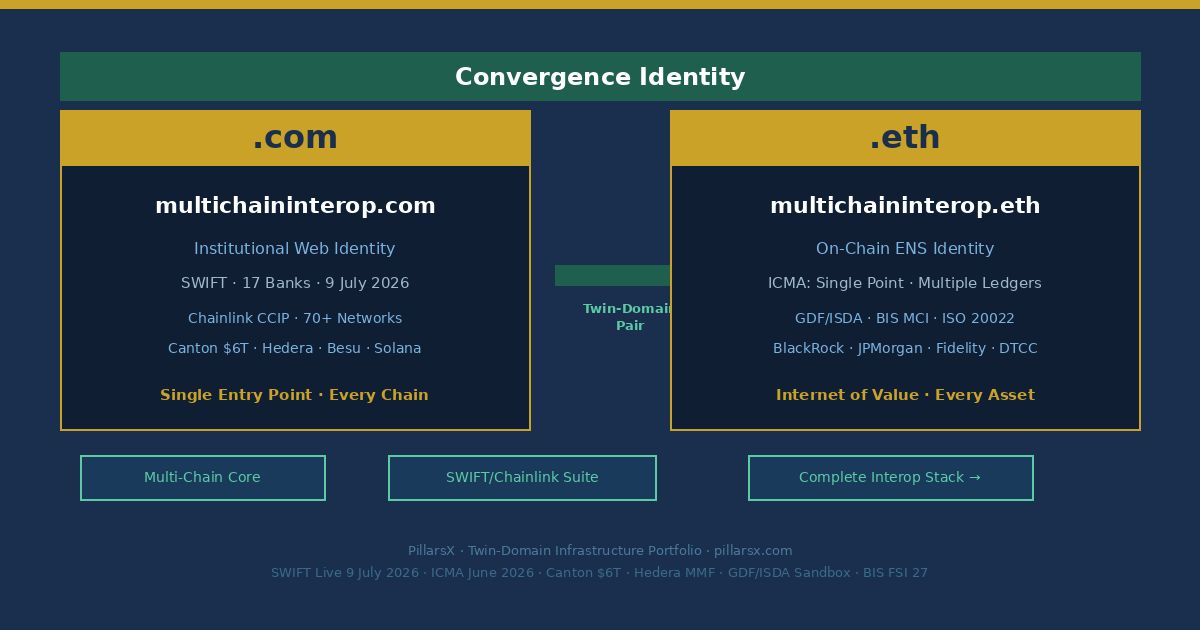
SWIFT's blockchain ledger went live on 9 July 2026 with 17 banks across six continents — ANZ, BNP Paribas, BNY, Citi, DBS, First Abu Dhabi Bank, FirstRand, HSBC, Itaú Unibanco, Lloyds, Mashreq, MUFG, OCBC, Standard Chartered, UBS, UOB — using Hyperledger Besu with Chainlink CCIP as its cross-chain interoperability layer. The International Capital Market Association documented the architecture in its DLT Repo Report of 4 June 2026: "The SWIFT blockchain provides a single point of entry to multiple other distributed ledgers." Chainlink CCIP connects 70+ public and private networks and processed over $18 billion in cross-chain transfer volume in Q1 2026. The GDF/ISDA industry sandbox brings BlackRock, JPMorgan, Fidelity, Franklin Templeton, DTCC, and SWIFT together to evaluate multiple chains — Hedera, XRP Ledger, Ethereum, Solana, Avalanche, Stellar — for tokenized capital markets. Canton Network hosts $6 trillion in tokenized real-world assets across 700+ institutional firms. Broadridge processes $8 trillion in monthly repo volume on Canton infrastructure. Archax tokenized money market funds from BlackRock, Fidelity International, State Street, abrdn, and Legal & General on Hedera with per-second yield streaming live June 11, 2026. DTCC's Collateral AppChain targets Q4 2026 launch for 24/7 collateral management across $114 trillion in securities. The multichaininterop namespace anchors the institutional identity for multi-chain interoperability infrastructure — the cross-chain connectivity standard that SWIFT, Chainlink, ICMA, and DTCC have made the production standard for global institutional finance on 9 July 2026.
For eight years, institutional finance debated which blockchain would win. The debate is over — not because one network prevailed, but because the question turned out to be wrong. The financial system is not converging on a single distributed ledger any more than the internet converged on a single protocol. What the internet demonstrated — and what SWIFT confirmed on 9 July 2026 — is that the value lies not in any individual network but in the infrastructure that connects them. The internet’s value came from TCP/IP, the protocol that made every network speak to every other network. Institutional tokenized finance’s value will come from multi-chain interoperability — the protocol layer that makes every distributed ledger accessible from every institution’s existing infrastructure.
SWIFT’s blockchain ledger went live with 17 banks across six continents on 9 July 2026, built on Hyperledger Besu with Chainlink CCIP as its cross-chain interoperability layer. The International Capital Market Association captured the architectural significance in a single sentence in its June 2026 DLT Repo Report: “The SWIFT blockchain provides a single point of entry to multiple other distributed ledgers.” This is not a vision statement. This is the operational description of a system that is live and processing transactions between institutions that collectively represent the backbone of global finance. Banks do not need to upgrade infrastructure or overhaul legacy processes — they keep their existing SWIFT connections and send standard ISO 20022 messages. The multi-chain layer is invisible to them. The interoperability is automatic.
The GDF/ISDA industry sandbox that brings BlackRock, JPMorgan, Fidelity, Franklin Templeton, DTCC, and SWIFT together confirms the second dimension of this architecture: no single blockchain wins. Hedera, XRP Ledger, Ethereum, Solana, Avalanche, and Stellar are being evaluated simultaneously for different institutional use cases. Canton Network hosts $6 trillion in tokenized real-world assets across 700+ institutions. Hedera settles tokenized money market funds from BlackRock, Fidelity International, State Street, abrdn, and Legal & General through Archax with per-second yield streaming. The conclusion is precise: different networks serve different institutional functions, and multi-chain interoperability is the infrastructure that makes all of them accessible from a single institutional integration point.
multichaininterop.com and multichaininterop.eth anchor the institutional namespace for this multi-chain interoperability infrastructure — the identity layer for the cross-chain connectivity standard that SWIFT, Chainlink, ICMA, and DTCC have confirmed as the production architecture for global institutional tokenized finance.
SWIFT, ICMA and the Production Multi-Chain Standard
The ICMA DLT Repo Report of 4 June 2026 is the most authoritative institutional documentation of the multi-chain interoperability standard. ICMA confirmed that SWIFT’s blockchain “provides a single point of entry to multiple other distributed ledgers” — and that “transactions can be orchestrated between a distributed ledger and the conventional infrastructure, thereby proving a bridge between digital and traditional assets.” This framing collapses the architecture into three precise points: SWIFT becomes the institutional access point into any distributed ledger technology; the same rail can bridge a DLT and legacy infrastructure; and the bank chooses the destination network per transaction. Tech Times
The Chainlink Runtime Environment orchestrates the workflow. CCIP distributes confirmed records to DTCC’s blockchain ecosystem and additional public and private blockchains. This is implemented in nine months, global from day one — banks can now route tokenized asset instructions through CCIP using ISO 20022 messages and attach blockchain wallet addresses directly to payment instructions, settling tokenized currencies, bonds, and equities across banking and blockchain networks in the same message flow. Tech TimesBusiness News Week
The seventeen institutions in the live pilot span six continents. UBS Managing Director for Digital Assets Andreas Kubli identified interoperability as the key variable: “Swift’s ledger is an important industry initiative that can help connect digital money networks.” DBS’s Lim Soon Chong framed the condition for scaling directly: “Interoperability with existing payment rails and application in real world use cases will be critical for these capabilities to scale.” Business News Week
multichaininterop.com is the institutional reference point for this production multi-chain standard — the identity infrastructure for the cross-chain connectivity architecture that SWIFT, Chainlink, and 17 of the world’s largest banks have made operational.
Canton, Hedera and the Multi-Network Production Ecosystem
Canton Network now hosts roughly $6 trillion in tokenized real-world assets, connecting more than 700 institutional firms including Goldman Sachs, DTCC, JP Morgan, Nasdaq, and BNY Mellon. Broadridge processes more than $8 trillion in monthly repo volume on Canton infrastructure. The London Stock Exchange Group launched DiSH, its Digital Settlement House, on Canton in January 2026 — eleven global banks including Bank of America, Barclays, BNP Paribas, Citi, Deutsche Bank, HSBC, JP Morgan, Morgan Stanley, Nomura, Société Générale, and UBS hold a combined 20% stake, settling tokenized commercial bank deposits across multiple currencies 24/7. Chainlink Blog
Hedera operates the parallel institutional settlement layer for tokenized fund products. Archax has built one of the deepest tokenized fund lineups on any public network, tokenizing money market funds from abrdn, BlackRock, Fidelity International, State Street, and Legal & General on Hedera — with per-second yield streaming deployed June 11, 2026, converting income distribution from a scheduled batch process into a continuous on-chain flow. Lloyds Banking Group, abrdn, and Archax worked on a UK-first digital finance initiative where tokenized real-world assets were used as collateral for FX trades — tokenized units of abrdn’s money market fund and tokenized UK gilts issued, transferred, and held on the Hedera Hashgraph network. secsec
The multi-chain architecture is not a future aspiration — it is the production reality where Canton serves institutional repo and equity settlement, Hedera serves tokenized fund products and collateral, and SWIFT’s Chainlink CCIP layer connects both to the 11,000-bank SWIFT network through standard ISO 20022 messages.
BIS MCI Framework and the Multi-Chain Compliance Requirement
The BIS FSI Occasional Paper 27 (April 2026) adds the regulatory dimension that completes the multi-chain interoperability picture. The largest cryptoasset service providers now offer a broad range of products including yield/earn programmes, margin and secured lending, derivatives and token issuance — making them better described as multifunction cryptoasset intermediaries (MCIs). The BIS advocates a mix of entity-based and activity-based regulation — entity-based regulation means the MCI as a whole is subject to oversight, much like a bank is regulated as an institution rather than product by product, including requirements calibrated to the unique risks posed by each MCI’s business model. Pioneer EdgeCMS
For multi-chain interoperability specifically, the MCI regulatory framework creates a compliance requirement that did not previously exist: when an institution operates across multiple chains simultaneously — settling on Canton, tokenizing on Hedera, routing through SWIFT/Chainlink — the consolidated supervision framework that BIS mandates for MCIs requires a unified compliance identity that spans all chains. Multi-chain interoperability infrastructure is not merely a technical convenience — it is a regulatory necessity for any institution that the BIS classifies as an MCI operating across multiple blockchain networks.
multichaininterop.eth is the on-chain resolution address for this multi-chain compliance identity — the ENS anchor where cross-chain settlement attestations, multi-network compliance proofs, and SWIFT/Chainlink routing records are stored as cryptographically verifiable on-chain entries accessible to all participants in the multi-chain institutional ecosystem simultaneously.
multichaininterop in the Complete Interoperability Infrastructure Stack
multichaininterop is the dach-namespace of the PillarsX Interoperability cluster — the overarching multi-chain identity that sits above every specific interoperability function. It connects directly to smartinterop.com/.eth as the smart contract interoperability standard across multiple chains, tokenizedinterop.com/.eth as the tokenized asset interoperability layer, ledgerinterop.com/.eth as the cross-ledger connectivity standard, stablecoininterop.com/.eth as the stablecoin cross-chain interoperability layer, and paymentinterop.com/.eth as the cross-chain payment interoperability standard.
Beyond the Interoperability cluster, multichaininterop integrates with composablesettle.com/.eth as the composable settlement standard that multi-chain interoperability enables, clearingrouter.com/.eth as the routing infrastructure that directs transactions to the optimal chain, dvpatomic.com/.eth as the atomic DVP execution standard across multiple chains, and fxfinality.com/.eth as the cross-chain FX finality layer. Together these namespaces form the complete multi-chain institutional infrastructure — from cross-chain connectivity through composable settlement to atomic DVP execution and FX finality — covering every layer of the multi-chain architecture that SWIFT, Chainlink, Canton, and Hedera are simultaneously building as the production standard for global institutional finance.
Related PillarsX Infrastructure
smartinterop.com & .eth — Smart Interop Identity
smart contract interoperability across multiple chains — CCIP-enabled programmable cross-chain logic
composablesettle.com & .eth — Composable Settlement Identity
composable settlement across Canton, Hedera, and SWIFT rails simultaneously
tokenizedinterop.com & .eth — Tokenized Interop Identity
cross-chain tokenized asset interoperability — BlackRock, Fidelity, State Street funds across Canton and Hedera
ledgerinterop.com & .eth — Ledger Interop Identity
cross-ledger connectivity standard — Hyperledger Besu, Hedera Hashgraph, Canton interoperability
clearingrouter.com & .eth — Clearing Router Identity
cross-chain clearing router directing transactions to optimal settlement network per transaction
Strategic Constellations & Bundle Potential
Bundle 1 — Multi-Chain Interop Coremultichaininterop + smartinterop + tokenizedinterop + ledgerinterop — the complete multi-chain interoperability namespace from dach-identity through smart contract to tokenized asset and ledger connectivity. Targets: SWIFT, Chainlink, DTCC — institutions building the multi-chain institutional infrastructure standard.
Bundle 2 — SWIFT/Chainlink Infrastructure Suitemultichaininterop + composablesettle + clearingrouter + stablecoininterop — the complete SWIFT/Chainlink infrastructure namespace from multi-chain connectivity through composable settlement to stablecoin interoperability. Targets: ANZ, BNP Paribas, BNY, Citi, HSBC — SWIFT blockchain pilot participants building their multi-chain namespace infrastructure.
Bundle 3 — Complete Interoperability Architecturemultichaininterop + smartinterop + tokenizedinterop + ledgerinterop + stablecoininterop + paymentinterop + collateralinterop + margininterop + repointerop + dvpinterop + composablesettle + clearingrouter — the complete PillarsX Interoperability namespace covering every institutional cross-chain function. Targets: SWIFT, Chainlink, GDF/ISDA consortium members — any institution requiring complete namespace control over multi-chain institutional interoperability infrastructure.
· SWIFT — Blockchain Ledger Live · 17 Banks · Hyperledger Besu · Chainlink CCIP (9 July 2026)
· ICMA — DLT Repo Report Part I · "SWIFT Blockchain: Single Point of Entry to Multiple Distributed Ledgers" (4 June 2026)
· GDF/ISDA — Multi-Chain Sandbox · BlackRock, JPMorgan, Fidelity, Franklin Templeton, DTCC, SWIFT
· Canton Network — $6T Tokenized RWA · 700+ Institutions · Goldman, DTCC, JPMorgan, Nasdaq
· Broadridge — $8T Monthly Repo Volume on Canton Infrastructure (2026)
· Archax/Hedera — BlackRock, Fidelity, State Street, abrdn, L&G MMF Tokenization · Per-Second Yield (June 11, 2026)
· DTCC — Collateral AppChain Q4 2026 · $114T Securities · Chainlink CRE
· BIS FSI Paper 27 — MCI Consolidated Supervision · Multi-Chain Compliance Requirement (April 2026)
· Chainlink CCIP — 70+ Blockchains · $18B Q1 2026 Cross-Chain Volume · ISO 20022 Integration
Explore Related
· smartinterop.com & .eth — Smart Interop Identity
· composablesettle.com & .eth — Composable Settlement Identity
· tokenizedinterop.com & .eth — Tokenized Interop Identity
· ledgerinterop.com & .eth — Ledger Interop Identity
· Portfolio Acquisition → /acquire/
Disclaimer:PillarsX is a domain portfolio business. Nothing on this page constitutes legal, financial, or regulatory advice. Domain names do not confer regulatory status, licensing, or compliance certification of any kind. All content is for informational purposes only and does not constitute financial advice.