
OperationalBackstop — The GENIUS Act Liquidity Runway Standard
In 2026, every permitted payment stablecoin issuer must maintain a legally mandated liquidity buffer — separate from reserves, separate from capital. The Operational Backstop is the OCC’s non-negotiable answer to the question: what happens when operations are disrupted and reserves alone are not enough?
Pillar 1: Why the Operational Backstop Is the GENIUS Act’s Most Overlooked Capital Requirement
Under the OCC’s Notice of Proposed Rulemaking (February 25, 2026), the Operational Backstop is a third, independent layer of financial resilience — distinct from reserve assets and distinct from regulatory capital. It is the liquidity runway that keeps a PPSI operational during disruptions, before a crisis reaches the reserve layer.
The OCC proposes that every PPSI hold a designated pool of highly liquid assets as an operational backstop to maintain ongoing operations during a business disruption — separate from the proposed capital requirements. This backstop would be based on the actual total expenses of the PPSI over the past 12 months and held in readily available liquid assets: currency or balances at a Federal Reserve Bank, fully insured demand deposits at a US insured depository institution, or certain US Treasuries. Operational backstop assets may not be the same as reserve assets or any other assets of the PPSI. Morgan Lewis
Three structural requirements define every compliant backstop:
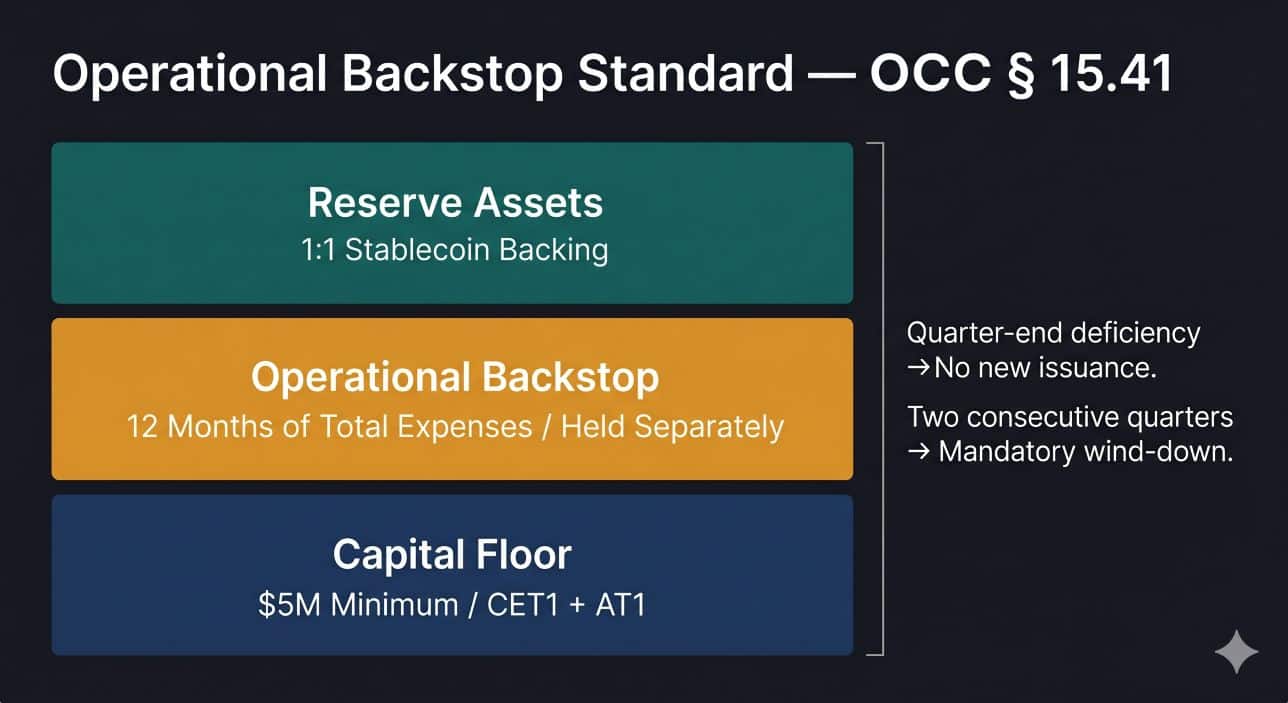
12-Month Expense Coverage: The OCC requires every PPSI to maintain assets equal to 12 months of expenses in highly liquid assets — held separately from reserve assets backing issued payment stablecoins — under proposed § 15.41(b). Davis Polk
Asset Segregation: The operational backstop must be held independently of both reserve assets and all other PPSI assets. Commingling is prohibited — at all times and under all conditions.
Quarterly Enforcement: Failure to meet capital or backstop requirements for one quarter triggers a prohibition on net new issuance. Failure for two consecutive quarters triggers mandatory redemption and wind-down. Mayer Brown
Source: OCC Proposed Rules – Permitted Payment Stablecoin Issuers, Federal Register, March 2, 2026
Pillar 2: The Three-Layer Architecture — Where the Operational Backstop Fits
The GENIUS Act creates a three-layer financial resilience structure for every PPSI. Understanding where the Operational Backstop sits — and what it is not — is critical for compliance teams and institutional counterparties alike.
PPSIs are required to maintain capital proportional to their annual expense levels for ongoing operations, in addition to the operational backstop. The operational backstop must consist only of specified high-quality liquid assets and must be held separately from the PPSI’s reserve assets and other assets. Sullivan & Cromwell
The three layers are structurally independent:
Layer 1 — Reserve Assets: 1:1 backing for all outstanding payment stablecoins. Held for stablecoin holders. Cannot be used for operational purposes.
Layer 2 — Operational Backstop: 12 months of total operating expenses in high-quality liquid assets. This is consistent with the OCC’s approach to chartering national trust banks, which typically requires a pool of liquid assets sufficient to cover six to twelve months of expenses. Gibson Dunn
Layer 3 — Regulatory Capital: Principles-based capital requirement calibrated to each PPSI’s risk profile. Minimum $5 million for de novo issuers, held for at least three years.
Three failure modes define the institutional risk landscape:
Commingling Risk: Any PPSI that holds backstop assets in the same pool as reserve assets is in immediate regulatory violation — regardless of the total asset value.
Calculation Gap: The 12-month backstop is recalculated quarterly on a rolling four-quarter basis. PPSIs that fail to update the calculation at each quarter-end risk silent deficiency — triggering issuance prohibition without warning.
Agentic Verification Gap: In automated settlement environments, counterparties and AI agents must confirm that a PPSI’s operational backstop is current and compliant before executing high-value transactions. Without a machine-readable, on-chain signal confirming backstop status at the moment of execution, every automated interaction carries unresolved operational risk.
This is where OperationalBackstop.com functions as the institutional backstop compliance registry — continuously updated and OCC-mapped. And where OperationalBackstop.eth translates that registry into a blockchain-native status signal, queryable by smart contracts at the exact moment of execution.
Pillar 3: OperationalBackstop as the Resilience Layer of the PillarsX Compliance Stack
Every institutional counterparty engaging with a PPSI needs one confirmed signal before settlement: is the issuer currently solvent at all three layers — reserves, backstop, and capital?
Within the PillarsX infrastructure, OperationalBackstop.com/.eth functions as the resilience layer:
OrderlyRedemption.eth      →  Redemption status confirmed
        ↓                     [Operational Solvency]
OperationalBackstop.eth    →  Liquidity runway verified
        ↓                     [Capital Adequacy]
CoveredCustodian.eth       →  Custodian qualification confirmed
                              [Programmable Compliance]
→ For the complete GENIUS Act solvency framework: Institutional Solvency Suite
Strategic Constellation & Bundle Potential
| Domain | Function | Regulatory Hook |
|---|---|---|
| OperationalBackstop.com/.eth | Liquidity runway registry & quarterly backstop monitor | OCC § 15.41(b) – Operational Backstop |
| OrderlyRedemption.com | Redemption status & circuit breaker signal | GENIUS Act § 4 – Timely Redemption |
| CoveredCustodian.com/.eth | Custodian qualification for reserve monetization | GENIUS Act § 10(a) – Covered Custodian |
| PermittedReserves.com/.eth | Reserve composition & diversification validation | OCC § 15.11(c) – Eligible Reserve Assets |
„All content is for informational purposes only and does not constitute financial advice.“