
PermittedReserves — The Permitted Reserves Standard for OCC-Compliant Institutions
🔴 Regulatory Update — June 15, 2026
Fidelity's FYMXX fund invests exclusively in the GENIUS Act's exact permitted reserve categories — 93-day T-Bills, cash, and Treasury-backed overnight repo — confirming the statutory eligibility framework in live institutional product form
Fidelity launched the Fidelity Reserves Digital Fund (FYMXX) on June 15, 2026, investing exclusively in GENIUS Act permitted reserve assets — US Treasury bills, notes, and bonds with maturities up to 93 days, cash, and overnight repurchase agreements backed by Treasuries — keeping interest-rate risk minimal while meeting the Act's daily and weekly liquidity thresholds. This is now the fourth major institutional fund product (following BlackRock, State Street/Anchorage Digital) built specifically around the permitted reserve eligibility standard, confirming that the statutory definition has become the de facto product specification across the asset management industry. permittedreserves.com & .eth anchors the namespace for this reserve eligibility standard as institutional fund products converge on its exact parameters.
→ Source: 99Bitcoins — Fidelity Launches GENIUS Act Ready Stablecoin Reserve Fund FYMXX, June 15, 2026🔴 Regulatory Update — June 20, 2026
State Street and Anchorage Digital combine institutional cash management with regulated stablecoin infrastructure — permitted reserve asset management consolidates around major fund providers as the market approaches $4 trillion by 2030
State Street Investment Management launched a GENIUS Act-compliant stablecoin fund in partnership with Anchorage Digital, combining decades of institutional cash management expertise with regulated stablecoin infrastructure — following the earlier Galaxy Onchain Liquidity Sweep Fund and BlackRock's comparable tokenized money market fund for stablecoin holders. With global stablecoin issuance projected to reach $1.9 to $4 trillion by 2030, permitted reserve assets under §15.11 are increasingly backed by dedicated institutional fund products rather than generic instruments repurposed for PPSI use. permittedreserves.com & .eth anchors the namespace for this reserve eligibility standard as the institutional fund ecosystem around it consolidates further.
→ Source: CoinGape — State Street Launches GENIUS Act Compliant Stablecoin Fund with Anchorage Digital, June 2026🔴 Regulatory Update — March 2026
Brookings analysis confirms reverse repo collateral carries no maturity restriction distinct from the 93-day T-Bill holding limit — PPSIs could become a cash collateral source for longer-dated Treasury counterparties
While stablecoin issuers' direct holdings of Treasury bills, notes, or bonds are limited to instruments with a remaining maturity of 93 days or less, permissible reserve assets also include overnight reverse repurchase agreements where the issuer acts as cash lender, collateralized by Treasury notes, bills, or bonds subject to overcollateralization — with no apparent maturity restriction on that underlying collateral itself. This distinction means PPSIs could function as a source of cash collateral for counterparties seeking to finance longer-dated Treasury securities, expanding the permitted reserve framework's role in Treasury market liquidity beyond the 93-day eligibility window that governs directly held instruments. permittedreserves.com & .eth anchors the namespace for this full reserve eligibility standard, including the collateral nuance that distinguishes direct holdings from repo-based cash lending.
→ Source: Brookings — Next Steps for GENIUS Payment Stablecoins, March 2026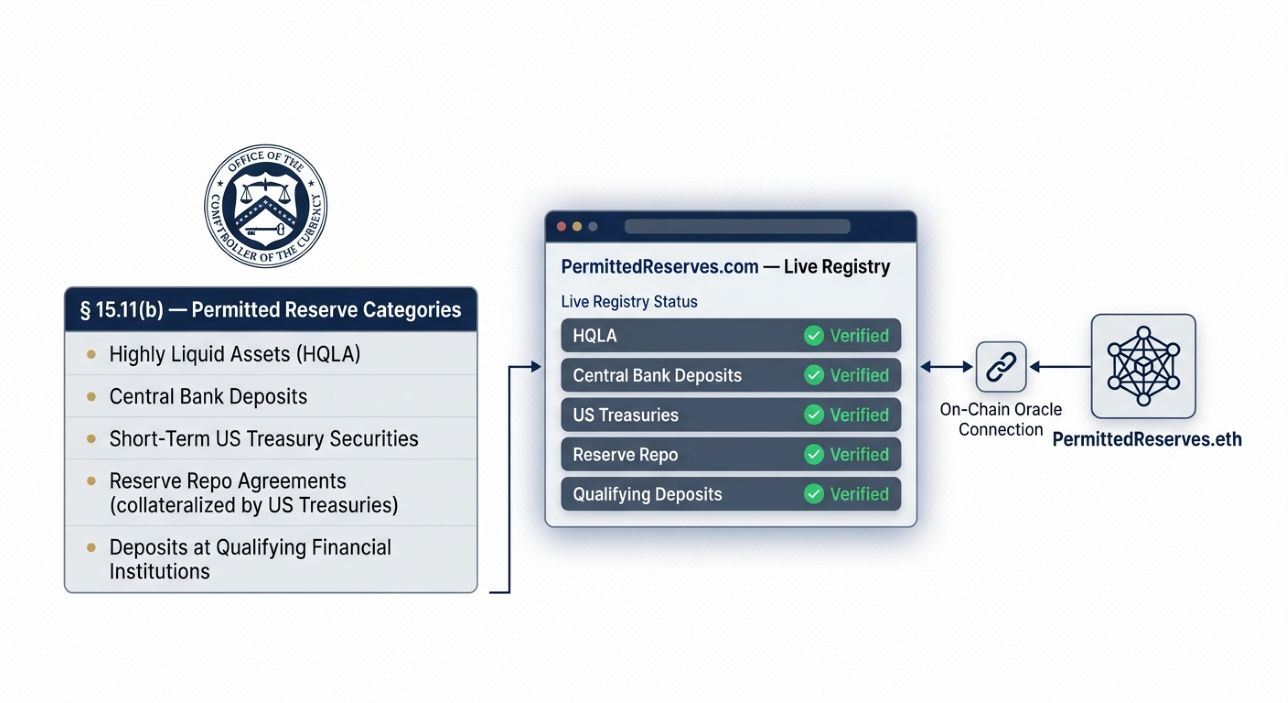
Namespace Acquisition: This Twin-Domain asset is available for institutional acquisition. Inquiries: hq@pillarsx.com
The Legal Boundary Every Stablecoin Issuer Must Operate Within
Under the GENIUS Act (12 U.S.C. § 5903) and the OCC Proposed Rules (Federal Register Vol. 91, No. 40, March 2, 2026), the term Permitted Reserves defines the exact boundaries of what a licensed stablecoin issuer may hold as backing assets. This is not a risk management guideline — it is a hard legal perimeter.
The OCC establishes eight exclusive reserve categories under § 15.11(b):
- Federal Reserve balances
- U.S. Treasury bills, notes, or bonds — remaining maturity of 93 days or less
- Overnight repurchase agreements backed by qualifying T-Bills
- Tri-party or centrally cleared reverse repurchase agreements
- Registered Government Money Market Funds investing solely in permitted assets
- Any similarly liquid federal government asset with prior OCC approval
- Demand deposits at insured depository institutions — subject to concentration limits
- Tokenized versions of categories 1–7 — subject to full OCC pre-approval (§ 15.11(b)(8))
Holding any asset outside this list — regardless of its credit quality or market liquidity — constitutes a regulatory violation. The Permitted Reserves Standard is therefore the single most critical compliance checkpoint for any institution operating under the GENIUS Act framework.
Source: OCC Proposed Rules – Permitted Payment Stablecoin Issuers, Federal Register, March 2, 2026
The Reserve Compliance Gap — When Real-Time Status Becomes a Legal Obligation
The challenge for treasury teams in 2026 is not identifying which asset classes are permitted. The OCC list is clear. The challenge is maintaining continuous proof of compliance — across every position, at every moment, under examination-ready conditions.
Three operational failure modes define the risk:
Concentration Drift: The OCC imposes diversification and concentration limits under § 15.11(c). A treasury position that was compliant at 9:00 AM may breach concentration thresholds by 3:00 PM due to market movements. Without continuous Real-Time Recon, the institution cannot detect or document this breach as it occurs.
Tokenized Asset Ambiguity: Category 8 — tokenized reserve assets — requires explicit OCC pre-approval per asset. An institution holding a tokenized T-Bill from an unapproved issuer is in violation, even if the underlying asset is otherwise permitted. Manual tracking of approval status across a dynamic portfolio is operationally untenable.
Audit Trail Failure: OCC examiners require demonstrable Operational Resilience — the ability to reconstruct the reserve composition at any point in time. Paper-based or spreadsheet-driven processes cannot satisfy this requirement at institutional scale.
This is where PermittedReserves.com operates as the institutional registry layer — a continuously updated, OCC-mapped classification and status API for treasury systems. And this is where PermittedReserves.eth becomes indispensable: it translates that registry into an on-chain source of truth, queryable by smart contracts and AI agents at the exact moment of execution — with cryptographic proof of reserve status at that precise block timestamp.
Source: BIS — Tokenisation and the future of money, 2025 — The BIS framework identifies continuous reserve verifiability as a prerequisite for Unified Ledger Integration across institutional settlement systems.
PermittedReserves as the Compliance Backbone of Institutional Settlement Infrastructure
Every downstream process in a regulated settlement stack depends on one verified input: is this reserve position currently permitted? Without that confirmation, no atomic transaction can be safely initiated, no collateral can be legitimately posted, and no audit trail can be considered complete.
Within the PillarsX infrastructure, PermittedReserves.com/.eth functions as the compliance backbone — the layer that every other component queries before execution:
PermittedReserves.eth      →  Reserve status confirmed [Programmable Compliance]
        ↓
EligibleAsset.eth          →  Asset classification verified [Qualified Digital Asset Custody]
        ↓
fhecollateral.com/.eth     →  Collateral locked with privacy preservation [Confidential Computing]
        ↓
mcpsettle.com/.eth         →  Atomic T0 execution [Atomic Settlement Efficiency]
        ↓
liqrecon.com/.eth          →  Position reconciled [Real-Time Recon]
This architecture embodies Operational Resilience at its deepest level: compliance is not checked once at onboarding — it is verified continuously, at every node, on every transaction.
Strategic constellation & Bundle Potential
“The Reserve Compliance Stack” · For GENIUS Act Licensing
For institutions building toward a Permitted Payment Stablecoin Issuer license, this bundle covers every mandatory compliance layer from asset classification through audit documentation:
| Domain | Function | Regulatory Hook |
|---|---|---|
| PermittedReserves.com/.eth | Live reserve status registry & on-chain oracle | OCC § 15.11(b) – Reserve Categories |
| EligibleAsset.com/.eth | Asset classification gateway | OCC § 15.11(b) – Eligibility Definition |
| coveredcustodian.com/.eth | Custody verification layer | GENIUS Act § 10(a) – Custody Requirements |
| verifiablereserves.com/.eth | Cryptographic Proof-of-Reserve | OCC § 15.11(c) – Diversification & Concentration |
Strategic Acquisition Inquiry
Initiate secure communication with representatives of the IP holder to evaluate the acquisition of this premium infrastructure namespace or its corresponding strategic asset bundle.