
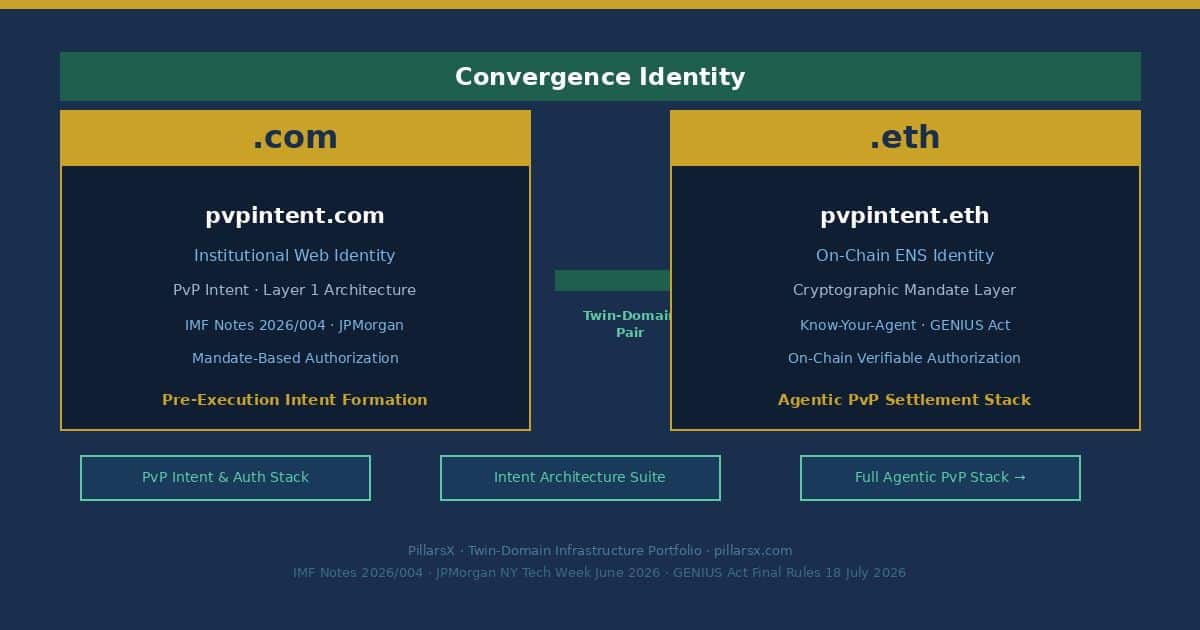
pvpintent.com & .eth — PvP Intent Identity
The IMF published Notes 2026/004 "How Agentic AI Will Reshape Payments" (April 2026), introducing a three-layer framework — intent formation and orchestration, authorization and control, and settlement — as the normative architecture for autonomous AI systems in payment infrastructure. The note identifies mandate-based authorization as the primary mitigation approach: authorization becomes structural rather than transactional, raising direct questions about traceability, consent, and liability under existing legal frameworks. JPMorgan confirmed at NY Tech Week (June 2026) that auditability — knowing why a payment was made and under what policy — is the foundation for any agentic payment system operating at institutional scale. The pvpintent namespace anchors Layer 1 of this architecture specifically for Payment-versus-Payment transactions: the cryptographic intent and mandate layer that must be established and verifiable before any autonomous cross-border currency settlement can execute.
Every financial transaction begins with an intention. A treasury manager decides to convert euros to dollars. A fund manager decides to execute a cross-currency swap. A corporate decides to settle a supplier invoice in a foreign currency. In the human-initiated payment world, this intention is expressed through an explicit instruction — a manual entry, a button pressed, a trade ticket submitted. The institution controls the authorization chain. The intent and the authorization are inseparable from the human who expresses them.
Agentic AI systems break this assumption entirely. A central challenge is the interaction between probabilistic, adaptive decision making and the deterministic requirements of payment infrastructures — specifically, that when AI agents initiate payments, verifying the identity of the agent and the intent of the user becomes significantly more complex, as traditional authorization mechanisms including Know-Your-Customer protocols and multi-factor authentication are designed for human users who explicitly approve transactions. Bank for International Settlements
For Payment-versus-Payment settlement — the atomic exchange of currency against currency across jurisdictions — this challenge is acute. A PvP transaction involves two currencies, two jurisdictions, two legal frameworks, and in the agentic era, potentially zero human approvals at the point of execution. The mandate — the structured, verifiable expression of what the agent is authorized to do, on whose behalf, within what parameters — must be established before execution, not during it. pvpintent.com and pvpintent.eth anchor the namespace for this pre-execution mandate layer: the identity infrastructure where PvP intent is formed, structured, authorized, and made verifiable before atomic settlement begins.
The IMF Three-Layer Framework and the Intent Layer
The IMF’s three-layer framework separates intent formation and orchestration, authorization and control, and settlement — as a normative analytical lens to clarify where agentic capabilities can operate productively and where rule-based safeguards remain essential. This framework is the most authoritative institutional articulation of how agentic payment systems must be structured — and it places the intent layer as the first and most critical component. Chainlink
For PvP settlement specifically, the intent layer carries regulatory weight that exceeds what it carries in domestic payment contexts. A cross-border currency exchange mandated to an AI agent involves foreign exchange risk, Herstatt risk, AML/CFT obligations across multiple jurisdictions, and — under GENIUS Act frameworks — specific authorization requirements for permitted payment stablecoin issuers. The intent cannot be implicit or reconstructed after the fact. It must be explicit, structured, cryptographically bound, and auditable. Authorization becomes structural and mandate-based, which raises questions about traceability, consent, and liability under existing legal frameworks. Bank of England
pvpintent is the namespace for this structural mandate — the identity layer where the authorization chain for autonomous PvP settlement is anchored, referenced, and verified by counterparties, regulators, and compliance systems before any atomic currency exchange executes.
Mandate-Based Authorization and the Know-Your-Agent Standard
The IMF identifies mandate-based authorization as the primary mitigation approach for agentic payment risk — a shift from transactional human approval to structural pre-authorization that defines what an agent may do, within what limits, and under what conditions. This is a fundamental architectural change: instead of a human approving each payment, the human approves a mandate that the agent operates within, and the mandate itself becomes the auditable authorization record.
For PvP settlement in institutional finance, this mandate architecture maps directly onto existing regulatory frameworks. The GENIUS Act requires that permitted payment stablecoin issuers maintain effective AML programs, transaction monitoring, and authorization chains for all settlement activity. High-value payment authorization is the clearest test case for agentic systems — auditability, knowing why a payment was made and under what policy, is the foundation for any agentic payment system, with cross-border payments involving a layered web of jurisdictional rules that vary significantly by market. International Monetary Fund
pvpintent.eth provides the on-chain dimension of this mandate infrastructure: an ENS-resolvable identity where mandate parameters, authorization scope, and intent records can be stored as cryptographically verifiable on-chain entries — machine-readable by the settlement systems and compliance engines that must verify authorization before executing atomic PvP transactions.
Related Infrastructure Series
Strategic Constellations & Bundle Potential
Bundle 1 — PvP Intent & Authorization Stackpvpintent + pvpverify + pvpsettle — Layers 1, 2, and 3 of the complete agentic PvP payment architecture. Targets: IMF/BIS-aligned payment infrastructure providers, JPMorgan Payments, PayPal agentic commerce stack, institutions building mandate-based autonomous settlement systems.
Bundle 2 — Intent Architecture Suitepvpintent + pvpintent + verifiableintent + dvpintent — the complete intent namespace across PvP currency settlement, DVP securities settlement, and verifiable intent standards. Targets: Legal Context Protocol participants (AAA, Google, IBM, Circle, Hedera), Mastercard Agent Pay infrastructure providers.
Bundle 3 — Full Agentic PvP Stackpvpintent + pvpverify + pvpsettle + pvpledger + pvpinterop — the complete five-domain agentic PvP architecture from intent formation through interoperability. Targets: Central banks building next-generation FX settlement infrastructure, G20 cross-border payments program participants, BIS Innovation Hub partners.
· IMF Notes 2026/004 — "How Agentic AI Will Reshape Payments" (April 2026)
· JPMorgan NY Tech Week 2026 — Agentic AI Payment Authorization Framework (June 2026)
· GENIUS Act (S.1582) — AML Authorization Requirements for PPSIs
· Legal Context Protocol (AAA, Google, IBM, Circle, Hedera, Stellar) — Agent Authorization Standards
· BIS Annual Economic Report 2026 — Mandate-Based Controls for Autonomous Payment Systems
· WEF AI Playbook for Financial Services 2026 — Know-Your-Agent Regulatory Framework
Explore Related
· pvpverify.com/.eth — PvP Verify Identity
· pvpsettle.com/.eth — PvP Settlement Identity
· verifiableintent.com/.eth — Verifiable Intent Identity
· agenticdvp.com/.eth — Agentic DVP Identity
· Portfolio Acquisition → /acquire/
Disclaimer:PillarsX is a domain portfolio business. Nothing on this page constitutes legal, financial, or regulatory advice. Domain names do not confer regulatory status, licensing, or compliance certification of any kind. All content is for informational purposes only and does not constitute financial advice.