
rlninterop.com & .eth | RLN Interoperability Identity
🔴 Regulatory Update — June 9, 2026
FinCEN/OFAC PPSI AML/Sanctions NPRM comment period closes — every RLN interoperability node must satisfy BSA monitoring requirements at the moment of cross-network settlement execution
The FinCEN and OFAC joint NPRM of April 8, 2026 implements AML and sanctions compliance requirements for all permitted payment stablecoin issuers under the GENIUS Act. Every cross-network RLN transaction — including tokenized deposit transfers, reserve movements, and multi-jurisdiction settlement flows — must satisfy BSA monitoring requirements simultaneously with settlement execution. The comment period closed June 9, 2026, marking the final step before binding AML rules apply to all RLN interoperability infrastructure by July 18, 2026.
→ Source: Federal Register — FinCEN/OFAC PPSI AML NPRM, April 10, 2026🔴 Regulatory Update — June 9, 2026
GENIUS Act comment period closes today — Regulated Liability Network (RLN) cross-chain interoperability standards enter final rulemaking with July 18 deadline
All GENIUS Act public comment periods officially close June 9, 2026. The Federal Reserve and the OCC are moving to finalize the supervisory framework for multi-bank shared ledgers and tokenized liabilities. Under proposed rules, any commercial bank deposit tokenization operating within a Regulated Liability Network (RLN) must prove secure, friction-free cross-pathway interoperability without compromising AML/CFT isolation. Technical architectures and namespace ownership must be finalized before the binding rules publish on July 18, 2026 — exactly 39 days.
→ Source: Federal Reserve & OCC — Interoperability Standards for Regulated Shared Ledgers, 2026The Regulated Liability Network resolves the settlement problem within a single platform. RLN interoperability resolves the deeper problem: how do institutions participating in different RLN deployments, different DLT platforms, and different jurisdictional frameworks settle with each other without abandoning the regulatory compliance requirements of their home jurisdiction?
This is the defining infrastructure challenge of tokenized finance in 2026. The IMF April 2026 Note confirmed the structural shift away from permissionless networks toward permissioned, institutionally governed shared ledgers — and identified interoperability across ledgers as the critical requirement for realizing the efficiency gains that tokenized settlement promises. The CPMI Cross-Border Payments Interoperability and Extension Task Force established in 2023 exists precisely to address this challenge at the global level, with harmonization targets set for 2026 and 2027.
Every institution connecting to RLN settlement infrastructure across jurisdictions — every bank routing tokenized deposits across the US, UK, EU, and Asian RLN nodes, every PPSI whose redemptions must satisfy both OCC and ECB standards simultaneously, every central bank anchoring settlement with reserve tokens across multiple DLT platforms — must document its RLN interoperability identity in a format that satisfies both Web2 legal documentation standards and Web3 protocol routing requirements simultaneously.
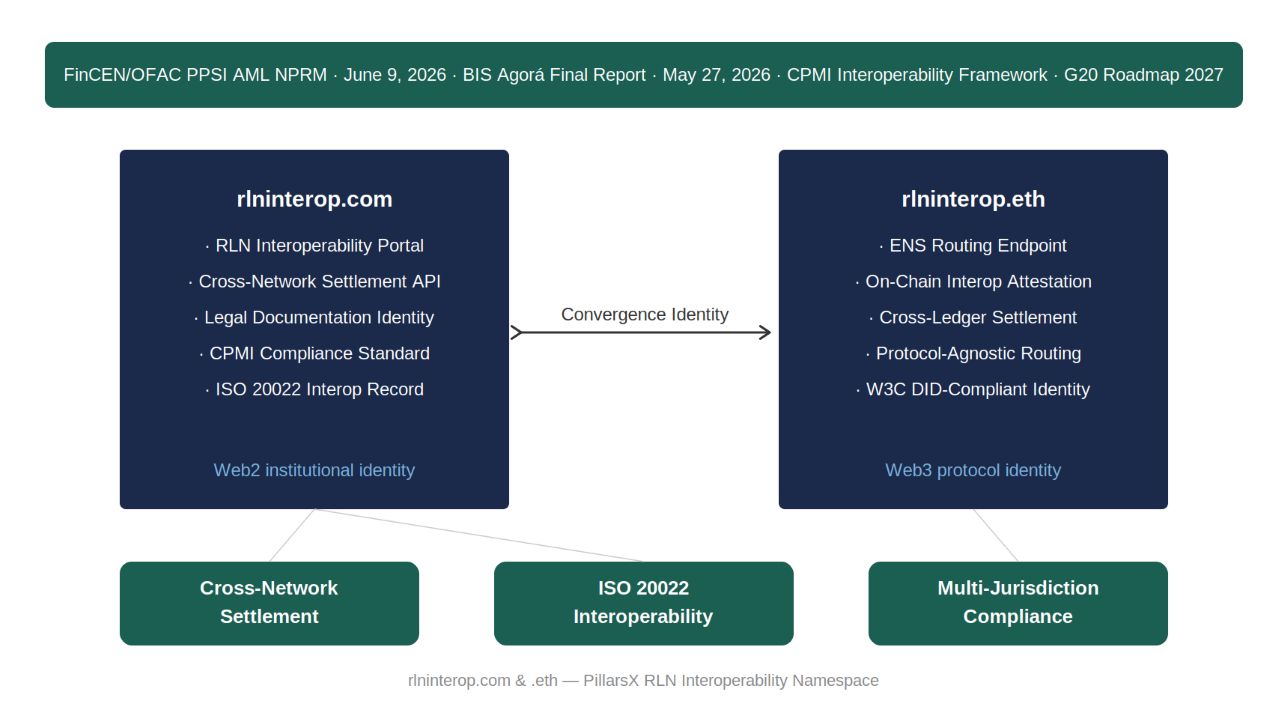
rlninterop.com is the institutional Web2 portal identity for this cross-network interoperability standard — the legal brand that appears in RLN participation agreements, CPMI compliance documentation, and cross-jurisdiction settlement contracts wherever RLN interoperability must be referenced under banking law. rlninterop.eth is the programmable on-chain routing identity — the ENS endpoint that software architects embed directly into cross-network settlement protocol logic to route tokenized liability transactions across different DLT platforms without intermediary DNS dependency.
Together they form the complete Convergence Identity for the RLN interoperability standard that every institution building cross-network tokenized settlement infrastructure must establish.
Namespace Acquisition: This Twin-Domain asset is available for institutional acquisition. Inquiries: hq@pillarsx.com
The Regulatory Foundation of RLN Interoperability
The CPMI established the Cross-Border Payments Interoperability and Extension Task Force in 2023 to deliver tangible enhancements to cross-border payments by end-2027 — with RLN interoperability as one of the core building blocks of the G20 Cross-border Payments Roadmap. The CPMI published harmonised ISO 20022 data requirements in February 2026, establishing the messaging standard that every cross-border settlement system must satisfy to achieve interoperability across jurisdictions. The RLN settlement layer that generates these cross-border transactions is documented at rlnsettle.com & .eth.
The IMF April 2026 Note on Tokenized Finance confirmed the structural importance: the trend is toward permissioned, institutionally governed shared ledgers with interoperability across ledgers managing the operational risks of bilateral connections and creating stronger network economies. This confirmation places RLN interoperability directly within the GENIUS Act framework — the Act requires that payment stablecoin settlement infrastructure be acceptable as a settlement asset to facilitate wholesale payments between banking organizations, and cross-network interoperability is the mechanism through which this multi-institution settlement occurs.
BIS Project Agorá confirmed on May 27, 2026 that atomic multi-currency settlement across eight jurisdictions is achievable — but achieving it requires connecting central bank reserve systems from the US, UK, EU, Japan, Korea, Mexico, Switzerland, and Canada on a shared interoperability standard. The ECB Pontes bridge implementing this standard for European TARGET Services from September 2026 is documented at pontessettle.com & .eth.
The FinCEN/OFAC PPSI AML NPRM of April 2026 — comment period closing June 9, 2026 — defines the BSA compliance obligations that apply at every interoperability node where RLN settlement crosses jurisdictional boundaries. Every cross-network RLN transaction must satisfy AML monitoring requirements at the moment of execution, making compliance documentation at the interoperability layer as operationally critical as the settlement execution itself. The asset interoperability layer connecting tokenized assets across networks is documented at assetinterop.com & .eth.
How RLN Interoperability Architecture Works
RLN interoperability infrastructure operates through three simultaneous layers that rlninterop.com documents and rlninterop.eth routes through.
The network connectivity layer establishes the technical connections between different RLN deployments, DLT platforms, and institutional settlement systems — enabling tokenized liabilities issued on one platform to settle against tokenized liabilities issued on another without requiring a single shared ledger. The CPMI framework identifies this as the foundational interoperability requirement: institutions must be able to connect to the broader RLN ecosystem without abandoning their existing technology infrastructure or regulatory compliance framework. The shared ledger infrastructure that RLN nodes operate on is documented at rlnledger.com & .eth.
The compliance harmonization layer ensures that every cross-network settlement transaction satisfies the regulatory requirements of all participating jurisdictions simultaneously — not sequentially. This is the core operational challenge that RLN interoperability solves: a payment stablecoin redemption that crosses from a US OCC-regulated PPSI to a UK FCA-regulated institution must satisfy GENIUS Act BSA requirements, FCA payment service standards, and CPMI ISO 20022 data requirements in a single atomic transaction. The deposit settlement layer feeding into this cross-jurisdiction flow is documented at depositsettle.com & .eth.
The identity verification layer confirms that every institution participating in cross-network RLN settlement is a regulated entity with documented compliance credentials — preventing unregulated actors from accessing RLN settlement infrastructure through interoperability connections. The RLN concept operates only with digital monies that are considered regulated liabilities, and the identity verification layer is the enforcement mechanism for this requirement at every network boundary. rlninterop.eth is the W3C DID-compliant ENS endpoint for this three-layer architecture — the on-chain routing identity that software architects embed directly into cross-network settlement protocol logic to route tokenized liability transactions across all participating platforms and jurisdictions.
The RLN Interoperability Ecosystem
rlninterop is the cross-network connectivity core of the PillarsX RLN namespace. It connects directly to rlnsettle.com & .eth as the RLN settlement identity whose transactions flow across the interoperability layer, and to rlnledger.com & .eth as the shared DLT ledger infrastructure on which individual RLN nodes operate before connecting through the interoperability layer.
Beyond the RLN cluster, rlninterop integrates with assetinterop.com & .eth as the broader asset interoperability identity for tokenized assets crossing network boundaries, dltinterop.com & .eth as the DLT-specific interoperability identity for cross-ledger technical connectivity, and pontessettle.com & .eth as the ECB Pontes bridge implementing RLN interoperability for European TARGET Services from September 2026.
The complete RLN interoperability stack — rlninterop for cross-network documentation, rlnsettle for settlement execution, rlnledger for ledger infrastructure — provides every institution with a complete RLN namespace that covers legal documentation, technical routing, and on-chain verification simultaneously across all participating jurisdictions.
STRATEGIC CONSTELLATIONS & BUNDLE POTENTIAL
Bundle 1 — “The RLN Interoperability Core” (for Cross-Network Settlement Participants) Target: JPMorgan, Citi, HSBC, BNY Mellon, Deutsche Bank — all institutions operating across multiple RLN deployments and jurisdictions simultaneously. Domains: rlninterop.com/.eth + rlnsettle.com/.eth + rlnledger.com/.eth. Complete RLN namespace — interoperability identity, settlement execution, and ledger infrastructure in one acquisition.
Bundle 2 — “The Cross-Jurisdiction Settlement Stack” (for BIS Agorá and ECB Pontes Participants) Target: Every institution connecting US, UK, EU, and Asian settlement infrastructure through RLN interoperability. Domains: rlninterop.com/.eth + pontessettle.com/.eth + assetinterop.com/.eth. Complete cross-jurisdiction settlement namespace — RLN interoperability, ECB Pontes bridge, and asset interoperability layer.
Bundle 3 — “The Full RLN and Interop Infrastructure” (for Strategic Acquirers) Domains: rlninterop.com/.eth + rlnsettle.com/.eth + rlnledger.com/.eth + assetinterop.com/.eth + dltinterop.com/.eth. The complete PillarsX RLN and interoperability namespace — every layer from cross-network connectivity through settlement execution to DLT infrastructure. This package exists exactly once.
📄 Academic Foundation
Twin-Domain Convergence Identity — The Institutional Framework Behind This Namespace
This Twin-Domain asset is part of the namespace architecture formalized in "Twin-Domain Convergence Identity: A Framework for Institutional Namespace Standards in Regulated Digital Asset Infrastructure" by Rolf Neumayr, PillarsX (SSRN Working Paper, 16 pages, posted June 12, 2026), classified under Monetary Economics — International Financial Flows, Financial Crises, Regulation & Supervision.
→ Read the Paper on SSRNRegulatory Sources
- IMF Note on Tokenized Finance — Interoperability Across Ledgers, April 2026
- BIS Project Agorá Final Report — Multi-Jurisdiction Atomic Settlement, May 27, 2026
- Federal Register — FinCEN/OFAC PPSI AML/Sanctions NPRM, April 10, 2026
- CPMI — Harmonised ISO 20022 Data Requirements, February 2026
- FSB — G20 Cross-Border Payments Roadmap Progress Report, October 2025
- UK Finance — RLN Interoperability Framework, Discovery Phase Report
Explore Related PillarsX Infrastructure
- rlnsettle.com & .eth — RLN Settlement Identity
- rlnledger.com & .eth — RLN Ledger Infrastructure Identity
- assetinterop.com & .eth — Asset Interoperability Identity
- dltinterop.com & .eth — DLT Interoperability Identity
- pontessettle.com & .eth — ECB Pontes Settlement Identity
- depositsettle.com & .eth — Deposit Settlement Identity
- wcbdcsettle.com & .eth — Wholesale CBDC Settlement Identity
- sovereignsettle.com & .eth — Sovereign Settlement Identity
Strategic Acquisition Inquiry
Initiate secure communication with representatives of the IP holder to evaluate the acquisition of this premium infrastructure namespace or its corresponding strategic asset bundle.