stablecoininterop.eth | Stablecoin Interoperability Identity
MiCA's transitional period for existing Crypto-Asset Service Providers expired on 1 July 2026 — all EU CASPs must now operate under full MiCA authorization or cease operations. The IMF has identified significant regulatory divergences between MiCA, the UK draft stablecoin framework, and the US GENIUS Act as creating clear cross-jurisdictional arbitrage risks: reserve composition requirements, direct remuneration prohibitions, and central bank access rules differ materially across all three frameworks. Stablecoin interoperability infrastructure must now navigate three simultaneously active, structurally divergent regulatory regimes — the EU requiring minimum 30% credit institution deposits, the UK in active consultation, and the US GENIUS Act entering Final Rules on 18 July 2026. The stablecoininterop namespace anchors the institutional identity for the cross-jurisdictional interoperability layer that must bridge these three frameworks for any institution operating across EU, UK, and US stablecoin rails simultaneously.
🔴 Regulatory Update — June 23, 2026
Ripple MiCA CASP + EMI dual-license in Luxembourg and BIS Annual Report 2026 converge — stablecoin interoperability becomes a structural compliance requirement as 30-country EEA passport activates and BIS confirms stablecoin fragmentation erodes monetary singleness
Two primary regulatory events on June 23, 2026 simultaneously define stablecoin interoperability as a structural compliance requirement. The BIS Annual Economic Report 2026, Chapter III, confirms that stablecoins in their current form fail the singleness and integrity requirements of the two-tier monetary system — and that fragmented stablecoin networks operating as walled gardens trap liquidity, force costly intermediation across chains, and erode the perception of par value. The BIS defines the solution as interoperable permissioned networks settling in central bank money with compliance embedded at the infrastructure layer. On the same day, Ripple secured preliminary MiCA CASP approval from Luxembourg's CSSF — combined with its existing EMI license, the first fully dual-licensed stablecoin infrastructure covering all 30 EEA countries through a single regulated integration. Circle's CCTP expansion to RWAs, EURC, USYC, and cirBTC in 2026 and Ripple's RLUSD EEA rollout create the first production stablecoin interoperability layer at European regulatory scale. stablecoininterop.com & .eth is the institutional namespace for this convergence — registered before the MiCA July 1 deadline locks the interoperability compliance baseline.
→ Source: BIS Annual Economic Report 2026, Chapter III; Ripple MiCA CASP Luxembourg CSSF, June 23, 2026🔴 Regulatory Update — May 8, 2026
ECB Lagarde confirms Appia interoperability as direct counter-strategy to stablecoin dollarization — MiCA-compliant euro instruments must operate within same interoperable environment as central bank money
ECB President Lagarde confirmed on May 8, 2026 that dollar-denominated stablecoins have through first-mover advantage already become the default settlement asset in tokenized finance. The Appia roadmap sets out the path to a fully interoperable European tokenized financial ecosystem by 2028 — where tokenized deposits and MiCAR-compliant euro instruments operate within the same interoperable environment as central bank money, eliminating the structural dependence on foreign private substitutes. Stablecoin interoperability is the technical standard that makes this convergence possible.
→ Source: ECB Lagarde — Stablecoins and the Future of Money, May 8, 2026Dollar-denominated stablecoins have through first-mover advantage and network effects already become the default settlement asset in tokenized finance. The Appia roadmap sets out the path to a fully interoperable European tokenized financial ecosystem by 2028 — where tokenized deposits and MiCAR-compliant euro instruments can operate within the same interoperable environment as central bank money, so market participants will have no reason to rely on a foreign private substitute by default. The Block
This is the stablecoin interoperability problem in one sentence. USDC operates on Ethereum, Base, Solana and eight other networks. RLUSD operates on XRPL. Qivalis’ MiCA-compliant euro stablecoin will operate on its own infrastructure. ECB Pontes connects to TARGET Services. Each operates under different technical standards, different compliance frameworks, and different settlement finality mechanisms. Without a common stablecoin interoperability standard, every cross-platform stablecoin transaction requires manual reconciliation — precisely the fragmentation that ECB Appia Building Block 1 is designed to eliminate.
MiCA emphasizes standardization — guaranteeing compatibility between blockchain networks is increasingly critical for operational efficiency. Interoperability standards ensure that MiCA-regulated stablecoins can be transferred across platforms without losing their compliance properties. Commodity Futures Trading Commission
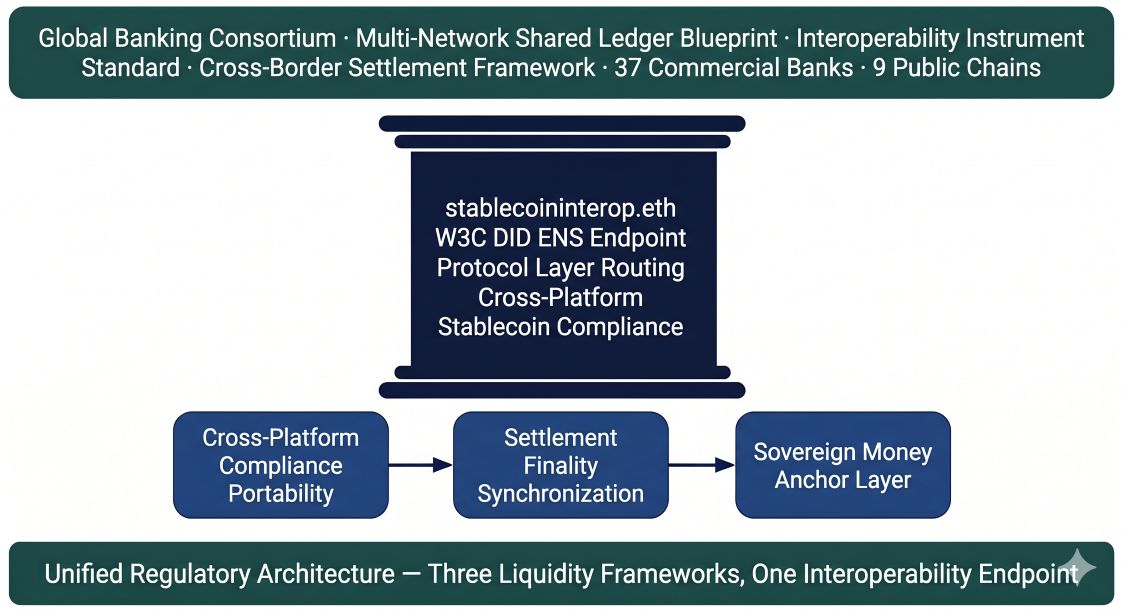
stablecoininterop.eth is the W3C DID-compliant ENS endpoint for the stablecoin interoperability standard — the programmable on-chain routing identity that software architects embed directly into cross-platform stablecoin settlement protocol logic to route regulated stablecoin transactions across different blockchain networks using compatible standards without intermediary DNS dependency.
As the Protocol Layer identity for stablecoin interoperability, stablecoininterop.eth implements what the GENIUS Act, MiCA, and ECB Appia collectively mandate — a single machine-readable endpoint that confirms cross-platform stablecoin compliance status at the exact moment of execution.
The Regulatory Foundation, The Stablecoin Interoperability Architecture, and The Ecosystem
2026 has become the pivotal year when stablecoin regulation shifts from legislation to real-world enforcement — with the GENIUS Act entering its rulemaking phase, MiCA enforcement active across the EU, and enterprises beginning to pursue meaningful real-world applications. Commodity Futures Trading Commission
Three simultaneous regulatory frameworks create the stablecoin interoperability mandate.
The GENIUS Act establishes that payment stablecoins must function as a single interoperable instrument — fully transferable, fungible, and interoperable across platforms and borders. Circle’s OCC comment letter explicitly endorsed this unified interoperable settlement standard as the operational floor every PPSI must meet. Lowenstein Sandler LLP
MiCA requires interoperability standards that guarantee compatibility between blockchain networks — ensuring MiCA-regulated stablecoins maintain their compliance properties when transferred across platforms. The Travel Rule drives real operational cost through data capture, screening, interoperability, and exception handling across counterparties. Commodity Futures Trading Commission
ECB Appia Building Block 1 focuses on asset interoperability and standards — ensuring that tokenized assets including MiCA-compliant stablecoins can be transferred across different DLT platforms using compatible data formats and smart contract standards. The Block
The Stablecoin Interoperability Architecture
The stablecoin interoperability architecture operates through three simultaneous compliance layers that stablecoininterop.eth routes through.
The cross-platform compliance portability layer ensures that AML/CFT restrictions, investor eligibility requirements, and GENIUS Act or MiCA compliance properties attached to a stablecoin follow the asset across platforms. Compliance with the FATF Travel Rule is essential for cross-platform stablecoin transfers — requiring fully interoperable, single-communication Travel Rule protocols that integrate compliance requirements across all participating platforms simultaneously. Commodity Futures Trading Commission
The settlement finality synchronization layer ensures that stablecoin transfers across platforms achieve simultaneous finality — that the sending platform releases the stablecoin at exactly the moment the receiving platform confirms receipt. This is the atomic settlement requirement that assetinterop.com & .eth provides at the asset layer and stablecoininterop.eth implements specifically for regulated stablecoins.
The sovereign money anchor layer connects regulated stablecoins to central bank money settlement through ECB Pontes — ensuring that euro-denominated MiCA stablecoins ultimately settle in central bank money rather than remaining in private stablecoin networks. The Bruegel policy brief for EU finance ministers confirmed: acceleration of ECB Appia to establish interoperability between DLT platforms and ECB payments infrastructure is the direct counter-strategy to stablecoin dollarization risk. The Block
The Stablecoin Interoperability Ecosystem
stablecoininterop.eth is the Protocol Layer interoperability endpoint of the PillarsX stablecoin namespace. It connects directly to assetinterop.com & .eth as the broader ECB Appia Building Block 1 asset interoperability standard that stablecoininterop.eth implements for the regulated stablecoin category specifically.
Beyond the interoperability cluster, stablecoininterop.eth integrates with sovereignsettle.com & .eth as the sovereign central bank money settlement identity that stablecoin interoperability ultimately routes to, emtsettle.com & .eth as the MiCA E-Money Token settlement identity that represents the euro stablecoin layer of the interoperability stack, and programmablecompliance.com & .eth as the automated compliance engine that enforces GENIUS Act and MiCA requirements across every cross-platform stablecoin transaction simultaneously.
Visa, Mastercard, Stripe, Ramp, Meta, Cloudflare, Klarna, Western Union, Intuit, Fiserv, Zelle and PayPal have all integrated or announced plans to adopt stablecoin rails — making cross-platform stablecoin interoperability the defining infrastructure challenge of 2026. WEEX
📄 Academic Foundation
Twin-Domain Convergence Identity — The Institutional Framework Behind This Namespace
This Twin-Domain asset is part of the namespace architecture formalized in "Twin-Domain Convergence Identity: A Framework for Institutional Namespace Standards in Regulated Digital Asset Infrastructure" by Rolf Neumayr, PillarsX (SSRN Working Paper, 16 pages, posted June 12, 2026), classified under Monetary Economics — International Financial Flows, Financial Crises, Regulation & Supervision.
→ Read the Paper on SSRNStrategic Constellations & Bundle Potential
Bundle 1 — “The Stablecoin Interoperability Stack” (for Cross-Platform Stablecoin Infrastructure) Target: Circle, Paxos, Ripple, Qivalis — all operating stablecoins across multiple platforms. Domains: stablecoininterop.eth + assetinterop.com/.eth + emtsettle.com/.eth. Complete stablecoin interoperability namespace — Protocol Layer routing endpoint, ECB Appia asset interoperability standard, and MiCA EMT settlement identity.
Bundle 2 — “The Anti-Dollarization Interoperability Axis” (for European Stablecoin Infrastructure) Target: Qivalis 37-bank consortium, ECB Appia Contact Group participants. Domains: stablecoininterop.eth + sovereignsettle.com/.eth + appiasettle.com/.eth. Complete European stablecoin interoperability namespace — cross-platform routing, sovereign money anchor, and Appia ecosystem identity.
Bundle 3 — “The Full Interoperability Namespace” (for Strategic Acquirers) Domains: stablecoininterop.eth + assetinterop.com/.eth + dltinterop.com/.eth + rlninterop.com/.eth. The complete PillarsX interoperability namespace — stablecoin routing endpoint, ECB Appia asset standard, DLT platform interoperability, and RLN settlement interoperability. This package exists exactly once.
Regulatory Sources
ECB Lagarde — Stablecoins and the Future of Money, May 8, 2026
Bruegel — New Strategy to Contain Stablecoin Risks in the EU, May 2026
BVNK — Global Stablecoin Compliance: GENIUS Act MiCA and Interoperability Standards, 2026
GENIUS Act — Public Law 119-27, Unified Stablecoin Instrument Standard
EU MiCA — Interoperability Standards for Crypto-Asset Service Providers, 2024
Explore related PillarsX infrastructure
→ assetinterop.com & .eth — ECB Appia Asset Interoperability Identity
→ emtsettle.com & .eth — MiCA E-Money Token Settlement Identity
→ sovereignsettle.com & .eth — Sovereign Settlement Identity
→ appiasettle.com & .eth — ECB Appia Settlement Identity
→ programmablecompliance.com & .eth — Programmable Compliance Identity
→ dltinterop.com & .eth — DLT Platform Interoperability Identity
Strategic Acquisition Inquiry
Initiate secure communication with representatives of the IP holder to evaluate the acquisition of this premium infrastructure namespace or its corresponding strategic asset bundle.