
VerifiableReserve — The Verifiable Reserve Standard for Real-Time Institutional Solvency
In 2026, institutional solvency is no longer a quarterly snapshot — Verifiable Reserve is the cryptographic infrastructure that proves asset backing continuously, at the millisecond, on-chain.
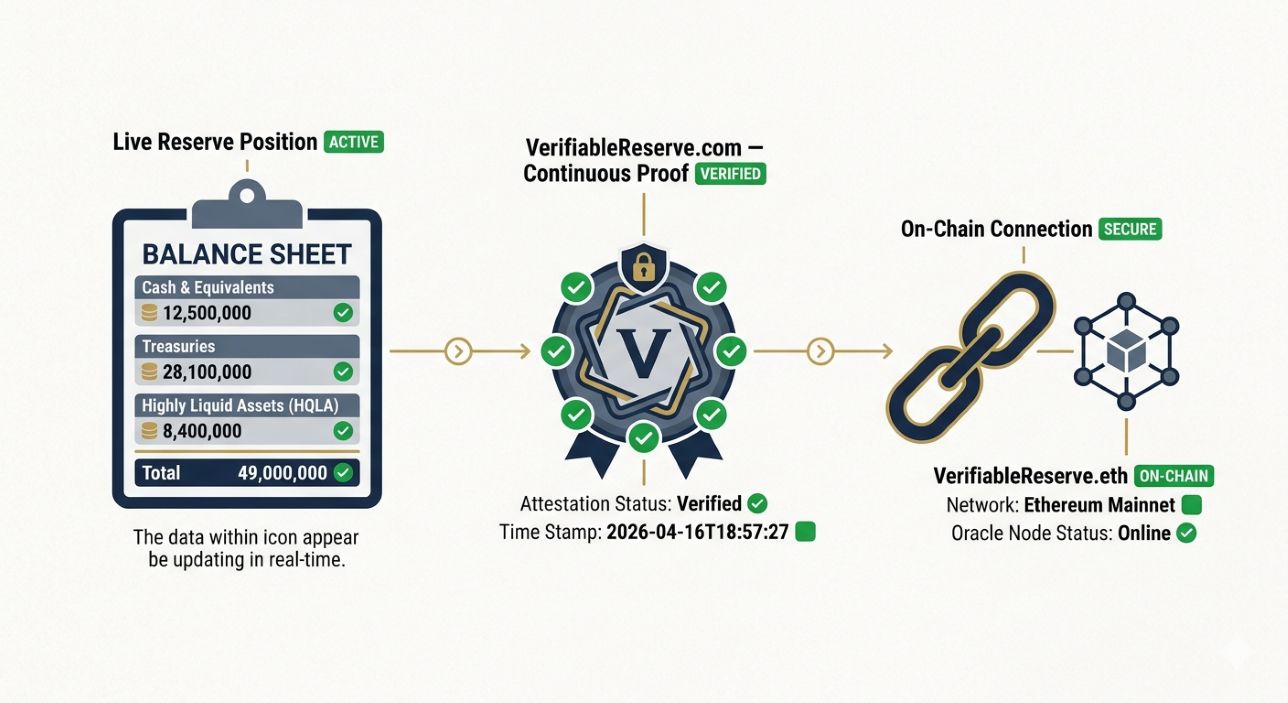
Pillar 1: Why Continuous Reserve Proof Is Now a Legal Obligation
The era of annual audits and quarterly reserve snapshots is over. Under the GENIUS Act (12 U.S.C. § 5903) and the updated Basel IV Framework (2026), financial institutions are no longer permitted to demonstrate solvency through delayed, third-party attestations. The regulatory mandate is unambiguous: reserve proof must be continuous, machine-readable, and cryptographically verifiable at any point in time.
The OCC operationalizes this requirement through two specific obligations under § 15.11:
Continuous Reserve Backing: Every unit of issued payment stablecoin must be backed 1:1 by a permitted reserve asset at all times — not at month-end, not at audit time, but at every moment of every trading day. Any gap between issuance and backing constitutes an immediate regulatory violation.
Real-Time Diversification Compliance: The OCC’s concentration limits under § 15.11(c) require that reserve positions remain within defined thresholds continuously. A position compliant at market open may breach concentration limits by afternoon — and the institution must be able to demonstrate compliance at both moments with equal precision.
The Verifiable Reserve Standard is the direct institutional response: a cryptographically anchored, continuously updated attestation layer that satisfies both mandates simultaneously — eliminating the gap between regulatory requirement and operational reality.
Source: OCC Proposed Rules – Permitted Payment Stablecoin Issuers, Federal Register, March 2, 2026
Pillar 2: The Solvency Gap — When Reserve Proof Fails at the Moment It Matters Most
The operational challenge for treasury teams in 2026 is not the absence of reserve data. Most institutions have reserve positions recorded somewhere. The critical gap is continuous, cryptographically provable attestation — the ability to demonstrate solvency not just to internal teams but to regulators, counterparties, and automated systems at the exact moment they request it.
Three failure modes define the institutional risk landscape:
Shadow Reserve Risk: An institution holds assets it believes qualify as permitted reserves — but lacks a continuous, on-chain verification mechanism. When an OCC examiner requests real-time reserve proof, the institution can produce a spreadsheet but not a cryptographic attestation. Under Programmable Compliance standards, this gap is a direct supervisory failure — regardless of whether the underlying assets were actually compliant.
Concentration Breach: Reserve positions shift continuously with market movements. Without Real-Time Recon at the reserve layer, concentration limit breaches under § 15.11(c) go undetected until the next manual reconciliation cycle — potentially hours or days after the violation occurred. In a 24/7 digital asset environment, this lag is legally untenable.
Counterparty Trust Failure: In atomic settlement environments, counterparties and solver networks require real-time reserve verification before executing high-value transactions. An institution that cannot provide an on-chain, machine-readable reserve signal is effectively excluded from the next generation of institutional settlement infrastructure.
This is where VerifiableReserve.com operates as the institutional attestation registry — a continuously updated, OCC-mapped reserve status layer accessible via API to compliance teams, treasury systems, and external auditors. And this is where VerifiableReserve.eth becomes the critical on-chain layer: translating that registry into a blockchain-native oracle signal, queryable by smart contracts and AI agents at the precise moment of execution — with cryptographic proof of reserve status at that exact block timestamp.
Source: BIS — Tokenisation and the future of money, 2025 — The BIS framework identifies continuous, machine-readable reserve attestation as a foundational requirement for Unified Ledger Integration across institutional settlement systems.
Pillar 3: VerifiableReserve as the Solvency Layer of the PillarsX Settlement Stack
Every atomic transaction in a regulated settlement environment depends on one confirmed input before execution: is the reserve position behind this transaction currently proven, compliant, and cryptographically attested? Without that confirmation, no intent can be safely authorized, no collateral can be legitimately posted, and no settlement can achieve legal finality.
Within the PillarsX infrastructure, VerifiableReserve.com/.eth functions as the solvency backbone — the layer that confirms institutional backing before every downstream process is initiated:
VerifiableIntent.eth       →  Intent authorized & cryptographically bound
        ↓                     [Fiduciary Agentic Responsibility]
VerifiableReserve.eth      →  Reserve position proven & continuously attested
        ↓                     [Programmable Compliance]
EligibleAsset.eth          →  Asset classification confirmed
        ↓                     [Qualified Digital Asset Custody]
PermittedReserves.eth      →  Reserve category validated
        ↓                     [Real-Time Recon]
mcpsettle.com/.eth         →  Atomic T0 execution initiated
                              [Atomic Settlement Efficiency]
→ Every reserve position begins with a verified intent signal: VerifiableIntent — The Verifiable Intent Standard
This architecture delivers Operational Resilience at its most fundamental level: solvency is not assumed at onboarding — it is proven continuously, at every node, on every transaction. An institution that can demonstrate this level of reserve integrity does not merely satisfy regulatory requirements — it becomes the counterparty of choice in every institutional settlement network it participates in.
Strategic Constellation & Bundle Potential
“The Solvency Proof Stack” · For Continuous Reserve Compliance Under GENIUS Act
Designed for institutions requiring uninterrupted, cryptographically provable reserve attestation across every layer of their compliance obligations — from real-time solvency proof through to final audit documentation:
| Domain | Function | Regulatory Hook |
|---|---|---|
| VerifiableReserve.com/.eth | Continuous reserve attestation & on-chain solvency oracle | GENIUS Act § 5903 – 1:1 Reserve Backing |
| PermittedReserves.com/.eth | Live reserve category status & OCC classification registry | OCC § 15.11(b) – Permitted Reserve Assets |
| EligibleAsset.com/.eth | Asset eligibility gateway & classification oracle | OCC § 15.11(b) – Eligible Asset Definition |
| verifiablereserves.com/.eth | Cryptographic Proof-of-Reserve for external audit & counterparty verification | OCC § 15.11(c) – Diversification Requirements |