
VerifiableLedger — The Verifiable Ledger Standard for Cryptographic Audit Integrity
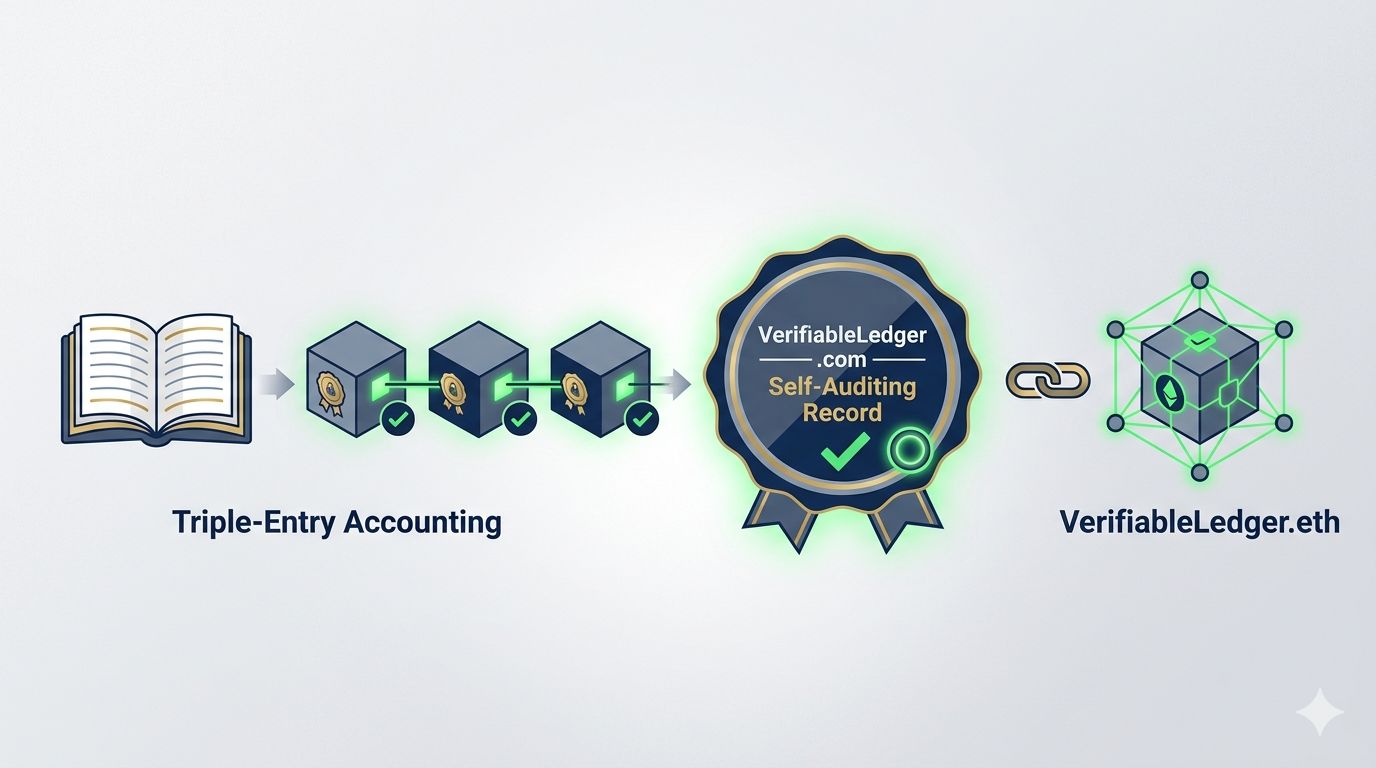
In 2026, a financial ledger must do more than record transactions — the Verifiable Ledger Standard ensures every entry is cryptographically sealed, self-auditing, and forensic-grade traceable from the first millisecond.
Pillar 1: Why Cryptographic Record Integrity Is Now a Regulatory Mandate
The integrity of a financial system is only as strong as its record-keeping layer. Under the GENIUS Act (12 U.S.C. § 5903) and the 2026 Global Digital Asset Standards, institutions are no longer permitted to rely on traditional double-entry accounting systems for digital asset operations. The regulatory mandate is clear: every transaction must be recorded in a format that is immutable, time-stamped, and independently verifiable — without requiring full access to private database infrastructure.
…under the GENIUS Act (12 U.S.C. § 5903) and the 2026 Global Digital Asset Standards…”
The OCC operationalizes this requirement through two specific obligations:
Forensic-Grade Audit Trail: Every transaction touching a permitted reserve asset must generate an immutable, cryptographically sealed record. OCC examiners must be able to reconstruct the complete history of any position at any point in time — not from internal spreadsheets, but from a tamper-proof, independently verifiable source of truth.
Privacy-Preserving Auditability: Institutions must satisfy regulator verification requirements without exposing sensitive proprietary data to public ledgers. The Confidential Computing mandate requires that ledger integrity be publicly provable while transaction details remain protected — a requirement that traditional accounting systems are architecturally incapable of meeting.
The Verifiable Ledger Standard is the direct institutional response: a cryptographically anchored, self-auditing record-keeping layer that satisfies both mandates simultaneously — delivering forensic-grade transparency to regulators without compromising institutional confidentiality.
Source: OCC Proposed Rules – Permitted Payment Stablecoin Issuers, Federal Register, March 2, 2026
Pillar 2: The Audit Integrity Gap — When Record-Keeping Fails Under Examination
The operational challenge for compliance teams in 2026 is not a lack of transaction data. Every institution records its movements. The critical gap is cryptographic provability — the ability to demonstrate to regulators, counterparties, and automated audit systems that every record is genuine, unaltered, and traceable to its exact point of origin.
Three failure modes define the institutional risk landscape:
Retroactive Data Manipulation Risk: Traditional database systems allow authorized users to modify historical records — intentionally or accidentally. Without cryptographic sealing at the moment of entry, no institution can guarantee the forensic integrity of its transaction history. Under OCC supervisory standards, a ledger that cannot prove its own immutability is a ledger that cannot be trusted.
Cross-Border Reconciliation Failure: In multi-ledger, multi-jurisdiction environments, reconciling transaction histories across disparate systems is operationally complex and legally unreliable. Without a unified Interoperability Standard at the record-keeping layer, cross-border audit trails fragment — creating gaps that regulators in multiple jurisdictions can challenge simultaneously.
Privacy vs. Transparency Conflict: Institutions face an impossible choice with traditional systems: either expose sensitive transaction details to satisfy audit requirements, or protect proprietary data and fail regulatory transparency mandates. Confidential Computing resolves this conflict — but only when implemented at the ledger layer itself.
This is where VerifiableLedger.com operates as the institutional record integrity layer — a continuously sealed, cryptographically anchored transaction registry accessible via API to compliance teams and external auditors. And this is where VerifiableLedger.eth becomes indispensable: it translates the ledger’s state-proofs into a blockchain-native oracle, allowing regulators and counterparties to verify the complete integrity of the record chain without requiring access to private database clusters.
Source: BIS — Tokenisation and the future of money, 2025 — The BIS framework identifies cryptographically provable record integrity as a foundational requirement for cross-border reconciliation across Unified Ledger infrastructures.
Pillar 3: VerifiableLedger as the Integrity Layer of the PillarsX Settlement Stack
Every atomic transaction in a regulated settlement environment generates one non-negotiable output: an immutable, cryptographically sealed record that proves what happened, when it happened, and under whose authorization it occurred. Without this record layer, no downstream audit can be completed, no regulatory examination can be satisfied, and no cross-border reconciliation can achieve legal finality.
Within the PillarsX infrastructure, VerifiableLedger.com/.eth functions as the integrity backbone — the layer that seals every transaction into a forensic-grade, tamper-proof record immediately upon execution:
VerifiableIntent.eth       →  Intent authorized & cryptographically bound
        ↓                     [Fiduciary Agentic Responsibility]
VerifiableReserve.eth      →  Reserve position proven & attested
        ↓                     [Programmable Compliance]
mcpsettle.com/.eth         →  Atomic T0 execution initiated
        ↓                     [Atomic Settlement Efficiency]
VerifiableLedger.eth       →  Transaction sealed & forensic record created
        ↓                     [Confidential Computing / Real-Time Recon]
VerifiableSettle.eth       →  Final cryptographic finality confirmed
                              [Operational Resilience]
This architecture delivers Operational Resilience at its most complete level: every action is not only executed atomically — it is permanently sealed into a cryptographically provable record the moment it occurs. An institution operating on this stack does not merely satisfy audit requirements — it makes retroactive manipulation architecturally impossible.
→ Every ledger entry begins with a cryptographically proven reserve position: VerifiableReserve — The Verifiable Reserve Standard
Strategic Constellation & Bundle Potential
“The Audit Integrity Stack” · For Forensic-Grade Compliance Under OCC Examination
Designed for institutions requiring cryptographically provable, examiner-ready record integrity across every layer of their digital asset operations — from transaction sealing through to cross-border reconciliation:
| Domain | Function | Regulatory Hook |
|---|---|---|
| VerifiableLedger.com/.eth | Cryptographic record sealing & self-auditing transaction registry | OCC – Forensic-Grade Audit Trail |
| VerifiableReserve.com/.eth | Continuous reserve attestation backing every ledger entry | GENIUS Act § 5903 – 1:1 Reserve Backing |
| fheledger.com/.eth | Privacy-preserving ledger layer via Confidential Computing | OCC – Confidential Computing Mandate |
| UnifiedLedger.com/.eth | Cross-system ledger consolidation & interoperability layer | BIS Unified Ledger Framework |