
MCPTreasury — The MCP Treasury Standard for AI-Native Institutional Capital Management (Twin-Bundle: .com + .eth)
The Model Context Protocol has established itself as the universal communication layer of agentic finance. MCP Treasury is the institutional standard that makes AI-native reserve disposition, capital management, and T0-compliant treasury operations verifiable, legally binding, and examination-ready.
Pillar 1: Why MCP Treasury Infrastructure Is the First Mandatory Step in Agentic Finance
Treasury operations are the entry point of every institutional financial workflow. Before a single settlement instruction is issued, before a reserve asset is transferred, before a stablecoin redemption is processed — a treasury disposition mandate must be authorized. In a world where AI agents are the primary operators of institutional capital, that authorization layer must be natively compatible with the Model Context Protocol.
The GENIUS Act (2026) operationalizes this requirement through two specific obligations that directly govern treasury infrastructure:
Reserve Asset Monetization Capacity: Under OCC Proposed Rule §15.11, every Permitted Payment Stablecoin Issuer must demonstrate the operational capacity to monetize all reserve asset types it maintains — including U.S. Treasury bills, notes, bonds, and reverse repurchase agreements. In an MCP-driven environment, where AI agents manage reserve portfolios in real time, this monetization capacity must be protocol-native. An institution whose treasury infrastructure cannot communicate directly with MCP-based agent systems cannot demonstrate monetization capacity at agent speed — making regulatory compliance architecturally impossible.
Weighted Average Maturity Compliance: The OCC requires that reserve asset portfolios maintain a weighted average maturity of no more than 20 days. This constraint demands continuous, automated portfolio monitoring and real-time rebalancing capability. Manual treasury operations cannot meet this requirement at the scale and speed that permitted stablecoin issuers will operate in 2026 and beyond. MCP Treasury infrastructure is the protocol-native response: a direct, agent-compatible disposition layer that monitors, adjusts, and documents reserve composition in real time — maintaining WAM compliance as an automated operational standard rather than a periodic audit function.
The MCPTreasury Standard is the institutional answer: a natively agentic, OCC-aligned treasury disposition layer that connects AI agent mandates directly to compliant capital management infrastructure — before a single settlement instruction reaches execution.
MCPTreasury.eth — ENS Relevance: 9/10
In a world of over 10,000 public MCP servers and 97 million monthly SDK downloads, mcptreasury.eth is the only on-chain identity that permanently reserves “Treasury via MCP” as an institutional namespace. While mcptreasury.com represents the legal identity, API portal, and regulatory liability address for treasury operations, mcptreasury.eth is the verifiable on-chain treasury disposition endpoint — the address an agentic system targets when a capital mandate must be cryptographically authorized before downstream settlement execution begins.
The distinction from a generic treasury API is fundamental: any institution can build a treasury endpoint. No institution can replicate mcptreasury.eth. This ENS identity is the Sovereign Liquidity Rail entry point of institutional agentic capital management — immutable, censorship-resistant, and directly composable with the smart contract logic that governs reserve asset allocation, stablecoin issuance, and redemption workflows.
Institutions that take Fiduciary Agentic Responsibility seriously require both layers: .com for the regulatory identity, compliance interface, and audit trail, .eth for on-chain mandate authorization with cryptographic Proof of Intent before any capital movement is initiated. Together, they form the complete Convergence Identity — delivering Front-to-Back conformity and brand sovereignty in agentic treasury management within a single Twin-Bundle.
Pillar 2: The Agentic Treasury Gap — When AI Agents Cannot Authorize Capital Before Execution
The operational challenge for treasury teams deploying AI agents in 2026 is not the capability of the agents themselves. MCP-based systems can monitor reserve portfolios, calculate WAM exposure, identify rebalancing requirements, and initiate disposition instructions with a precision and speed no legacy treasury system can match. The critical gap is authorization integrity — the ability to connect an AI agent’s treasury mandate directly to institutional-grade, OCC-compliant capital infrastructure without creating liability gaps in the authorization chain.
Three failure modes define the institutional risk landscape:
Mandate Authorization Ambiguity: In multi-agent MCP environments, treasury instructions may originate from orchestration agents, pass through compliance validation agents, and reach execution agents before any capital movement occurs. Without a standardized MCP Treasury Standard applied consistently at the disposition layer, the authorization chain fragments — creating precisely the liability exposure that OCC examiners will target under the CLARITY Act’s Fiduciary Agentic Responsibility provisions. An instruction that cannot be traced back to a verified, protocol-native mandate is an instruction that cannot be examined.
Reserve Composition Signal Loss: As treasury instructions pass through non-native protocol layers, the metadata that defines reserve eligibility — asset class, maturity, counterparty classification, monetization status — is stripped or corrupted before reaching the settlement layer. Under OCC §15.11, every reserve asset transaction must be traceable to a compliant disposition decision. A treasury infrastructure that loses compliance metadata in transit does not just create operational risk — it creates a regulatory gap that no post-hoc audit can close.
WAM Monitoring Discontinuity: Institutions managing reserve portfolios across multiple asset classes and maturity buckets require continuous, real-time WAM monitoring to maintain the 20-day threshold required by the OCC. Legacy treasury systems operating in batch cycles — even daily — cannot provide the continuous monitoring that MCP-based reserve management demands. Without a protocol-native treasury layer, institutions face a structural choice: under-utilize their MCP agents to match legacy monitoring cadence, or exceed OCC WAM thresholds as agent-speed portfolio adjustments outpace manual oversight.
This is where MCPTreasury.com operates as the institutional MCP disposition layer — a natively protocol-compatible, regulatory-mapped treasury interface that connects MCP-based AI agents directly to compliant capital management infrastructure. And this is where MCPTreasury.eth becomes indispensable: translating every MCP-authorized treasury mandate into a blockchain-native disposition proof — verifiable at the moment of OCC examination, traceable to the originating agent authorization.
Source: BIS — “Tokenisation and the Future of Financial Market Infrastructure”, 2025 — The BIS framework identifies protocol-native treasury disposition as a foundational requirement for institutions operating reserve portfolios on programmable ledger infrastructure.
Pillar 3: MCPTreasury as the Disposition Layer of the PillarsX Agentic Settlement Stack
Every AI-initiated capital movement in a regulated environment requires one verified starting point: a direct, protocol-native treasury mandate that authorizes the downstream settlement chain before any asset transfer begins. Without that starting point, every autonomous instruction enters the execution layer without a verified authorization anchor — creating the compliance gaps that OCC §15.13 Risk Management requirements are specifically designed to prevent.
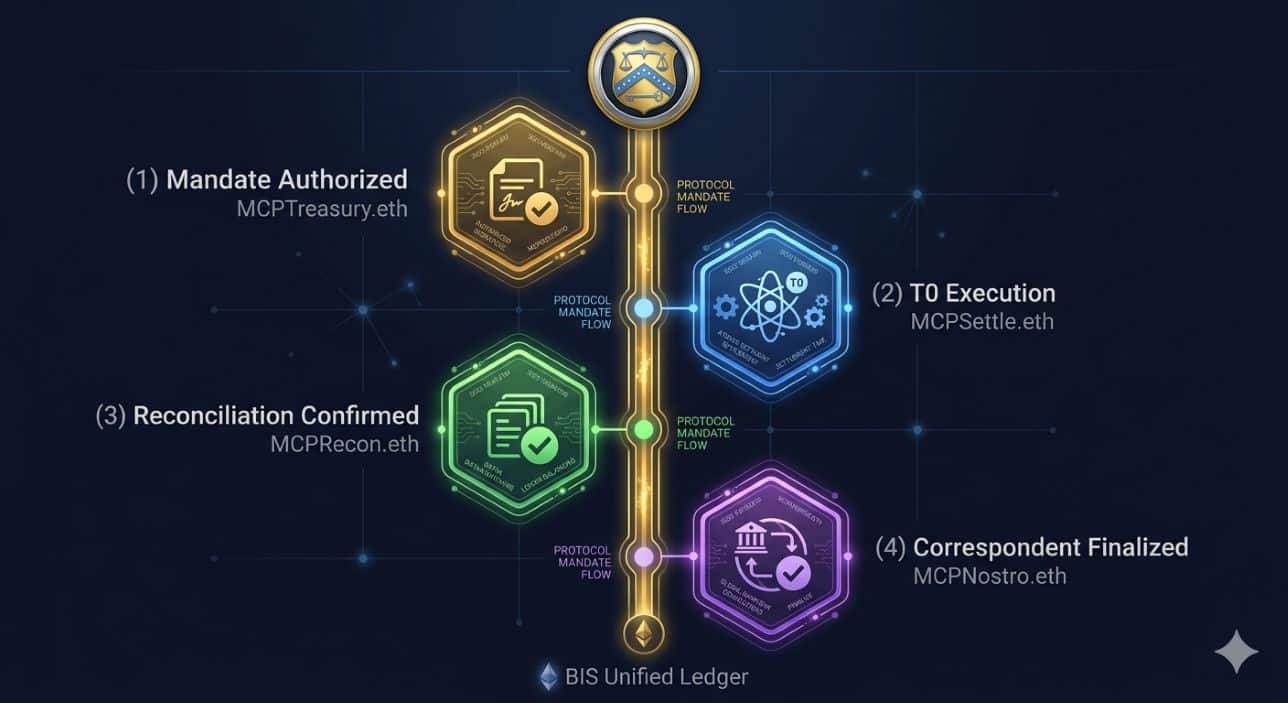
Within the PillarsX infrastructure, MCPTreasury.com/.eth functions as the disposition layer — the first step in a fully documented, examination-ready agentic settlement chain:
MCPTreasury.eth     →  Treasury mandate authorized & cryptographically bound
        ↓               [Fiduciary Agentic Responsibility + WAM Compliance]
MCPSettle.eth       →  MCP-native atomic T0 execution initiated
        ↓               [Atomic Settlement Efficiency]
MCPRecon.eth        →  Real-Time Reconciliation & compliance proof confirmed
        ↓               [Operational Resilience]
MCPNostro.eth       →  Cross-border correspondent settlement finalized
                        [Interoperability Standard]
MCPTreasury is not the end of the workflow — it is the authorized beginning. Every downstream settlement, reconciliation, and correspondent operation inherits its regulatory validity from the treasury mandate that MCPTreasury issues and cryptographically documents.
→ The next step in the execution chain: MCPSettle — The MCP Settlement Standard
MCPTreasury Within the PillarsX MCP Series
MCPTreasury is the Disposition Layer — the authorized entry point of a complete institutional MCP infrastructure series:
| Layer | Domain | Function |
|---|---|---|
| Disposition | MCPTreasury.com/.eth | Treasury mandate & reserve authorization |
| Execution | MCPSettle.com/.eth | Atomic T0 settlement via MCP |
| Reconciliation | MCPRecon.com/.eth | Real-Time Recon & compliance proof |
| Correspondent | MCPNostro.com/.eth | Cross-border correspondent settlement |
Each domain in this series is a standalone strategic asset — and an indispensable building block of the complete Operational Resilience architecture that the OCC requires of institutions operating in agentic finance.
Strategic Constellation & Bundle Potential
“The Agentic Treasury Stack” · For MCP-Native Institutional Reserve Management
Designed for institutions deploying MCP-based AI agents in treasury and reserve management roles — ensuring every protocol-native disposition mandate is compliant, documented, and cryptographically traceable before execution begins:
| Domain | Function | Regulatory Hook |
|---|---|---|
| MCPTreasury.com/.eth | MCP-native treasury disposition & reserve mandate layer | GENIUS Act §4(a) – Reserve Asset Requirements |
| MCPSettle.com/.eth | Atomic T0 execution of treasury-authorized instructions | GENIUS Act – T0 Settlement Mandate |
| MCPRecon.com/.eth | Real-time reconciliation of reserve positions post-execution | OCC §15.14 – Audits & Reporting |
| ProgrammableCompliance.com/.eth | Embedded compliance logic at the treasury disposition layer | CLARITY Act – Programmable Compliance |
“The Reserve Integrity Bundle” · For Stablecoin Issuers Under OCC §15.11
Designed for Permitted Payment Stablecoin Issuers managing reserve asset portfolios under OCC supervision — ensuring WAM compliance, reserve eligibility, and monetization capacity are continuously documented through protocol-native treasury infrastructure:
| Domain | Function | Regulatory Hook |
|---|---|---|
| MCPTreasury.com/.eth | Reserve disposition mandate & WAM monitoring layer | OCC §15.11 – Reserve Asset Requirements |
| VerifiableReserve.com/.eth | On-chain proof of reserve composition & eligibility | OCC §15.14 – Reserve Reporting |
| MCPTBills.com/.eth | T-Bill specific MCP treasury operations layer | GENIUS Act – Eligible Reserve Assets |
| EligibleAsset.com/.eth | Asset eligibility verification before reserve inclusion | OCC §15.11 – Eligible Asset Classification |
What is the difference between MCPTreasury.com and MCPTreasury.eth?
MCPTreasury.com is the institutional Web2 layer — the legal identity, API portal, compliance interface, and regulatory liability address for MCP-native treasury operations. MCPTreasury.eth is the on-chain Web3 layer — the verifiable ENS endpoint where treasury mandates are cryptographically authorized before any downstream capital movement begins. Institutions require both to achieve Front-to-Back conformity: .com for regulatory documentation and audit trails, .eth for on-chain Proof of Intent that satisfies OCC examination requirements under the CLARITY Act. Together, they form the complete Convergence Identity — the MCPTreasury Twin-Bundle.
How does MCPTreasury relate to OCC §15.11 Reserve Asset Requirements?
OCC §15.11 requires every Permitted Payment Stablecoin Issuer to maintain a reserve asset portfolio with a weighted average maturity of no more than 20 days, demonstrate continuous monetization capacity across all reserve asset types, and maintain comprehensive documentation of reserve composition and eligibility.
MCPTreasury provides the protocol-native infrastructure layer that makes these requirements operationally achievable at agent speed: continuous WAM monitoring, real-time reserve eligibility verification, and cryptographically documented disposition mandates that satisfy OCC audit and reporting obligations under §15.14.
Why does treasury disposition need to happen before settlement in an MCP environment?
In a multi-agent MCP architecture, settlement instructions execute at a speed and scale that makes post-hoc authorization validation operationally impossible. Without a verified treasury disposition mandate at the protocol layer, settlement agents operate without an authorization anchor — creating the Mandate Authorization Ambiguity that regulators specifically target under Fiduciary Agentic Responsibility provisions of the CLARITY Act. MCPTreasury ensures that every settlement instruction executed by MCPSettle can be traced to a cryptographically verified, OCC-compliant treasury mandate — making the entire downstream execution chain examination-ready from the first agent instruction.
All content is for informational purposes only and does not constitute financial advice.