
RepoLedger — The Repo Ledger Standard for Atomic Repurchase Agreement Settlement
The global repo market moves trillions daily on trust and timing — the Repo Ledger Standard replaces both with cryptographic certainty, atomic execution, and a continuously verifiable audit trail.
Pillar 1: Why Cryptographic Repo Settlement Is Now a Regulatory Imperative
The repurchase agreement market — the backbone of short-term institutional liquidity — operates on a foundation of trust, timing, and counterparty relationships that have remained largely unchanged for decades. Under the GENIUS Act (12 U.S.C. § 5903), the OCC Proposed Rules (Federal Register, March 2, 2026), and the DTCC Risk Framework Phase 2 (2026), this foundation is being replaced by a new mandatory standard: every repo transaction involving permitted reserve assets must achieve atomic, cryptographically verifiable settlement with a continuous, examiner-ready audit trail.
The OCC operationalizes this requirement through two specific obligations:
Atomic Repo Settlement: Under § 15.11(b)(3) and (4) of the GENIUS Act implementing rules, permitted payment stablecoin issuers may hold overnight repurchase agreements as reserve assets — but only under strictly defined conditions. These include tri-party or centrally cleared structures, overnight maturity limits, and T-Bill collateral requirements. Every repo transaction that fails to meet these conditions at the moment of execution creates an immediate reserve compliance violation — regardless of its historical track record.
Continuous Collateral Verification: The OCC requires that repo collateral — T-Bills, Treasury notes, and qualifying government securities — be continuously verified as eligible, correctly valued, and properly overcollateralized throughout the life of every repo agreement. Static collateral verification at initiation is insufficient. The Repo Ledger Standard ensures continuous, cryptographically proven collateral compliance from initiation through maturity.
The Repo Ledger Standard is the direct institutional response: a cryptographically anchored, continuously verified repo settlement layer that satisfies both mandates simultaneously.
Source: OCC Proposed Rules – Permitted Payment Stablecoin Issuers, Federal Register, March 2, 2026
Pillar 2: The Repo Settlement Gap — When Speed and Compliance Cannot Keep Pace With Each Other
The operational challenge for repo desks in 2026 is not transaction volume or counterparty access. Modern repo markets process trillions in daily volume with established counterparty networks and well-understood legal frameworks. The critical gap is simultaneous speed and verifiability — the ability to execute repo transactions at institutional speed while maintaining continuous, cryptographically provable compliance with every OCC requirement governing permitted reserve assets.
Three failure modes define the institutional risk landscape:
Collateral Eligibility Drift: A repo transaction is initiated with qualifying T-Bill collateral — but market movements alter the collateral’s remaining maturity, value, or concentration status before the agreement matures. Without Real-Time Recon at the collateral layer, the institution continues holding a repo position whose collateral no longer meets OCC § 15.11(b) requirements — accumulating reserve compliance violations with every passing hour.
Settlement Timing Risk: In non-atomic repo settlement environments, cash and securities transfer in sequential steps — creating a window of counterparty exposure between delivery and payment. Under OCC supervisory standards, this timing gap constitutes residual Herstatt risk that Atomic Settlement Efficiency mandates explicitly prohibit for permitted reserve asset transactions.
Audit Trail Fragmentation: Repo transactions span multiple systems — trading platforms, collateral management engines, settlement infrastructure, and accounting ledgers. Without a unified Repo Ledger Standard maintaining a continuous, cryptographically sealed audit trail across every system, OCC examiners cannot reconstruct the complete history of a repo position — creating examination gaps that trigger supervisory action regardless of underlying compliance.
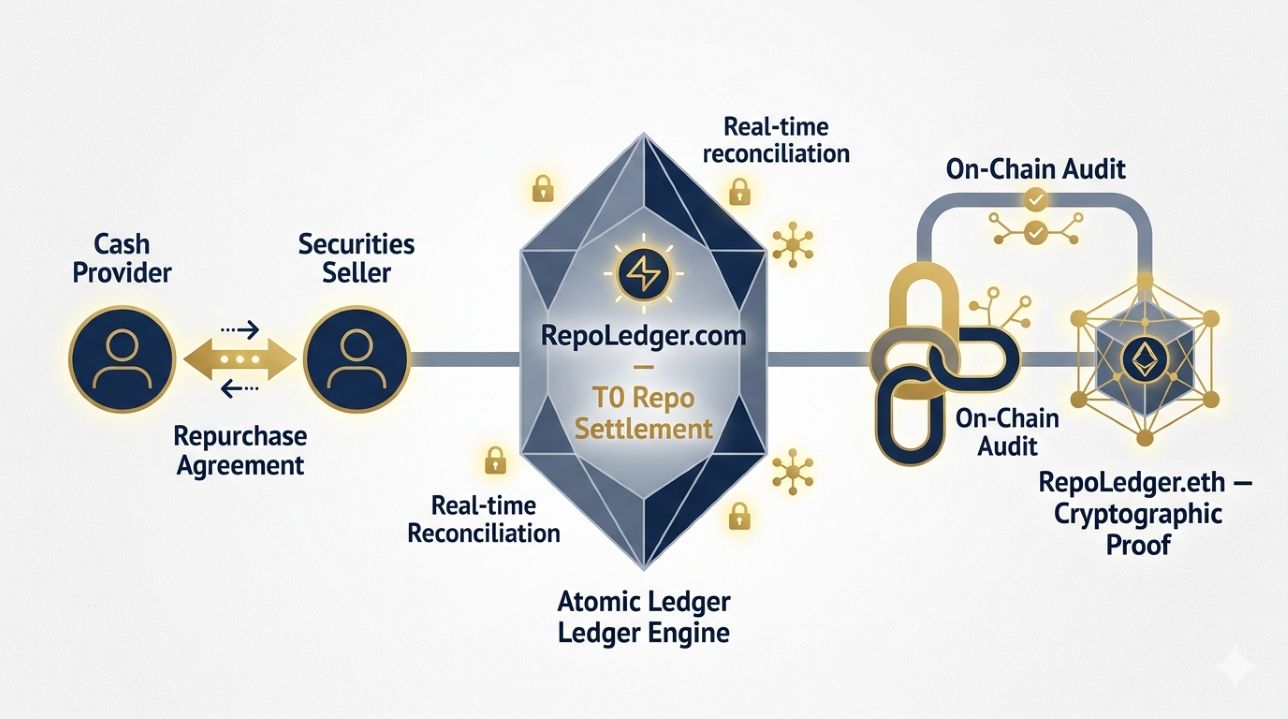
This is where RepoLedger.com operates as the institutional repo settlement registry — a continuously updated, OCC-mapped layer that maintains atomic execution records, collateral verification status, and cryptographic audit trails for every repo transaction. And this is where RepoLedger.eth becomes indispensable: translating every repo settlement event into a blockchain-native proof — queryable by regulators, counterparties, and AI agents at the moment of examination.
Source: BIS — Tokenisation and the future of money, 2025 — The BIS framework identifies atomic, cryptographically proven repo settlement as a foundational requirement for institutional liquidity management across Unified Ledger environments.
Pillar 3: RepoLedger as the Liquidity Layer of the PillarsX Settlement Stack
Every institutional repo transaction requires one verified foundation before execution: cryptographically confirmed collateral eligibility, atomic delivery versus payment, and a continuously sealed audit trail from initiation through maturity. Without that foundation, no repo position can legitimately qualify as a permitted reserve asset under OCC § 15.11(b).
Within the PillarsX infrastructure, RepoLedger.com/.eth functions as the liquidity layer — sitting between permitted reserve validation and atomic settlement execution:
PermittedReserves.eth   →  Reserve category & collateral eligibility confirmed
        ↓                  [Programmable Compliance]
RepoLedger.eth          →  Atomic repo settlement executed & sealed
        ↓                  [Atomic Settlement Efficiency / Real-Time Recon]
VerifiableSettle.eth    →  Final cryptographic finality confirmed
                           [Operational Resilience]
As part of the complete PillarsX Settlement Stack, RepoLedger sits at the critical intersection between reserve validation and settlement finality — ensuring that every repo transaction is not only compliant at initiation but continuously verified through maturity and cryptographically sealed at settlement.
→ Every repo position requires verified reserve classification: PermittedReserves — The Permitted Reserves Standard
Strategic Constellation & Bundle Potential
“The Atomic Repo Stack” · For OCC-Compliant Repurchase Agreement Infrastructure
Designed for institutions managing repo positions as permitted reserve assets under GENIUS Act § 15.11(b) — ensuring every repo transaction is atomically settled, continuously verified, and cryptographically auditable:
| Domain | Function | Regulatory Hook |
|---|---|---|
| RepoLedger.com/.eth | Atomic repo settlement & continuous collateral audit trail | OCC § 15.11(b)(3)(4) – Permitted Repo Assets |
| PermittedReserves.com/.eth | Reserve category validation for repo collateral | OCC § 15.11(b) – Permitted Reserve Categories |
| EligibleAsset.com/.eth | Collateral eligibility classification before repo initiation | OCC § 15.11(b) – Eligible Asset Definition |
| VerifiableSettle.com/.eth | Final cryptographic finality for repo settlement | CLARITY Act – Atomic Settlement Efficiency |