
unifiedsettle.com & .eth | Unified Settlement Identity
🔴 Regulatory Update — June 23, 2026
BIS Annual Economic Report 2026 confirms unified ledger as the institutional endgame — tokenised central bank reserves, commercial bank money and government bonds on interoperable platforms as the mandatory architecture for next-generation settlement
The Bank for International Settlements published Chapter III of its Annual Economic Report on June 23, 2026 — "Anchoring Trust in Money: Innovation Beyond Stablecoins" — confirming that a unified ledger implemented as a system of interoperable networks is the only architecture capable of upholding the foundational properties of money in the digital age. The BIS defines the unified ledger as a shared programmable infrastructure integrating tokenised central bank reserves, tokenised commercial bank money, and tokenised assets in a single venue with atomic settlement finality. Project Agorá — eight central banks and over 40 regulated institutions — demonstrates the architecture in production: payments settle atomically across currencies in an all-or-nothing manner, with participation rules and domestic control over reserves preserved. The BIS confirms that stablecoins fall short of the singleness, elasticity, and integrity requirements that the unified ledger upholds. unifiedsettle.com & .eth is the institutional namespace for unified settlement identity — registered before the BIS architecture becomes the mandatory compliance standard.
→ Source: BIS Annual Economic Report 2026, Chapter III — Anchoring Trust in Money, June 23, 2026🔴 Regulatory Update — June 3, 2026
Mastercard activates unified settlement across 9 blockchains and 5 stablecoins — ECB Schnabel confirms dollarization risk makes sovereign unified settlement mandatory
Mastercard confirmed on June 3, 2026 the activation of unified settlement rails across 9 blockchain networks and 5 regulated stablecoins simultaneously — proving that cross-asset unified settlement is operationally live at commercial scale. The same week ECB Executive Board Member Schnabel confirmed that USD stablecoin dominance creates structural dollarization risk — making unified settlement in sovereign central bank money a monetary policy requirement for every European institution operating on public blockchains.
→ Source: Mastercard — Unified Settlement Expansion, June 3, 2026In May 2026, the BIS Project Agorá Final Report confirmed atomic multi-currency settlement across eight central bank jurisdictions simultaneously. In June 2026, Mastercard activated unified settlement across nine blockchain networks and five regulated stablecoins. The DTCC Canton Network tokenization pilot launches H2 2026 for US equities and Treasury securities.
Three simultaneous developments — BIS, Mastercard, DTCC — all point to the same structural conclusion: fragmented settlement across disconnected systems is no longer a technology problem. It is a compliance failure. Every institution that settles equities through one system, Treasury bills through another, FX through a third, and stablecoins through a fourth is accumulating counterparty exposure, capital inefficiency, and regulatory examination risk at every fragmentation point simultaneously.
unifiedsettle.com is the institutional Web2 portal identity for the unified settlement standard that eliminates this fragmentation — the legal brand that appears in BIS Unified Ledger compliance documentation, DTCC Canton Network participation agreements, and institutional cross-asset settlement contracts wherever unified atomic settlement must be referenced. unifiedsettle.eth is the programmable on-chain routing identity — the ENS endpoint that software architects embed directly into unified settlement protocol logic to route cross-asset transactions to atomic execution across all asset classes simultaneously, without intermediary DNS dependency.
Together they form the complete Convergence Identity for the unified settlement standard that every institution participating in BIS Agorá, ECB Pontes, Mastercard’s stablecoin network, and DTCC Canton must establish.
Namespace Acquisition: This Twin-Domain asset is available for institutional acquisition. Inquiries: hq@pillarsx.com
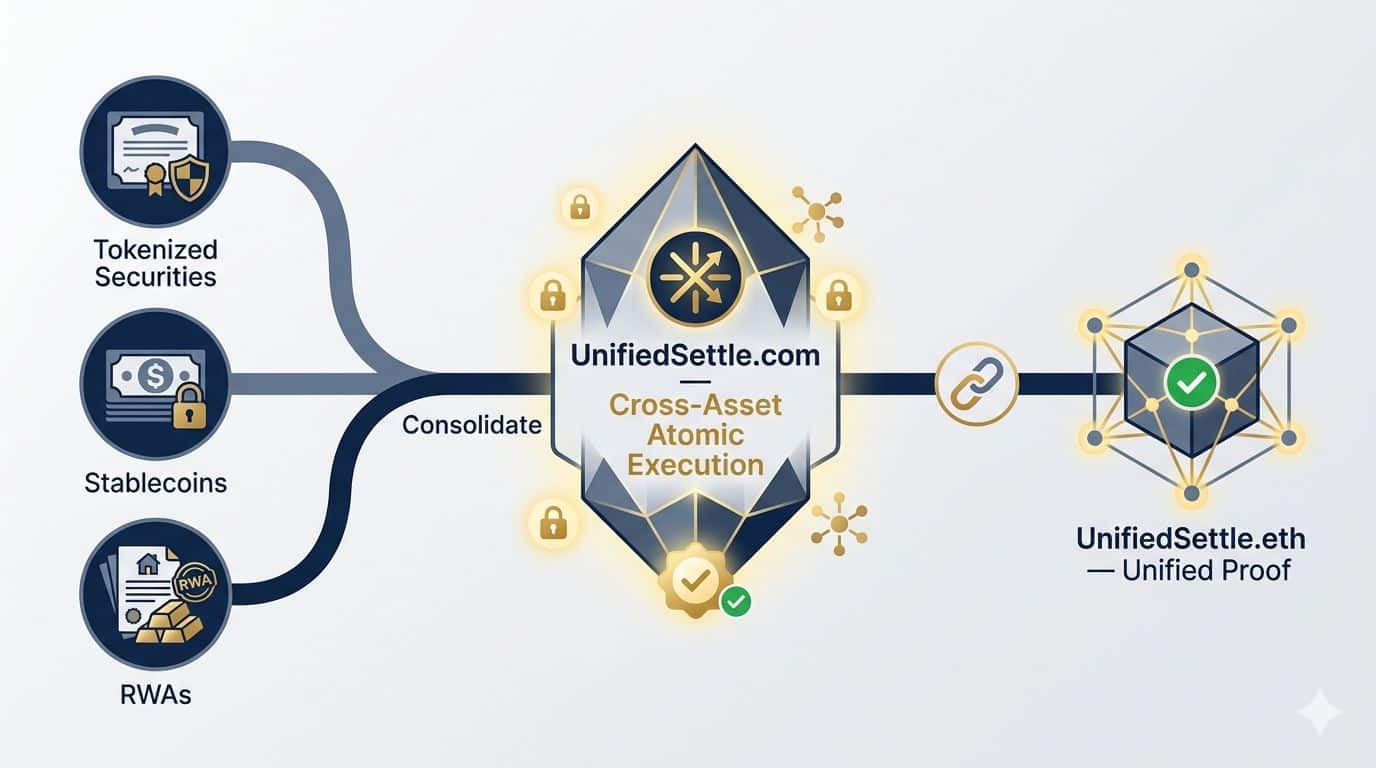
Why BIS Agorá, Mastercard and DTCC Make Unified Settlement the Defining Infrastructure Standard of 2026
The fragmentation of global settlement infrastructure — across asset classes, jurisdictions, currencies, and ledger systems — has been identified by the world’s leading financial regulators as the single greatest source of systemic risk in modern capital markets. Under the GENIUS Act (12 U.S.C. § 5903), the CLARITY Act (2026), and the BIS Unified Ledger Framework, institutions are now required to demonstrate that their settlement infrastructure can achieve atomic finality across every asset class they operate in — simultaneously, without sequential dependencies that create counterparty exposure.
…under the BIS Unified Ledger Framework, the GENIUS Act and the CLARITY Act…
The OCC operationalizes this requirement through two specific obligations:
Cross-Asset Settlement Integrity: Every institution operating across multiple asset classes — tokenized securities, payment stablecoins, repo agreements, and Real World Assets — must demonstrate that settlement across these classes achieves simultaneous atomic finality. A settlement infrastructure that achieves T0 finality for one asset class but introduces sequential dependencies when crossing asset boundaries fails OCC Operational Resilience standards — regardless of its performance within individual asset silos.
Interoperability Standard Compliance: Under the CLARITY Act, institutions must demonstrate that their settlement infrastructure can communicate natively with legacy systems, DLT networks, and cross-border payment rails simultaneously. A settlement layer that requires manual intervention to bridge asset classes or jurisdictions creates operational bottlenecks that are architecturally incompatible with 24/7 institutional finance.
The Unified Settlement Standard is the direct institutional response: a cross-asset, cross-border atomic settlement layer that satisfies both mandates simultaneously — consolidating every settlement obligation into a single, cryptographically proven execution event.
unifiedsettle.com provides the institutional Web2 portal identity — the legal brand that compliance teams reference in BIS Unified Ledger documentation, DTCC Canton Network participation agreements, and cross-asset settlement contracts.
unifiedsettle.eth is the programmable on-chain routing identity — the ENS endpoint that software architects embed directly into unified settlement protocol logic to route cross-asset transactions atomically across all asset classes simultaneously. Where the BIS Unified Ledger framework defines what unified settlement must achieve regulatorily, unifiedsettle.eth provides the machine-readable routing layer that protocol engineers embed into settlement infrastructure to implement that standard — connecting regulatory compliance to cross-asset atomic execution in a single ENS endpoint.
Together, unifiedsettle.com & .eth form the complete Convergence Identity: the legal anchor for compliance teams documenting unified settlement under BIS, DTCC and Mastercard standards, and the technical routing layer for software architects implementing cross-asset atomic execution — the two audiences that every institutional unified settlement deployment must simultaneously satisfy.
The Unified Settlement Ecosystem: From Cross-Asset Atomic Execution to BIS Unified Ledger Compliance
The operational challenge for institutional settlement teams in 2026 is not the absence of settlement infrastructure. Every asset class has its own settlement system — DTCC for securities, SWIFT for cross-border payments, bilateral agreements for repo, and emerging DLT networks for tokenized assets. The critical gap is unified execution — the ability to settle across every asset class, every jurisdiction, and every counterparty network simultaneously, in a single atomic event, without sequential dependencies that create counterparty exposure.
Three failure modes define the institutional risk landscape:
Cross-Asset Settlement Lag: An institution executes a complex transaction involving tokenized securities, stablecoin payment, and repo collateral simultaneously. Each component settles in its own system, on its own timeline, with its own finality standard. The result: a transaction that appears complete but carries residual exposure at every asset boundary — a direct violation of Atomic Settlement Efficiency mandates under OCC supervisory standards.
Jurisdiction Fragmentation: A cross-border transaction requires simultaneous settlement in three jurisdictions — each with different legal finality standards, different regulatory requirements, and different settlement windows. Without a standardized Interoperability Standard at the settlement layer, institutions cannot achieve legally enforceable finality in all three jurisdictions simultaneously — creating legal ambiguity that counterparties and regulators cannot accept.
Legacy-DLT Bridge Failure: Institutions operating across both legacy settlement infrastructure and DLT networks face a fundamental translation problem. Every time a settlement instruction crosses the legacy-DLT boundary, compliance metadata is lost, timing guarantees break, and audit trails fragment. Without a Unified Settlement Standard bridging both worlds natively, this boundary becomes the single greatest source of operational risk in the institution’s entire settlement stack.
This is where UnifiedSettle.com operates as the institutional cross-asset settlement layer — a continuously synchronized, protocol-agnostic execution registry that maintains atomic finality standards across every asset class, jurisdiction, and network simultaneously. And this is where UnifiedSettle.eth becomes indispensable: translating every unified settlement event into a blockchain-native finality proof — verifiable by regulators, counterparties, and AI agents across every network the transaction touches.
Source: OCC Proposed Rules – Permitted Payment Stablecoin Issuers, Federal Register, March 2, 2026 — The OCC identifies cross-asset settlement integrity as a foundational requirement for institutional digital asset operations.
Pillar 3: UnifiedSettle as the Convergence Layer of the PillarsX Settlement Stack
Every complex institutional transaction ultimately converges on one requirement: simultaneous, atomic finality across every asset class, jurisdiction, and network involved. Without a unified settlement layer that speaks natively to every component of the stack, this convergence remains architecturally impossible — regardless of how sophisticated each individual component is.
Within the PillarsX infrastructure, UnifiedSettle.com/.eth functions as the convergence layer — sitting between atomic execution and final cryptographic proof:
MCPSettle.eth           →  AI-native atomic execution initiated
        ↓                  [Atomic Settlement Efficiency]
UnifiedSettle.eth       →  Cross-asset convergence & unified finality
        ↓                  [Interoperability Standard]
VerifiableSettle.eth    →  Final cryptographic proof confirmed
                           [Operational Resilience]
As part of the complete PillarsX Settlement Stack, UnifiedSettle sits at the critical intersection between atomic execution and cryptographic finality — ensuring that every transaction achieves legally binding, simultaneously proven settlement across every asset class and jurisdiction it touches.
→ Every unified settlement begins with AI-native atomic execution: MCPSettle — The MCP Settlement Standard
Strategic Constellation & Bundle Potential
“The Cross-Asset Settlement Stack” · For BIS Unified Ledger Compliant Institutions
Designed for institutions requiring simultaneous atomic finality across every asset class, jurisdiction, and network — from AI-native execution through to cryptographically proven cross-border settlement:
| Domain | Function | Regulatory Hook |
|---|---|---|
| UnifiedSettle.com/.eth | Cross-asset convergence & unified finality layer | BIS Unified Ledger – Interoperability Standard |
| MCPSettle.com/.eth | AI-native atomic execution feeding unified settlement | GENIUS Act – T0 Settlement Mandate |
| RepoLedger.com/.eth | Repo settlement component of unified asset stack | OCC § 15.11(b) – Permitted Repo Assets |
| VerifiableSettle.com/.eth | Final cryptographic proof across all unified positions | CLARITY Act – Atomic Settlement Efficiency |
Regulatory Sources
BIS Project Agorá Final Report — Eight-Jurisdiction Unified Settlement, May 27, 2026
Mastercard — 9-Chain Unified Settlement Expansion, June 3, 2026
ECB Schnabel — Digital Dollarization Warning, June 1, 2026
BIS — Tokenisation and the Future of Money, 2025
GENIUS Act — Public Law 119-27, Unified Settlement Framework
Explore related PillarsX infrastructure
→ agorasettle.com — BIS Project Agorá Settlement Identity
→ settlerails.com & .eth — Fed-Compatible Payment Rails Identity
→ atomicsettle.eth — Atomic Settlement Core Identity
→ sovereignsettle.com & .eth — Sovereign Settlement Identity
→ nostrosettle.com & .eth — Nostro Settlement Identity
→ programmablecompliance.com & .eth — Programmable Compliance Identity
„All content is for informational purposes only and does not constitute financial advice.“