
mcisettle – The MCI Settlement Identity for Multifunction Cryptoasset Intermediaries (.com + .eth)
In 2022, Celsius Network held approximately $12 billion in customer assets — and collapsed because its settlement infrastructure had no prudential safeguards, no capital buffers, and no atomic finality standard. The BIS FSI Paper No. 27 of April 23, 2026 named this structural failure precisely: Multifunction Cryptoasset Intermediaries engaged in financial intermediation require settlement infrastructure equivalent to regulated banks.
This is the schmelzpunkt — the moment where the absence of a dedicated MCI settlement identity becomes a compliance failure, not merely a branding gap.
Every MCI now building under the BIS prudential framework, the FDIC GENIUS Act rules, and the CLARITY Act faces the same question: under what institutional identity does it present its settlement capability to regulators, counterparties, and clients?
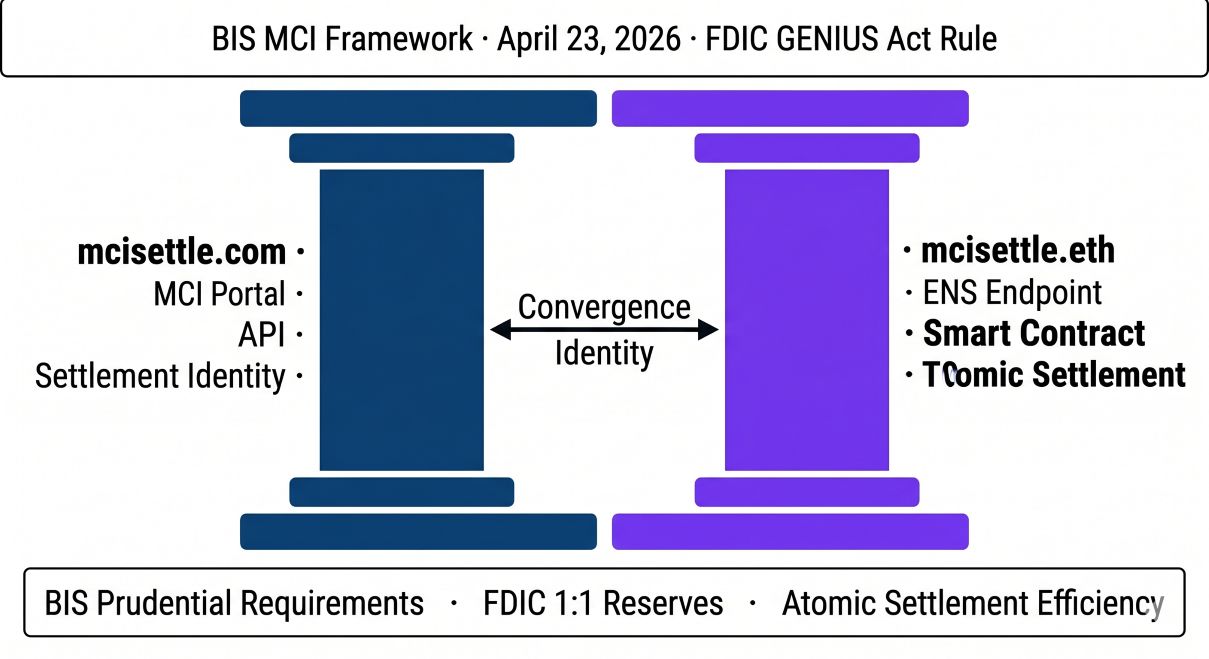
mcisettle.com is the institutional Web2 portal identity for this answer — the legal brand that appears in BIS prudential filings, OCC examination submissions, and institutional settlement agreements. mcisettle.eth is the programmable on-chain routing identity — the ENS endpoint that software architects embed directly into MCI settlement protocol logic, connecting the BIS prudential settlement standard to its on-chain atomic execution without intermediary DNS dependency. Together they form the complete Convergence Identity for the settlement standard that every regulated MCI must build before the CLARITY Act July 4 signing makes MCI compliance permanent federal law.
MiCA's transitional period expired 1 July 2026, establishing full authorization requirements for all EU Crypto-Asset Service Providers — including MCI-classified intermediaries operating tokenized settlement infrastructure across EU jurisdictions. The SEC published its Draft Strategic Plan 2026–2030 on June 2, 2026, designating digital assets and distributed ledger technology as the agency's first regulatory objective, with explicit priorities around compliant capital formation through tokenized offerings and custody, trading, and staking services under appropriate oversight. The IMF identified that as post-trade functions concentrate on shared ledgers, the systemic importance of infrastructure governance increases — regulators must require FMIs to comply with high standards of resilience, governance, and operational integrity. The mcisettle namespace anchors MCI settlement infrastructure at the convergence of MiCA full enforcement, SEC DLT strategic prioritization, and IMF systemic governance standards for tokenized post-trade infrastructure.
The BIS Prudential Framework: Why MCI Settlement Identity Is Now a Regulatory Requirement
The BIS Working Paper on Multifunction Cryptoasset Intermediaries (April 23, 2026) establishes that MCIs engaged in financial intermediation — accepting customer assets, funding lending and market making, managing credit and liquidity risk — must be subject to prudential requirements equivalent to those applied to traditional financial intermediaries.
The paper explicitly cites the failures of Celsius Network and FTX in 2022 and the cryptoasset flash crash of October 2025 as evidence that settlement risk and counterparty exposure without prudential safeguards creates systemic vulnerability.
The FDIC Proposed Rule implementing the GENIUS Act (April 7, 2026) reinforces this framework at the federal level: Permitted Payment Stablecoin Issuers must maintain 1:1 reserves, meet capital requirements, and demonstrate Operational Resilience — all requirements that a dedicated MCI settlement identity directly addresses.
With the Arnold & Porter Advisory confirming that timely redemption — generally within two business days — is now a statutory requirement, mci-settle holds the namespace for the settlement infrastructure that makes this possible.
mcisettle.eth — ENS Relevance: 9.5/10
mcisettle.com provides the institutional Web2 portal identity — the legal brand that compliance teams reference in BIS prudential filings, FDIC examination submissions, and MCI settlement agreements.
mcisettle.eth is the programmable on-chain routing identity — the ENS endpoint that software architects embed directly into MCI settlement protocol logic to execute atomic settlement on-chain, without intermediary DNS dependency. Where the BIS FSI Paper No. 27 defines what MCI settlement must achieve regulatorily, mcisettle.eth provides the machine-readable routing layer that bank software architects embed into settlement protocol logic to implement what the BIS requires — connecting prudential compliance to technical execution in a single ENS endpoint.
Together, mcisettle.com & .eth form the complete Convergence Identity: the legal anchor for compliance teams navigating BIS, FDIC, and CLARITY Act MCI settlement standards, and the technical routing layer for software architects implementing atomic MCI settlement — the two audiences that every regulated MCI deployment must simultaneously satisfy.
The Convergence Identity: How mcisettle.com & .eth Closes the MCI Settlement Gap
Every Multifunction Cryptoasset Intermediary building settlement infrastructure under the BIS and FDIC frameworks faces the same question: under what institutional identity does it present its settlement capability to regulators, counterparties, and clients? mcisettle.com is the answer — the API portal, the legal brand, the compliance anchor that signals prudential settlement capability in a single, memorable name. mcisettle.eth is the on-chain complement — an ENS-resolvable endpoint for smart contract interaction, T0 atomic settlement, and programmatic compliance on distributed ledger infrastructure.
Together they eliminate the counterparty risk the BIS identifies as the core MCI vulnerability: mcisettle.com presents the institutional face of settlement compliance, mcisettle.eth executes it on-chain with atomic finality.
No existing domain combines the BIS’s Multifunction Cryptoasset Intermediary framework with settlement infrastructure as directly and institutionally as mcisettle.
The MCI Settlement Ecosystem: From Prudential Compliance to Atomic Finality
mci settle is the settlement anchor of the PillarsX Multifunction Cryptoasset Intermediary namespace — the first domain an institutional buyer encounters and the one that anchors the entire MCI stack.
It connects directly to mcisettlement.com/.eth as the legal longform settlement identity, mcirisk.com/.eth as the risk management layer that precedes every settlement event, and mciledger.com/.eth as the Unified Ledger where settlement records are stored. Beyond the MCI cluster, mcisettle integrates with cuisettle.com/.eth as the CUI-compliant interface layer above it, and mcicustody.com/.eth as the qualified custody layer beneath it.
An institution acquiring mci settle.com/.eth secures the most direct, most memorable, and most regulatorily precise MCI settlement namespace available — the name that stands at the center of every BIS-compliant MCI settlement architecture.
📄 Academic Foundation
Twin-Domain Convergence Identity — The Institutional Framework Behind This Namespace
This Twin-Domain asset is part of the namespace architecture formalized in "Twin-Domain Convergence Identity: A Framework for Institutional Namespace Standards in Regulated Digital Asset Infrastructure" by Rolf Neumayr, PillarsX (SSRN Working Paper, 16 pages, posted June 12, 2026), classified under Monetary Economics — International Financial Flows, Financial Crises, Regulation & Supervision.
→ Read the Paper on SSRNWhat is the difference between mcisettle.com and mcisettle.eth?
mcisettle.com is the institutional compliance address — the domain OCC examiners access, legal departments reference in settlement agreements, and compliance teams cite in BIS prudential filings. It operates within the existing Web2 DNS infrastructure that every regulated institution already uses.
mcisettle.eth is the on-chain execution endpoint — the ENS address that smart contracts and agentic systems target when an MCI settlement instruction must be executed atomically on distributed ledger infrastructure. It resolves directly on-chain without DNS intermediary, making it the native identifier for protocol-level MCI settlement logic.
One is for humans and regulators. The other is for machines and protocols. Both are required.
How does mcisettle relate to OCC Bulletin 2026-19?
OCC Bulletin 2026-19 requires every national bank to conduct a formal MCI Risk Assessment covering five core functions before engaging with any Multifunction Cryptoasset Intermediary.
Settlement operations are the first and most critical assessment area — a bank cannot demonstrate OCC-compliant MCI engagement without documented settlement infrastructure.
mcisettle.com/.eth is the institutional namespace that provides this documentation: the settlement identity that signals OCC-awareness, BIS-alignment, and atomic execution capability to both examiners and counterparties.
Why is MCI settlement infrastructure needed now — before Final Rules are published?
The OCC Bulletin 2026-19 is already in effect — it is not a proposed rule, it is active supervisory guidance. Every national bank engaging with an MCI is already subject to the Risk Assessment requirement.
Institutions that build MCI settlement infrastructure now — before CLARITY Act Final Rules in July 2026 — establish the namespace, brand, and compliance architecture before competitors define these terms.
The window for pre-rulemaking namespace sovereignty closes when Final Rules publish and market participants converge on standard terminology.
Strategic Constellations & Bundle Potential
Bundle 1 — “The MCI Settlement Core” (for Cryptoasset Intermediaries) Target: Large MCIs preparing for BIS prudential regulation — exchanges, lending platforms, derivatives providers. Domains: mci settle.com/.eth + mcisettlement.com/.eth + mcirisk.com/.eth. Settlement identity, legal longform, and risk framework namespace — the three most urgent compliance requirements from the BIS paper in one acquisition.
Bundle 2 — “The MCI Settlement & CUI Stack” (for Full-Stack Infrastructure Providers) Target: Institutions building end-to-end infrastructure from CUI interface to MCI settlement. Domains: mci settle.com/.eth + cui settle.com/.eth + mci custody.com/.eth. Front-to-back settlement namespace — CUI interface layer, MCI settlement layer, and qualified custody layer in one acquisition.
Bundle 3 — “The Full MCI Infrastructure” (for Strategic Acquirers) Domains: mcisettle.com/.eth + mcisettlement.com/.eth + mcirisk.com/.eth + mciledger.com/.eth + mcicustody.com/.eth. The complete PillarsX MCI stack — one acquirer secures the entire Multifunction Cryptoasset Intermediary namespace under the BIS and FDIC frameworks. This package exists exactly once.
Related PillarsX Infrastructure
MCI Infrastructure — the complete Multifunction Cryptoasset Intermediary namespace overview
cuisettle.com & .eth — the CUI Settlement anchor domain connecting to MCI settlement
„All content is for informational purposes only and does not constitute financial advice.“