
Multifunction Cryptoasset Intermediary (MCI) – The Complete Domain Namespace (.com + .eth)
On April 23, 2026, the Bank for International Settlements published a landmark working paper defining a new regulatory category: the Multifunction Cryptoasset Intermediary (MCI). For the first time, the BIS formally mapped the full spectrum of cryptoasset intermediation — from yield programmes and margin lending to derivatives and token issuance — to the functions of traditional financial intermediation, and called for comprehensive prudential regulation.
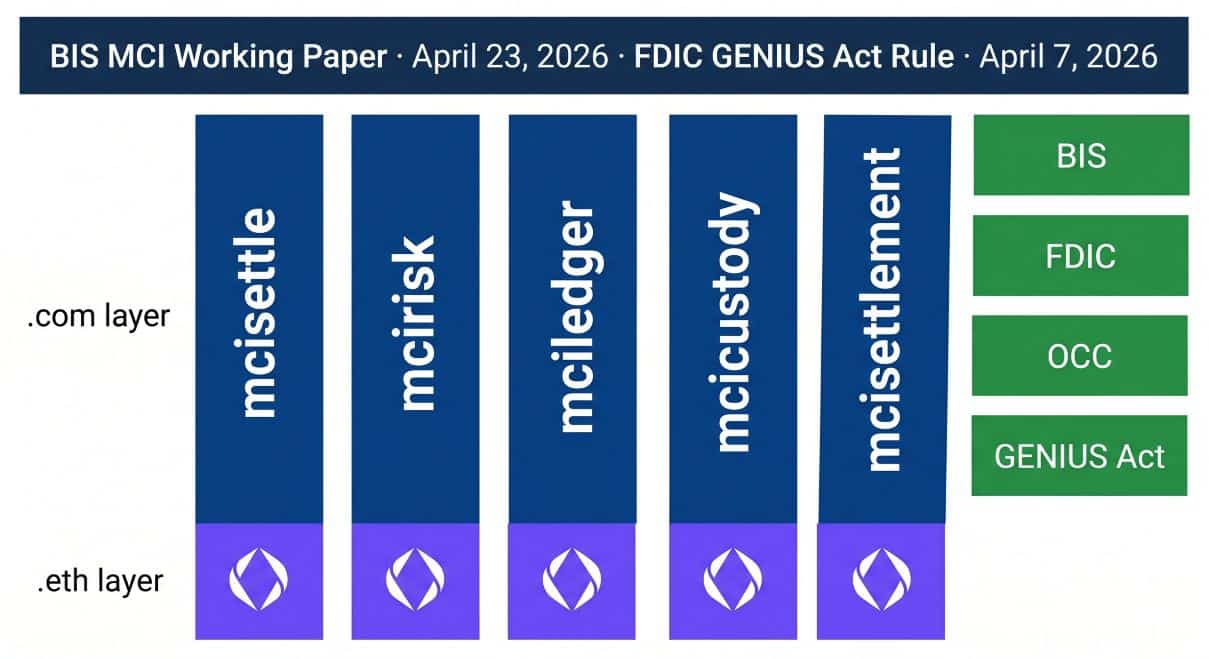
PillarsX holds the complete Multifunction Cryptoasset Intermediary namespace: five Twin-Domain pairs covering settlement, risk, ledger, custody, and legal documentation — each as a .com + .eth Convergence Identity. As the definitive Multifunction Cryptoasset Intermediary domain stack, PillarsX provides the namespace foundation for every institution required to comply with the emerging global MCI regulatory framework.
Pillar 1 — Regulation
The BIS Working Paper on Multifunction Cryptoasset Intermediaries (April 23, 2026) establishes MCI as the authoritative term for cryptoasset service providers that have expanded beyond trading and custody into financial intermediation activities traditionally performed by banks and prime brokers.
The paper draws on a structured review of terms and conditions of selected large MCIs conducted between November 2025 and March 2026, and maps MCI products — earn programmes, margin loans, derivatives, token issuance — directly to the functions of credit, liquidity, and maturity risk transformation.
The BIS explicitly calls for a combination of entity-based and activity-based regulation, including capital and liquidity buffers, robust governance and risk management frameworks, and stress testing. Parallel to the BIS paper, the FDIC issued its Proposed Rule implementing the GENIUS Act (April 7, 2026), establishing comprehensive prudential requirements for Permitted Payment Stablecoin Issuers — the direct regulatory counterpart to the MCI category at the federal level.
Together, the BIS paper and the FDIC Proposed Rule define the regulatory architecture within which every MCI must operate. PillarsX MCI Infrastructure provides the namespace for exactly this architecture.
Pillar 2 — The Problem Solved
Every institution operating as a Multifunction Cryptoasset Intermediary faces the same structural challenge: how to demonstrate, to regulators and counterparties simultaneously, that its settlement, risk, ledger, and custody infrastructure meets the prudential standards the BIS and FDIC now require.
The PillarsX MCI Infrastructure resolves this completely. mcisettle.com/.eth delivers the settlement identity for T0 atomic finality, eliminating the counterparty risk that contributed to the failures of Celsius Network and FTX in 2022 and the cryptoasset flash crash of October 2025.
mcirisk.com/.eth addresses the credit, liquidity, and maturity risk framework that the BIS identifies as the core vulnerability of MCI intermediation. mciledger.com/.eth connects the MCI directly to the Unified Ledger concept of the BIS, providing the data availability and reporting standards the paper identifies as critically underdeveloped.
mcicustody.com/.eth delivers the qualified custody identity required under both the FDIC Proposed Rule and the OCC’s parallel rulemaking. mcisettlement.com/.eth completes the stack as the legal longform variant for regulatory filings, BIS submissions, and official compliance documentation.
Pillar 3 — System Integration
The PillarsX MCI Infrastructure is the regulatory wrapper for the next generation of cryptoasset intermediation — built on the same Twin-Domain Convergence Identity architecture as the PillarsX CUI Compliance Infrastructure, but addressing the institutional intermediary layer rather than the interface layer.
Each MCI domain connects to a specialized infrastructure beneath it: mcisettle.com/.eth integrates with cuisettle.com/.eth as the CUI-compliant settlement interface, mcirisk.com/.eth connects to agenticcollateral.com/.eth as the agentic collateral management layer, and mciledger.com/.eth bridges directly to cuiledger.com/.eth and unifiedreserves.com as the reserve and ledger documentation stack.
An institution acquiring the complete PillarsX MCI Infrastructure secures brand sovereignty over the most precisely defined regulatory namespace in the global cryptoasset intermediation market — for the full duration of the BIS-driven MCI regulatory implementation cycle.
Strategic Constellations & Bundle Potential
Bundle 1 — “The MCI Settlement & Risk Stack” (for Cryptoasset Intermediaries) Target: Large MCIs preparing for BIS-driven prudential regulation — exchanges, lending platforms, derivatives providers. Domains: mcisettle.com/.eth + mcisettlement.com + mcirisk.com/.eth. Settlement identity, legal documentation, and risk framework namespace in one acquisition — the three most urgent compliance requirements from the BIS paper.
Bundle 2 — “The MCI Custody & Ledger Stack” (for Institutional Custodians) Target: Qualified custodians building MCI-compliant infrastructure under the FDIC Proposed Rule. Domains: mcicustody.com/.eth + mciledger.com/.eth + unifiedreserves.com. Complete custody-to-ledger namespace covering the FDIC’s reserve transparency and qualified custody requirements.
Bundle 3 — “The Full MCI Infrastructure” (for Strategic Acquirers) Domains: mcisettle.com/.eth + mcisettlement.com/.eth + mcirisk.com/.eth + mciledger.com/.eth + mcicustody.com/.eth. The complete PillarsX MCI stack — one acquirer secures the entire regulatory namespace for Multifunction Cryptoasset Intermediaries under the BIS and FDIC frameworks. This package exists exactly once.
What is a Multifunction Cryptoasset Intermediary (MCI)?
A Multifunction Cryptoasset Intermediary is a cryptoasset service provider that has expanded beyond its initial roles as a trading platform or custodial service provider into a broad range of financial intermediation activities.
The term was formally defined by the Bank for International Settlements in its working paper of April 23, 2026. MCIs typically offer yield and earn programmes, margin and secured lending, derivatives, and token issuance — activities that closely resemble financial intermediation traditionally performed by banks and prime brokers.
The BIS paper maps these activities to credit, liquidity, and maturity risk transformation, and calls for comprehensive prudential regulation of MCIs engaged in financial intermediation.
Why do MCIs need dedicated infrastructure domains?
MCIs operating under the emerging BIS and FDIC regulatory framework require institutional-grade brand identities that signal regulatory awareness, prudential compliance, and on-chain readiness simultaneously.
A dedicated MCI Infrastructure namespace — covering settlement, risk, ledger, and custody — communicates to regulators, counterparties, and clients that the institution has built its compliance architecture to the standards the BIS and FDIC require.
The PillarsX MCI Infrastructure provides this namespace as a complete Twin-Domain Convergence Identity stack.
How does the FDIC GENIUS Act Rule relate to MCIs?
The FDIC Proposed Rule of April 7, 2026 implements the GENIUS Act’s prudential requirements for Permitted Payment Stablecoin Issuers — the federal regulatory counterpart to the MCI category defined by the BIS.
Together, the BIS MCI framework and the FDIC GENIUS Act Rule establish a comprehensive global-to-federal regulatory architecture for cryptoasset intermediation, covering reserve requirements, capital buffers, liquidity management, redemption policies, and custody standards.
Every MCI operating in the US market must comply with both frameworks simultaneously.
What is the difference between MCI Infrastructure and CUI Compliance Infrastructure?
The PillarsX CUI Compliance Infrastructure addresses the interface layer — the Covered User Interface through which users interact with blockchain protocols, exempt from broker-dealer registration under the SEC Staff Statement of April 13, 2026.
The PillarsX MCI Infrastructure addresses the intermediary layer — the institutions that accept customer assets, manage reserves, and perform financial intermediation under the BIS and FDIC frameworks.
Together they form a complete front-to-back regulatory namespace: CUI at the interface, MCI at the intermediary, and the PillarsX settlement stack connecting both.
What is the difference between mcisettle.com and mcisettle.eth?
mcisettle.com is the institutional Web2 identity — the API portal, the legal brand, the compliance anchor for MCI settlement infrastructure presented to regulators, counterparties, and clients. mcisettle.eth is the on-chain Web3 identity — an ENS-resolvable endpoint for smart contract interaction, atomic T0 settlement, and programmatic compliance on distributed ledger infrastructure.
Together they form a Convergence Identity that signals BIS-awareness, settlement capability, and on-chain readiness in a single name — the core Twin-Domain architecture of the PillarsX MCI Infrastructure.
Related PillarsX Infrastructure
-
CUI Compliance Infrastructure — the CUI interface layer connecting to MCI infrastructure
MCPSettle — MCP protocol as the technical settlement layer beneath MCI infrastructure
„All content is for informational purposes only and does not constitute financial advice.“