
Atomicintent.com & .eth | Atomic Intent Identity
🔴 Regulatory Update — May 12, 2026
Aptos develops native transaction intent confidentiality — encrypted mempool eliminates MEV and order-flow leakage
Aptos announced a major protocol upgrade on May 12, 2026 to offer native encrypted mempool — hiding transaction intent until after ordering to eliminate MEV vulnerabilities, protect users from censorship, and prevent order-flow leakage. The upgrade aligns with a $50 million initiative to accelerate on-chain markets and AI systems, confirming that atomic intent confidentiality is now a protocol-level institutional standard.
→ Source: CryptoTimes — Aptos Transaction Intent Confidentiality, May 12, 2026The Architecture Shift From Transactions to Intentions
Intents and solvers are the two primitives rewriting how blockchain applications execute user requests in 2026. Instead of signing a transaction that dictates how a chain should move state, a user signs an intent that declares what outcome they want — and a competitive network of off-chain actors called solvers races to deliver it.
This architecture shift is not merely a UX improvement — it is the structural foundation that makes institutional compliance possible at blockchain speed.
In a traditional transaction model, an institution specifies every execution step explicitly — which pool, which path, which gas price. Every step is visible on-chain before execution, creating MEV exposure, front-running risk, and order-flow leakage that no institutional trading desk can accept.
In an intent-based model, an institution declares only the desired outcome — “settle $100 million in Treasury collateral against this derivatives position” — and the atomic execution layer delivers it without exposing the execution path. By hiding intent until after ordering, the encrypted mempool eliminates the window for bots to exploit pending trades — all at the protocol layer, without new trust assumptions or throughput sacrifices.
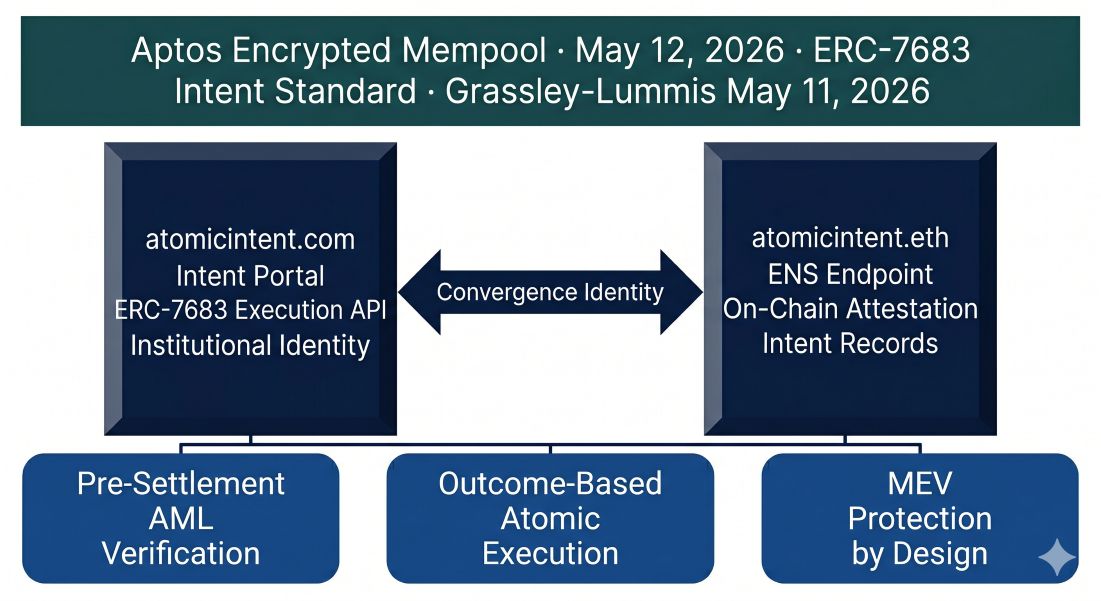
atomicintent.com/.eth is the Convergence Identity for the institutional infrastructure that makes this intent-based execution model compliant, auditable, and regulatorily defensible — the namespace at the intersection of ERC-7683 intent standards, atomic settlement finality, and pre-settlement AML verification.
Why Intent-Based Architecture Is Now the Institutional Execution Standard, How Atomic Intent Infrastructure Works in Practice, and The Atomic Intent Ecosystem
A typical intent-based swap in 2026 follows six phases: Signature — the user signs an EIP-712 message in their wallet with no on-chain transaction yet. Broadcast — the intent is posted to a public or permissioned mempool. Auction — solvers bid in a Dutch auction or race to submit. On-chain fill — the winning solver submits the fill transaction. Settlement — the settlement contract verifies the fill matches the intent’s constraints. Finalization — if cross-chain, a proof or challenge window may delay final solver reimbursement.
The regulatory relevance is direct: the intent signature phase is the pre-settlement AML verification point. Before any on-chain transaction executes, the institution’s intent is documented — creating the cryptographic record that satisfies the CLARITY Act demonstrable culpability standard and the FDIC BSA pre-transaction monitoring requirement simultaneously.
Canton Network allows atomic transactions where multiple steps either happen simultaneously or not at all — across different organizations, with strict data silos maintained between institutional participants. This privacy-by-design architecture ensures that atomic intent execution meets institutional confidentiality requirements while delivering cross-chain settlement finality.
The Grassley-Lummis AML compromise of May 11, 2026 established that demonstrable intent is the federal prosecution standard — making the intent signature phase not merely an execution architecture decision but a compliance documentation requirement under federal law.
How Atomic Intent Infrastructure Works in Practice
Atomic intent infrastructure operates through three simultaneous execution and compliance layers.
The intent declaration layer allows institutions to specify desired settlement outcomes — collateral transfers, payment obligations, derivatives positions — without revealing the execution path to the public network. The intent is signed cryptographically, creating the pre-settlement documentation record that satisfies AML compliance requirements before any on-chain transaction executes.
The solver execution layer delivers the declared outcome atomically — the settlement contract verifies the fill matches the intent’s constraints and releases the user’s input to the solver, ensuring that the atomic execution layer cannot deviate from the declared intent without cryptographic detection.
The compliance verification layer embeds AML and sanctions screening directly into the intent declaration phase — checking counterparty identities, transaction purposes, and sanctions lists before the intent is broadcast to solvers. If the compliance check fails, the intent is rejected before any on-chain action occurs, producing the pre-settlement documentation record that satisfies the FDIC BSA proactive prevention standard of May 22, 2026.
atomicintent.com is the institutional portal for this three-layer architecture — the compliance identity, the atomic intent brand, and the legal anchor for any institution building ERC-7683-compatible, CLARITY Act-compliant intent-based execution infrastructure.
atomicintent.eth is the on-chain complement — an ENS-resolvable endpoint where intent declarations, solver execution records, and AML compliance attestations can be stored as immutable distributed ledger entries.
The Atomic Intent Ecosystem
atomicintent is the execution architecture core of the PillarsX intent namespace. It connects directly to verifiableintent.com/.eth — the verifiable intent standard that establishes the legal framework within which atomic intents operate — and to amlintent.com/.eth as the AML intent documentation standard that governs the compliance verification layer of every atomic intent execution.
Beyond the intent cluster, atomicintent integrates with confidentialintent.com as the privacy-preserving layer for atomic intent declarations that require confidential execution, solverintent.com/.eth as the solver network identity for the competitive execution layer that delivers atomic intent outcomes, and dvpvp.com/.eth as the complete DVP+PvP finality endpoint that atomic intent settlement produces.
An institution acquiring atomicintent.com/.eth secures the namespace for the execution architecture that is rewriting institutional blockchain UX in 2026 — the intent-based execution identity that simultaneously satisfies ERC-7683 technical standards, CLARITY Act AML compliance requirements, and FDIC BSA pre-transaction monitoring obligations.
Strategic Constellations & Bundle Potential
Bundle 1 — “The Atomic Intent Stack” (for Intent-Based Settlement Infrastructure) Target: UniswapX, CoW Protocol, Across — all operating ERC-7683 solver networks. Domains: atomicintent.com/.eth + verifiableintent.com/.eth + solverintent.com/.eth. Complete atomic intent namespace — execution identity, verifiable intent standard, and solver network layer.
Bundle 2 — “The Compliant Intent Stack” (for CLARITY Act & FDIC BSA Compliance) Target: Every institution required to document pre-settlement AML intent. Domains: atomicintent.com/.eth + amlintent.com/.eth + confidentialintent.com. Complete compliant intent namespace — atomic execution identity, AML documentation standard, and confidential intent layer.
Bundle 3 — “The Full Intent Infrastructure” (for Strategic Acquirers) Domains: atomicintent.com/.eth + verifiableintent.com/.eth + amlintent.com/.eth + confidentialintent.com + solverintent.com/.eth. The complete PillarsX intent namespace — every layer from atomic execution through verifiable intent to AML compliance documentation. This package exists exactly once.
Related PillarsX Infrastructure
verifiableintent.com & .eth — Verifiable Intent Identity — the legal framework within which atomic intents operate
amlintent.com & .eth — AML Intent Documentation Identity — the AML compliance layer governing atomic intent pre-settlement verification
Explore related PillarsX infrastructure: → verifiableintent.com & .eth — Verifiable Intent Identity → amlintent.com & .eth — AML Intent Documentation Identity → confidentialintent.com — Confidential Intent Identity → solverintent.com & .eth — Solver Intent Identity → dvpvp.com & .eth — Complete DVP+PvP Finality Identity
Strategic Acquisition Inquiry
Initiate secure communication with representatives of the IP holder to evaluate the acquisition of this premium infrastructure namespace or its corresponding strategic asset bundle.