
VerifiableIntent.com & .eth – The Verifiable Intent Standard for Institutional Transaction Authorization
Swift's strategic vision for the financial stack of the future identifies always-on, verifiable trust — still grounded in authority — as the defining characteristic of the next phase of financial services. This is the precise architectural function of verifiable intent infrastructure: cryptographically anchored, machine-readable mandates that establish trust before autonomous execution begins — grounded in regulatory authority, verifiable by counterparties and compliance systems, and operating continuously without human intermediation at each transaction. The Global Layer One whitepaper (22 June 2026, IMF, BIS Innovation Hub, JPMorgan, GLEIF) simultaneously established that GLEIF's verifiable Legal Entity Identifier (vLEI) enables organizations to assert identities that counterparties can computationally verify — the institutional implementation of Swift's always-on verifiable trust vision. The verifiableintent namespace anchors the institutional identity for this verifiable trust layer — where intent is cryptographically established, authority is computationally verifiable, and trust operates continuously at the speed of programmable finance.
🔴 Regulatory Update — June 24, 2026
Legal Context Protocol launches with Google, IBM, Circle, Hedera and 15 founding contributors — Verifiable Intent named explicitly as complementary standard as $15 trillion in agentic commerce requires cryptographic proof of what was agreed before settlement executes
The American Arbitration Association, Integra Ledger, Google, IBM, Circle, Wayfair, Stellar Development Foundation, Hedera, Cardano, Aptos, Sui, Ava Labs, and eleven additional founding contributors launched the Legal Context Protocol on June 24, 2026 — an open standard that makes legal terms, consent, and dispute resolution discoverable and verifiable when AI agents transact on behalf of people and organizations. Gartner projects that by 2028, 90% of all B2B purchases will be intermediated by AI agents moving more than $15 trillion through automated exchanges. The protocol makes governing terms discoverable before the deal, provable afterward through cryptographic fingerprint bound to each payment, and tied to the law the parties chose to govern the transaction. The official LCP documentation explicitly names Verifiable Intent as a complementary standard within the agentic commerce infrastructure stack. verifiableintent.com & .eth is the institutional namespace for the pre-execution authorization identity that LCP's legal context layer is designed to complement — registered as the $15 trillion agentic commerce market defines its legal and intent infrastructure.
→ Source: AAA — Legal Context Protocol Launch, Google, IBM, Circle, Hedera Founding Contributors, June 24, 2026🔴 Regulatory Update — June 10, 2026
Mastercard launches Agent Pay for Machines — verified intent confirmed as the non-negotiable compliance foundation for every AI-initiated payment transaction
Mastercard launched Agent Pay for Machines on June 10, 2026 — enabling AI agents to transact autonomously at machine speed with enforced controls, smart contracts, and guaranteed settlement. Ripple confirmed XRPL and RLUSD as the Web3 infrastructure layer with full audit trails. The launch confirms what verifiableintent.com documents: when AI agents transact on behalf of institutions, verified intent is not a feature — it is the legal and operational foundation without which no regulator, no counterparty, and no audit trail can function. Mastercard's own framing is precise: payments need trust, controls, and clear rules for how value moves. That is verifiable intent.
→ Source: Mastercard — Agent Pay for Machines, June 10, 2026In 2026, every regulated financial transaction begins with a single question: can the intent behind this action be cryptographically proven? Verifiable Intent is the institutional answer.
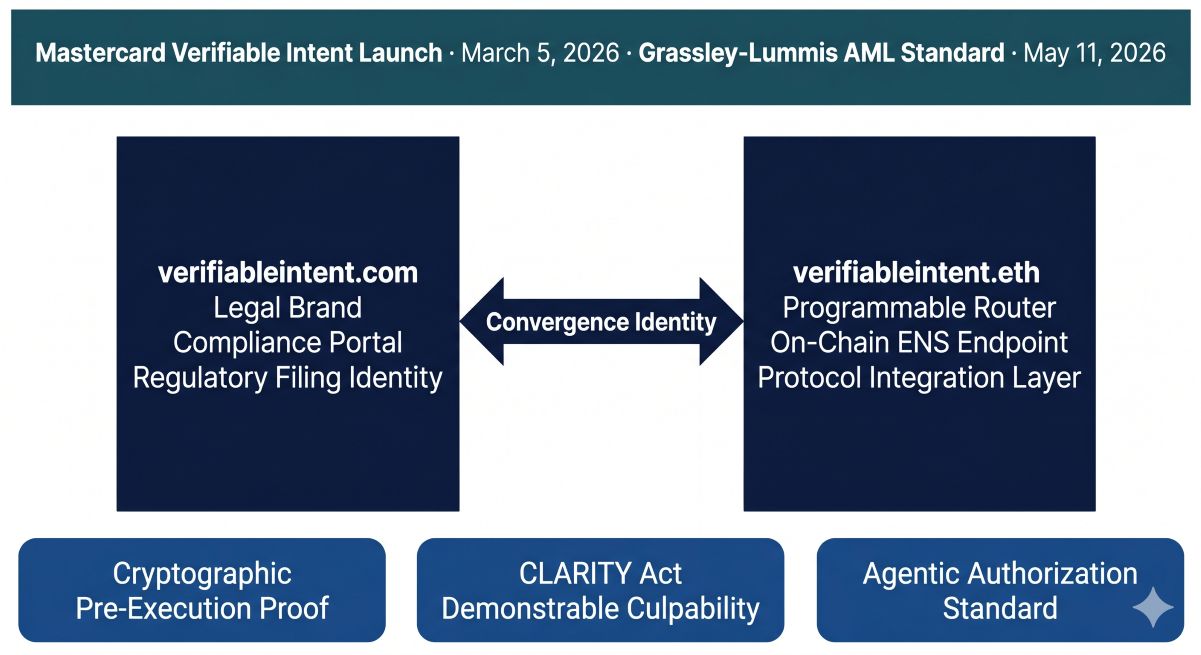
On March 5, 2026, Mastercard publicly launched its “Verifiable Intent” framework — deploying the concept at global payment network scale and validating that cryptographic pre-execution intent verification is not a theoretical standard but an operational institutional reality. verifiableintent.com/.eth was registered before this launch, making it the pre-existing institutional namespace for the standard that Mastercard confirmed.
In 2026, every regulated financial transaction begins with a single question: can the intent behind this action be cryptographically proven before execution? The CLARITY Act Grassley-Lummis compromise of May 11, 2026 answered this question with legal precision — demonstrable intent is now the federal prosecution boundary between protected infrastructure operators and culpable bad actors.
verifiableintent.com is the institutional Web2 portal identity for this standard — the legal brand that appears in CLARITY Act compliance filings, AML intent documentation, and institutional contracts. verifiableintent.eth is the programmable on-chain routing identity — the ENS endpoint that software architects embed directly into transaction protocol logic to resolve verifiable intent verification on-chain, without intermediary DNS dependency. Together they form the complete Convergence Identity for the most consequential compliance standard the CLARITY Act creates.
Namespace Acquisition: This Twin-Domain asset is available for institutional acquisition. Inquiries: hq@pillarsx.com
The Regulatory Foundation: Why Every Regulated Transaction Must Begin With Provable Intent
The GENIUS Act and the CLARITY Act have introduced a fundamental shift in how financial transactions must be authorized. It is no longer sufficient to prove that a transaction occurred — institutions must now prove why it occurred, who authorized it, and under what conditions it was permitted to execute.
The OCC operationalizes this requirement through two interconnected mandates.
Proof of Intent for Automated Systems: as AI agents increasingly execute treasury operations, collateral movements, and settlement instructions autonomously, the OCC requires that every automated action be traceable to a verified, human-authorized mandate. An agent acting without a cryptographically bound intent signal is an agent operating outside regulatory boundaries.
Activity-Based Authorization: under the CLARITY Act, passive operations are no longer sufficient for compliance. Every asset movement must be linked to a verifiable, documented intent — distinguishing legitimate institutional activity from unauthorized automated behavior.
The Grassley-Lummis AML compromise of May 11, 2026 established the definitive legal standard: prosecution applies only to demonstrably culpable actors. This means the legal burden has shifted — an institution that can produce cryptographic proof of compliant intent is protected. An institution that cannot is exposed regardless of the transaction outcome.
Mastercard’s “Verifiable Intent” deployment of March 5, 2026 — the commercial validation that arrived after verifiableintent.com/.eth was already registered — demonstrated that this standard is operationally viable at global payment network scale. The namespace exists. The regulatory standard exists. The commercial proof-of-concept exists.
The Intent Gap: Three Failure Modes That Cryptographic Intent Verification Eliminates
The operational risk in 2026 is not a lack of automation. Treasury desks, settlement systems, and collateral engines are already running on algorithmic logic. The critical gap is verifiability: when an AI agent executes a high-value instruction, can the institution prove — at the exact moment of execution — that the action was authorized, compliant, and intentional?
Without a dedicated intent verification layer, three failure modes define the institutional risk landscape.
Unauthorized State Change: an AI agent triggers a settlement instruction based on stale or unverified parameters. No cryptographic record exists of the original mandate. Under fiduciary agentic responsibility doctrine, the institution bears full liability for every unauthorized state change — regardless of whether a human or algorithm initiated it.
Regulatory Audit Failure: an OCC examiner requests the authorization trail for a specific treasury movement. The institution can show the transaction — but cannot demonstrate the verified intent behind it. This gap between execution record and intent proof is a direct operational resilience failure under OCC supervisory standards.
Cross-Chain Execution Risk: in multi-ledger environments, a transaction intent signed on one chain must be verifiable on another. Without a standardized, machine-readable intent protocol, interoperability breaks down — and atomic settlement becomes legally unenforceable across jurisdictions.
verifiableintent.com provides the institutional mandate registry — a continuously updated, cryptographically signed record of authorized transaction intents, accessible via API to compliance teams and treasury systems.
verifiableintent.eth is the programmable on-chain routing identity — the ENS endpoint that software architects at banks, payment networks, and digital asset infrastructure providers embed directly into transaction protocol logic to resolve verifiable intent verification on-chain, without intermediary DNS dependency. Where Mastercard’s deployment demonstrated the commercial viability of the concept at network scale, verifiableintent.eth provides the machine-readable routing layer that every institution replicating this architecture must embed into its own protocol implementation.
Together, verifiableintent.com & .eth form the complete Convergence Identity: the legal anchor for compliance teams navigating CLARITY Act demonstrable culpability standards, and the technical routing layer for software architects implementing verifiable intent verification directly into settlement and payment protocol logic — the two audiences that every institutional Verifiable Intent deployment must simultaneously satisfy.
The Authorization Stack: How VerifiableIntent Anchors the Complete Settlement Infrastructure
Every atomic transaction in a regulated settlement environment requires one verified input before execution can begin: a cryptographically bound, institution-grade intent signal. Without it, no downstream system — collateral engine, settlement protocol, or reconciliation layer — can operate within regulatory boundaries.
Within the PillarsX infrastructure, verifiableintent.com/.eth functions as the mandatory authorization gateway — the layer that every subsequent component depends on before a single instruction is processed.
Strategic Constellation & Bundle Potential
“The Agentic Authorization Stack” · For AI-Driven Institutional Treasury Operations
Designed for institutions deploying AI agents in treasury, settlement, and collateral management roles. Every domain in this bundle addresses a discrete layer of the Fiduciary Agentic Responsibility chain — from intent authorization through final audit proof:
| Domain | Function | Regulatory Hook |
|---|---|---|
| VerifiableIntent.com/.eth | Cryptographic mandate registry & on-chain intent oracle | CLARITY Act – Activity-Based Authorization |
| agenticriskstandard.com | Liability framework for autonomous treasury operations | OCC – Fiduciary Agentic Responsibility |
| dtaintent.com/.eth | Per-transaction intent verification & Digital Transfer Agent proof | GENIUS Act – Proof of Intent |
| fhecollateral.com/.eth | Privacy-preserving collateral authorization via Confidential Computing | OCC – Confidential Computing / FHE |
verifiableintent.eth → Intent verified & cryptographically bound
↓ [Fiduciary Agentic Responsibility]
eligibleasset.eth → Asset classification confirmed
↓ [Qualified Digital Asset Custody]
permittedreserves.eth → Reserve status validated
↓ [Programmable Compliance]
atomicintent.com/.eth → Atomic execution intent bound
↓ [Atomic Settlement Efficiency]
dvpvp.com/.eth → DVP+PvP finality achieved
[Complete Settlement Finality]
This architecture delivers operational resilience at its deepest level: intent is not assumed — it is proven. Every node in the stack operates on verified inputs. Every action is traceable to a cryptographically sealed mandate. Every audit trail begins at the moment of intent, not the moment of execution.
In the agentic economy of 2026, this is not optional infrastructure. It is the legal foundation upon which every autonomous treasury operation must be built — and verifiableintent.com/.eth is the institutional namespace that holds this foundation.
Strategic Constellations & Bundle Potential
Bundle 1 — “The Agentic Authorization Stack” (for AI-Driven Institutional Treasury) Target: JPMorgan, Goldman Sachs, every institution deploying AI agents in treasury operations. Domains: verifiableintent.com/.eth + agenticriskstandard.com + atomicintent.com/.eth. Complete agentic authorization namespace — intent standard, risk governance, and atomic execution layer.
Bundle 2 — “The CLARITY Act Intent Stack” (for AML Compliance Infrastructure) Target: Every digital asset operator subject to CLARITY Act demonstrable culpability standard. Domains: verifiableintent.com/.eth + amlintent.com/.eth + verificationcontrol.com. Complete intent compliance namespace — verifiable standard, AML documentation, and verification governance.
Bundle 3 — “The Full Intent Infrastructure” (for Strategic Acquirers) Domains: verifiableintent.com/.eth + veriintent.com/.eth + amlintent.com/.eth + atomicintent.com/.eth + confidentialintent.com. The complete PillarsX intent namespace — every layer from verifiable standard through AML documentation to confidential execution. This package exists exactly once.
Explore related PillarsX infrastructure: → atomicintent.com & .eth — Atomic Intent Identity → amlintent.com & .eth — AML Intent Documentation Identity → confidentialintent.com — Confidential Intent Identity → agenticriskstandard.com — Agentic Risk Standard Identity → dvpvp.com & .eth — Complete DVP+PvP Finality Identity
Strategic Acquisition Inquiry
Initiate secure communication with representatives of the IP holder to evaluate the acquisition of this premium infrastructure namespace or its corresponding strategic asset bundle.