
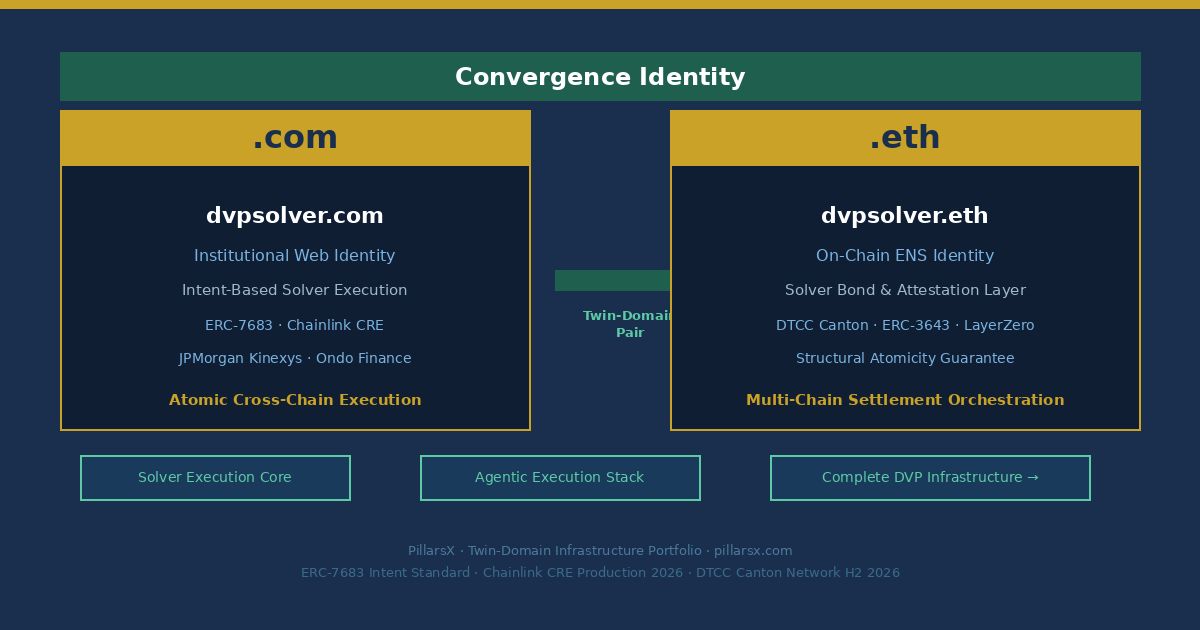
dvpsolver.com & .eth — DVP Solver Identity
DTCC, custodian of $114 trillion in securities, begins limited production trades of tokenized Russell 1000 constituents, major index ETFs, and US Treasuries in July 2026, with full platform launch set for October 2026. The initiative — backed by 50+ firms including BlackRock, Goldman Sachs, JPMorgan, Circle, and Ondo Finance — operates under a three-year SEC No-Action Letter authorization (December 2025) and uses Stellar and Canton Network as settlement rails, with Chainlink named as the data layer for a 24/7 tokenized collateral platform. This is the largest institutional DVP solver deployment to date by custodial scale — confirming that solver-orchestrated atomic settlement is now core infrastructure for the entity that processes the vast majority of US equity and Treasury trades.
ERC-7683, the cross-chain intent standard, has established the solver as the canonical execution layer for intent-based settlement: the intent contract enforces atomicity such that the solver only receives payment if the user's asset delivery is confirmed. Chainlink's Runtime Environment, deployed in production with Kinexys by J.P. Morgan and Ondo Finance, demonstrates this architecture at institutional scale — monitoring escrow events, reaching offchain consensus, and authenticating payment release only upon satisfaction of delivery conditions. DTCC's SEC-cleared tokenized Treasury pilot on Canton Network, with broader industry rollout planned for H2 2026, represents the next production deployment of solver-orchestrated atomic DVP settlement. The dvpsolver namespace anchors the institutional identity for the solver execution layer — the autonomous agent infrastructure that finds, verifies, and atomically executes DVP transactions across fragmented multi-chain environments.
In every DVP settlement, there is a moment of pure mechanical execution: the asset moves, the payment moves, both simultaneously, both irreversibly. But before that moment can occur, something has to find the optimal path, verify the conditions, and orchestrate the execution across what may be entirely separate blockchain networks, each with its own consensus mechanism, its own liquidity, its own compliance requirements. That something is the solver.
The solver is the actor that finds the optimal execution path and only receives payment if the user’s asset delivery is confirmed — the intent contract enforces atomicity structurally, not through trust. This is a fundamentally different architecture from traditional settlement infrastructure, where a central intermediary — a custodian, a clearing house, a correspondent bank — coordinates the transaction and bears the operational risk of failure. In solver-based DVP, the coordination function is decentralized to an open market of competing solvers, each economically incentivized to find the most efficient, lowest-risk execution path — and each structurally unable to profit unless the delivery actually completes. Bank for International Settlements
In a landmark institutional implementation, Kinexys by J.P. Morgan, Ondo Finance, and Chainlink’s Runtime Environment executed a cross-chain atomic DVP transaction — monitoring escrow events on Ondo Chain, reaching offchain consensus, translating events into payment instructions for Kinexys Digital Payments, and authenticating payment release only upon satisfaction of escrow conditions. This is the solver architecture operating at institutional scale, with regulated counterparties, real tokenized Treasury assets, and production-grade compliance workflows. dvpsolver.com and dvpsolver.eth anchor the namespace for this execution layer — the identity infrastructure for the autonomous agents that orchestrate atomic DVP settlement across the fragmented multi-chain landscape of institutional tokenized finance. Quant
The Solver Architecture — From Intermediation to Intent
Traditional DVP settlement relies on a central intermediary to coordinate the asset leg and the payment leg — a central securities depository instructing custodians, a clearing house netting obligations, a settlement bank confirming receipt. This intermediated model works, but it concentrates operational risk in a single point of coordination and constrains settlement to the operating hours and technical capabilities of that intermediary.
Treasury teams use atomic settlement primarily for cross-chain stablecoin movement, B2B payments where Herstatt risk is unacceptable, and DVP for tokenized assets — with intent-based protocols settling both legs atomically so that neither party is simultaneously exposed. The solver model inverts the intermediated structure: instead of a single coordinator, an open market of solvers competes to execute settlement intents, each bonded by the atomicity guarantee that they are paid only upon confirmed delivery. Atomic DVP and PvP reduce principal and settlement risk by removing partial-settlement outcomes — cleanest on a single ledger where both legs settle in one state transition, and more failure-prone in multi-ledger designs requiring HTLCs, notaries, or interoperability gateways, which is precisely where solver-based intent execution provides the missing coordination layer. OpendueMastercard
dvpsolver is the namespace for this coordination layer — the identity infrastructure for the solver execution function within the institutional DVP settlement stack.
Chainlink CRE, ERC-3643 and the Production Solver Standard
The institutional solver standard is being established in production, not in theory. A cross-chain Delivery-vs-Payment solution for regulated tokenized assets between ERC-3643-based security tokens and cash-equivalent tokens, built across the Polygon and Base networks, demonstrates how DVP settlements can occur across two separate chains, enabling the asset and cash legs to operate independently while settling atomically, without any counterparty risk through a lock-and-release mechanism that ensures settlement is secure, synchronized, and risk-free. International Monetary Fund
Swift has demonstrated how its network can interoperate with public and private blockchains using Chainlink CCIP to facilitate the transfer of tokenized value, allowing legacy banking systems to interact with blockchain-based assets without overhauling their entire backend. This is the solver architecture extending beyond crypto-native infrastructure into the existing institutional banking network — Swift, JPMorgan Kinexys, DTCC — all converging on solver-orchestrated atomic execution as the production standard for cross-chain DVP. Fiatrails
dvpsolver.eth provides the on-chain resolution layer for this architecture: an ENS-resolvable identity where solver bonds, execution attestations, and atomicity guarantees can be referenced by the smart contracts and compliance systems that depend on confirmed, verifiable solver execution.
dvpsolver in the Complete DVP Settlement Stack
dvpsolver is the execution engine that connects intent formation to settlement finality across the PillarsX DVP namespace architecture. dvpintent establishes the mandate. dvpsolver finds the optimal execution path and orchestrates atomic delivery. dvpatomic and instantdvp describe the settlement mechanics. dvpverify confirms completion. dvpvp anchors the complete DVP+PvP finality standard when currency conversion is involved.
In the agentic finance architecture emerging across institutional settlement infrastructure, agenticdvp represents the AI-driven coordination layer that operates above individual solver execution — directing intent, selecting among competing solvers, and managing the complete settlement lifecycle. dvpsolver is the execution layer that agenticdvp orchestrates: the namespace for the actors that actually move the assets and confirm the payments, atomically, across whatever chains the transaction requires.
Related Infrastructure Series
Strategic Constellations & Bundle Potential
Bundle 1 — Solver Execution Coredvpsolver + dvpintent + dvpatomic — the complete intent, solver execution, and atomic settlement namespace. Targets: Chainlink, Eco, Across Protocol, institutions building ERC-7683-compatible solver infrastructure for institutional DVP settlement.
Bundle 2 — Agentic Execution Stackdvpsolver + agenticdvp + dvpagent — the complete autonomous execution namespace from solver-level orchestration through AI-agent-level coordination. Targets: JPMorgan Kinexys, Ondo Finance, institutions building agentic settlement coordination infrastructure.
Bundle 3 — Complete DVP Infrastructuredvpsolver + instantdvp + dvpverify + dvpvp — the complete DVP namespace from solver execution through verification to settlement finality. Targets: DTCC, Euroclear, Swift, Canton Network participants building production-grade institutional DVP infrastructure.
· ERC-7683 — Cross-Chain Intent Standard Specification
· Chainlink Runtime Environment — Kinexys/Ondo Finance Production DVP Deployment (2026)
· ERC3643 Association — Cross-Chain DVP Solutions with LayerZero, Tokeny, Fasanara, ABN AMRO (May 2026)
· DTCC — SEC-Cleared Tokenized Treasury Pilot on Canton Network (H2 2026 Rollout)
· IMF FinTech Note 2025/011 — Strict vs. Weak Atomicity in Settlement Systems
· BIS Working Papers — Settlement Risk and DVP Standards
Explore Related
· dvpintent.com/.eth — DVP Intent Identity
· agenticdvp.com/.eth — Agentic DVP Identity
· dvpverify.com/.eth — DVP Verify Identity
· dvpvp.com/.eth — DVP-to-PvP Routing Identity
· Portfolio Acquisition → /acquire/
Disclaimer:PillarsX is a domain portfolio business. Nothing on this page constitutes legal, financial, or regulatory advice. Domain names do not confer regulatory status, licensing, or compliance certification of any kind. All content is for informational purposes only and does not constitute financial advice.