
dvpintent.com & .eth | DVP Intent Identity
🔴 Regulatory Update — May 11, 2026
Grassley-Lummis compromise establishes demonstrable intent as the federal AML standard — DVP intent documentation becomes compliance prerequisite
The CLARITY Act Grassley-Lummis AML compromise of May 11, 2026 established that prosecution applies only to demonstrably culpable actors — making cryptographic pre-execution DVP intent documentation the compliance mechanism that separates protected settlement infrastructure operators from prosecutable illicit finance facilitators. Every institution executing DVP settlement must now document intent before execution, not merely report transactions after settlement.
→ Source: CLARITY Act Grassley-Lummis AML Compromise, May 11, 2026Execution Privacy in DVP settlement means concealing the strategic intent and metadata behind a trade before it is settled — preventing predatory practices like frontrunning where bots exploit visible pending transactions. EBC Financial Group
But in 2026 institutional finance, DVP intent documentation serves a second equally critical purpose: compliance proof. The Grassley-Lummis AML compromise established that demonstrable intent is the federal prosecution boundary — meaning every institution executing DVP settlement must be able to produce cryptographic proof of its settlement intent before execution, not merely a transaction record after.
Institutional finance requires strict compliance — financial transactions must adhere to KYC/AML policies and other regulations, which can be difficult to enforce onchain. Chainlink’s Automated Compliance Engine allows institutions to build and enforce custom, rule-based policies for onchain assets. Bitget
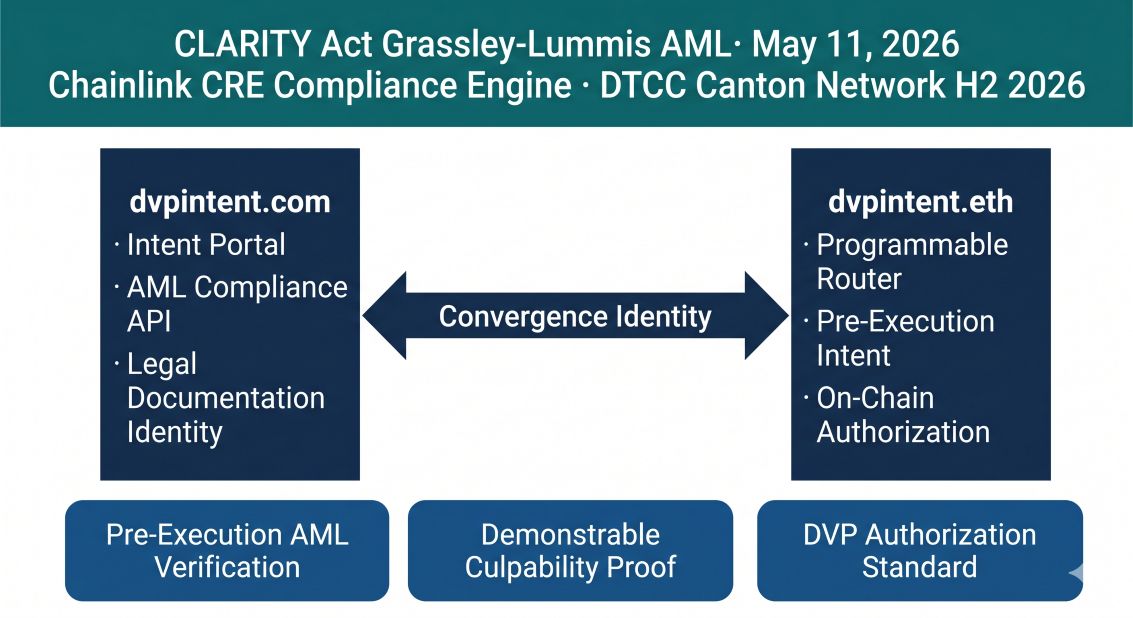
dvpintent.com is the institutional Web2 portal identity for the pre-execution DVP intent documentation standard — the legal brand that appears in CLARITY Act AML filings, OCC examination submissions, and settlement agreements wherever the DVP intent authorization must be referenced. dvpintent.eth is the programmable on-chain routing identity — the ENS endpoint that software architects embed directly into DVP settlement protocol logic to record pre-execution intent before the atomic settlement event executes, creating the cryptographic compliance record that the Grassley-Lummis standard requires.
The Regulatory Foundation, The DVP Intent Architecture, and The Ecosystem
What is new in 2026 is that tokenised assets and tokenised deposits make atomic DVP technically achievable at the commercial layer — without the pre-funding requirements, operational complexity, or time constraints of existing DVP infrastructure. Solulab
This technical achievement creates a new compliance requirement: when DVP settlement executes in milliseconds rather than T+2 days, the window for retroactive compliance verification closes simultaneously. Intent must be documented before execution — not reconstructed after.
The Grassley-Lummis AML compromise of May 11, 2026 operationalized this requirement at the federal statutory level: demonstrable culpability is the prosecution standard, meaning an institution that cannot produce pre-execution intent documentation is exposed to regulatory enforcement regardless of whether its DVP settlement was ultimately compliant.
The Chainlink Runtime Environment acts as the orchestration layer — connecting the Data Standard for verifying asset prices or NAV and the Compliance Standard for checking identity into a unified workflow. In a DVP scenario, the CRE coordinates CCIP messages, ensures compliance checks are met via the Automated Compliance Engine, and executes the atomic swap. Crypto Times
This CRE architecture is the technical implementation of DVP intent documentation: compliance checks are verified before the atomic swap executes — creating the pre-execution intent record that the Grassley-Lummis standard requires as proof of demonstrable compliance.
The DTCC Canton Network pilot launching H2 2026 will bring this pre-execution intent standard to US equity and Treasury markets — requiring every institution participating in the pilot to document DVP settlement intent before execution under full DTCC oversight.
The DVP Intent Architecture
DVP intent infrastructure operates through three simultaneous documentation layers that dvpintent.com and dvpintent.eth address directly.
The mandate authorization layer captures and cryptographically signs the institutional authorization for every DVP settlement event before execution — establishing the documented proof that the settlement was initiated by an authorized party under a legitimate mandate. This is the pre-execution record that satisfies the Grassley-Lummis demonstrable culpability standard at the DVP transaction level.
The compliance verification layer attaches KYC/AML checks directly to the DVP intent record before the settlement executes — verifying counterparty identities, sanctions screening, and transaction purpose at the intent layer rather than retroactively after settlement. The protocol ensures neither transaction is finalized unless both legs are valid — if one leg fails, the bond transfer is never executed, protecting both counterparties. The compliance layer extends this protection to the intent documentation itself. Blockchain Council
The execution authorization layer releases the intent record to the DVP router — signaling to dvprouter.com/.eth, Chainlink CRE, and any other routing infrastructure that the settlement has been authorized, compliant-checked, and documented before atomic execution begins.
dvpintent.com is the institutional portal for this three-layer architecture — the compliance identity, the DVP intent brand, and the legal anchor for any institution building Grassley-Lummis-compliant pre-execution DVP intent documentation.
dvpintent.eth is the programmable on-chain routing identity — the ENS endpoint that software architects embed directly into DVP settlement protocol logic to record pre-execution intent on-chain before atomic settlement executes. Where dvpintent.com provides the legal documentation identity that compliance teams reference in CLARITY Act filings, dvpintent.eth provides the machine-readable routing layer that protocol engineers embed into the DVP execution stack — creating the immutable pre-execution intent record that connects regulatory compliance to technical settlement execution.
Together, dvpintent.com & .eth form the complete Convergence Identity: the legal anchor for compliance teams documenting DVP settlement intent under the Grassley-Lummis AML standard, and the technical routing layer for software architects implementing pre-execution intent verification — the two audiences that every institutional DVP deployment must simultaneously satisfy.
The DVP Intent Ecosystem
dvpintent is the pre-execution authorization layer of the PillarsX DVP namespace. It connects directly to dvprouter.com/.eth — the DVP routing identity that receives intent authorization before executing cross-chain settlement — and to dvpvp.com/.eth as the complete DVP+PvP finality identity that dvpintent authorizes.
Beyond the DVP cluster, dvpintent integrates with verifiableintent.com/.eth as the broader verifiable intent standard within which DVP intent operates, amlintent.com/.eth as the AML intent documentation standard that governs DVP intent compliance verification, and atomicintent.com/.eth as the atomic execution intent layer that parallels dvpintent across all asset classes simultaneously.
The complete DVP authorization stack — dvpintent for pre-execution documentation, dvprouter for cross-chain routing, dvpvp for finality confirmation, dvpledger for immutable record-keeping — provides every institution executing DVP settlement with a complete institutional identity that covers intent authorization, execution routing, finality confirmation, and compliance documentation simultaneously.
Strategic Constellations & Bundle Potential
Bundle 1 — “The DVP Authorization Stack” (for Pre-Execution Compliance Infrastructure) Target: Every institution executing DVP settlement under CLARITY Act AML requirements. Domains: dvpintent.com/.eth + dvprouter.com/.eth + dvpvp.com/.eth. Complete DVP authorization namespace — intent documentation, routing execution, and finality confirmation.
Bundle 2 — “The Intent Compliance Stack” (for CLARITY Act AML Documentation) Target: Compliance teams building Grassley-Lummis demonstrable culpability documentation. Domains: dvpintent.com/.eth + verifiableintent.com/.eth + amlintent.com/.eth. Complete intent compliance namespace — DVP authorization, verifiable intent standard, and AML documentation layer.
Bundle 3 — “The Full DVP Infrastructure” (for Strategic Acquirers) Domains: dvpintent.com/.eth + dvprouter.com/.eth + dvpvp.com/.eth + dvpledger.com/.eth + instantdvp.com/.eth. The complete PillarsX DVP namespace — every layer from intent authorization through routing and finality to immutable ledger records. This package exists exactly once.
Explore related PillarsX infrastructure: → dvprouter.com & .eth — DVP Router Identity → dvpvp.com & .eth — Complete DVP+PvP Finality Identity → dvpledger.com & .eth — DVP Ledger Identity → verifiableintent.com & .eth — Verifiable Intent Identity → amlintent.com & .eth — AML Intent Documentation Identity
Strategic Acquisition Inquiry
Initiate secure communication with representatives of the IP holder to evaluate the acquisition of this premium infrastructure namespace or its corresponding strategic asset bundle.