
ledgerinterop.com & .eth — Ledger Interop Identity
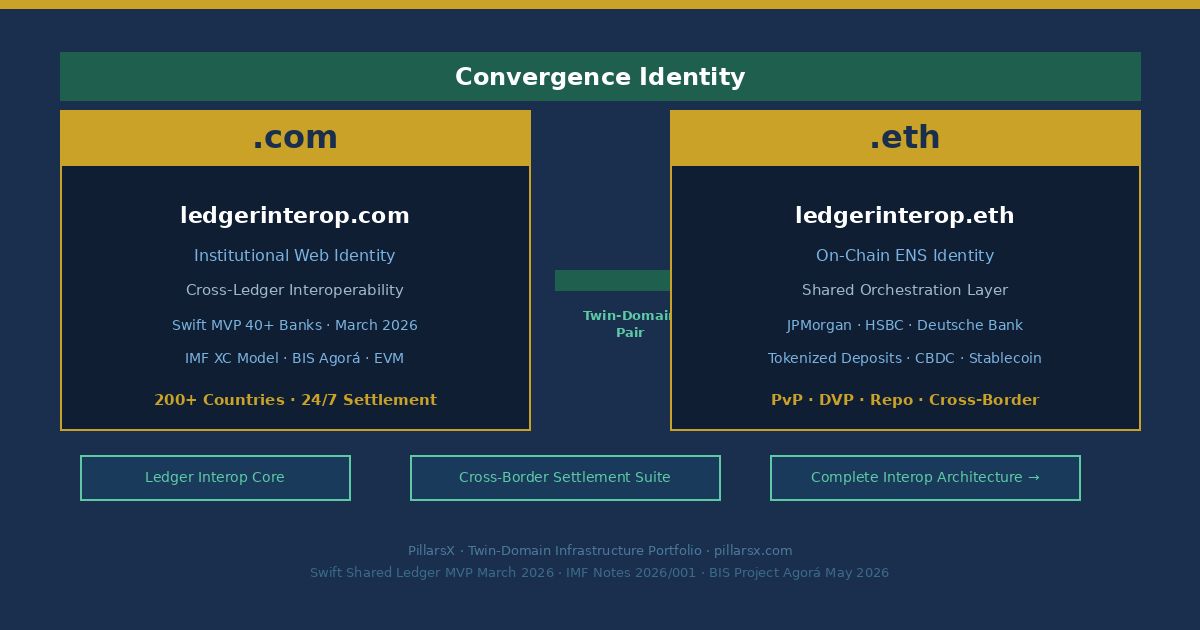
Swift announced on 30 March 2026 that its blockchain-based shared ledger — built on EVM-compatible Hyperledger Besu architecture with 40+ participating banks including JPMorgan, HSBC, Deutsche Bank, Standard Chartered, and Wells Fargo — has moved from design to MVP construction, with live transactions planned before end of 2026. The ledger introduces a shared orchestration layer that validates and synchronises interbank payment commitments using tokenised deposits, enabling 24/7 cross-border payments across 200+ countries while supporting interoperability across institutions without fragmenting existing infrastructures. The IMF confirmed in Notes 2026/001 (April 2026) that cross-border interoperability without a single supranational ledger requires a common interface layer linking domestic financial institutions and tokenized infrastructures — the XC model — while retaining jurisdictional control over currency issuance, compliance standards, and monetary policy. The ledgerinterop namespace anchors the institutional identity for this cross-ledger interoperability infrastructure — the shared orchestration, synchronisation, and interface layer connecting national tokenized deposit ledgers, stablecoins, CBDCs, and blockchain networks.
The history of financial infrastructure is a history of interoperability problems. SWIFT itself was born from the interoperability problem of the 1970s — banks in different countries with different messaging systems, different settlement cycles, different legal frameworks, unable to communicate efficiently across borders. The solution was a shared messaging standard: not a single ledger, not a unified system, but a common interface layer that let different systems communicate without requiring any of them to become the same system. Fifty years later, Swift is building the same solution for the tokenized era — and the problem it is solving is identical in structure, even if the technology has changed beyond recognition.
The tokenized finance landscape of 2026 is fragmenting in precisely the pattern that financial infrastructure has always fragmented when new technology arrives ahead of coordination: dozens of national tokenized deposit systems, multiple stablecoin networks, competing CBDC architectures, permissioned institutional blockchains, and public DeFi infrastructure, all operating in isolation. The IMF has named this the defining structural challenge of tokenized finance: cross-border interoperability without creating a single supranational ledger requires a common interface layer that links domestic financial institutions and tokenized infrastructures, allowing jurisdictions to retain control over currency issuance, compliance standards, and monetary policy while facilitating standardized messaging, foreign exchange conversion, and settlement coordination across borders.
Swift’s response is the most concrete institutional answer to this challenge to date: a blockchain-based shared ledger built on EVM-compatible Hyperledger Besu architecture, developed with 40+ global banks, moving to live transactions in 2026. The ledger is not a replacement for national settlement systems — it is the interoperability layer above them: a shared orchestration infrastructure that validates and synchronises interbank payment commitments using tokenised deposits, enabling 24/7 cross-border payments without fragmenting existing infrastructures. ledgerinterop.com and ledgerinterop.eth anchor the institutional namespace for this interoperability layer — the identity infrastructure for cross-ledger coordination at the convergence of Swift’s shared ledger, the IMF’s XC model, BIS Project Agorá, and the full landscape of national tokenized deposit architectures.
Swift Shared Ledger — The Production Interoperability Standard
Swift’s shared ledger architecture establishes the production standard for ledger interoperability in institutional finance. The design is explicit: the ledger enables interoperability between banks’ tokenised deposits to facilitate 24/7 cross-border payments — not by replacing existing settlement infrastructure, but by adding an orchestration layer that coordinates across it. The MVP supports multiple settlement options and reuses existing compliance infrastructure, functioning as a bridge between traditional finance and decentralised systems — explicitly enabling interoperability between stablecoins, tokenised deposits, CBDCs, and blockchain solutions including Ripple and Stellar.
The model can support advanced interbank processes spanning programmable corporate payment flows, foreign exchange PvP and cash movements for securities transactions — meaning ledger interoperability is not limited to simple payment flows but extends to the full settlement stack: DVP, PvP, repo, margin, collateral. These capabilities build on the same principles of shared visibility, enhancing coordination across institutions without introducing competing parallel rails or fragmenting existing infrastructures.
Forty banks including JPMorgan, HSBC, Deutsche Bank, MUFG, Standard Chartered, Societe Generale-FORGE, Wells Fargo, and Westpac participated in the design phase. Twenty-five are expected to begin adopting the framework by end of June 2026. This is not a research consortium — it is a production deployment by the institutions that collectively process the majority of global cross-border payment volume.
IMF XC Model and the Multi-Ledger Interoperability Architecture
The IMF’s XC model — developed as a complement to the BIS unified ledger concept — addresses the interoperability challenge from a different architectural starting point. Where BIS Project Agorá tests whether a single unified ledger can serve all settlement functions, the XC model envisions a common interface layer that links domestic financial institutions and tokenized infrastructures, allowing jurisdictions to retain control over currency issuance, compliance standards, and monetary policy.
The XC approach has significant implications for ledger interoperability infrastructure. If the future financial system is not a single global ledger but a network of national tokenized systems connected through common interface layers, then the identity infrastructure of those interface layers becomes a critical namespace question. What do institutions resolve to when they initiate a cross-ledger transaction? What identity anchors the interoperability protocol that routes a tokenized deposit from Deutsche Bank’s ledger through Swift’s shared orchestration layer to Standard Chartered’s settlement system in Singapore? ledgerinterop.com and ledgerinterop.eth provide that institutional identity — the namespace for the interface layer of cross-ledger coordination.
ledgerinterop in the Complete Interoperability and Ledger Stack
ledgerinterop is the cross-ledger coordination layer of the PillarsX interoperability namespace — the infrastructure identity for the orchestration and synchronisation layer that connects national tokenized deposit systems, stablecoins, CBDCs, and permissioned blockchains without requiring any of them to become the same system. It connects directly to ledgerintent as the intent formation layer where cross-ledger transactions originate, paymentinterop as the payment-specific interoperability identity, pvpinterop as the PvP-specific cross-currency interoperability layer, and stablecoininterop as the stablecoin-specific cross-chain interoperability standard.
Beyond the interoperability cluster, ledgerinterop integrates with composablesettle as the composable settlement standard for multi-ledger transactions, dvpinterop as the DVP-specific cross-ledger settlement identity, and mciinterop as the MCI-specific interoperability standard under MiCA and GENIUS Act requirements. Together these form the complete institutional interoperability namespace — from ledger-level cross-system orchestration through payment, PvP, DVP, and stablecoin-specific layers — covering every dimension of the cross-ledger coordination that Swift, the IMF, and BIS are simultaneously building as the foundational infrastructure of tokenized global finance.
Related PillarsX Infrastructure
ledgerintent.com & .eth — Ledger Intent Identity
intent formation and mandate anchoring for programmable ledger agent execution
pvpinterop.com & .eth — PvP Interop Identity
cross-ledger PvP currency settlement interoperability under Swift and BIS Agorá
paymentinterop.com & .eth — Payment Interop Identity
payment-specific cross-ledger interoperability standard
composablesettle.com & .eth — Composable Settlement Identity
composable settlement for multi-ledger transactions across interoperable systems
Strategic Constellations & Bundle Potential
Bundle 1 — Ledger Interoperability Coreledgerinterop + ledgerintent + paymentinterop — the complete ledger coordination namespace from intent formation through interoperability to payment execution. Targets: Swift shared ledger MVP participants, IMF XC model implementers, BIS Project Agorá private sector participants building cross-ledger coordination infrastructure.
Bundle 2 — Cross-Border Settlement Interop Suiteledgerinterop + pvpinterop + dvpinterop + stablecoininterop — the complete cross-border settlement interoperability namespace spanning PvP currency, DVP securities, and stablecoin cross-chain layers. Targets: JPMorgan, HSBC, Deutsche Bank, Standard Chartered — Swift shared ledger MVP participants requiring complete interoperability namespace documentation.
Bundle 3 — Complete Interoperability Architectureledgerinterop + mciinterop + composablesettle + clearingrouter — the complete institutional interoperability namespace from ledger-level coordination through MCI compliance to composable settlement routing. Targets: Institutions building complete cross-ledger settlement infrastructure under simultaneous Swift, MiCA, and GENIUS Act requirements.
· Swift — Blockchain-Based Shared Ledger MVP · 40+ Banks · Live Transactions 2026 (March 30, 2026)
· IMF Notes 2026/001 — XC Common Interface Layer for Cross-Border Tokenized Finance (April 2026)
· BIS Project Agorá Final Report — Unified Ledger Interoperability Architecture (27 May 2026)
· Swift Financial Stack of the Future — Programmable Ledger Interoperability Standard (July 2026)
· FCA Horizon Scan — Programmable Finance Cross-Ledger Governance Framework (July 2026)
· GENIUS Act (S.1582) — Interoperability Standards for Payment Stablecoin Issuers (Final Rules 18 July 2026)
Explore Related
· ledgerintent.com & .eth — Ledger Intent Identity
· pvpinterop.com & .eth — PvP Interop Identity
· mciinterop.com & .eth — MCI Interop Identity
· composablesettle.com & .eth — Composable Settlement Identity
· Portfolio Acquisition → /acquire/
Disclaimer:PillarsX is a domain portfolio business. Nothing on this page constitutes legal, financial, or regulatory advice. Domain names do not confer regulatory status, licensing, or compliance certification of any kind. All content is for informational purposes only and does not constitute financial advice.