
ledgerintent.com & .eth — Ledger Intent Identity
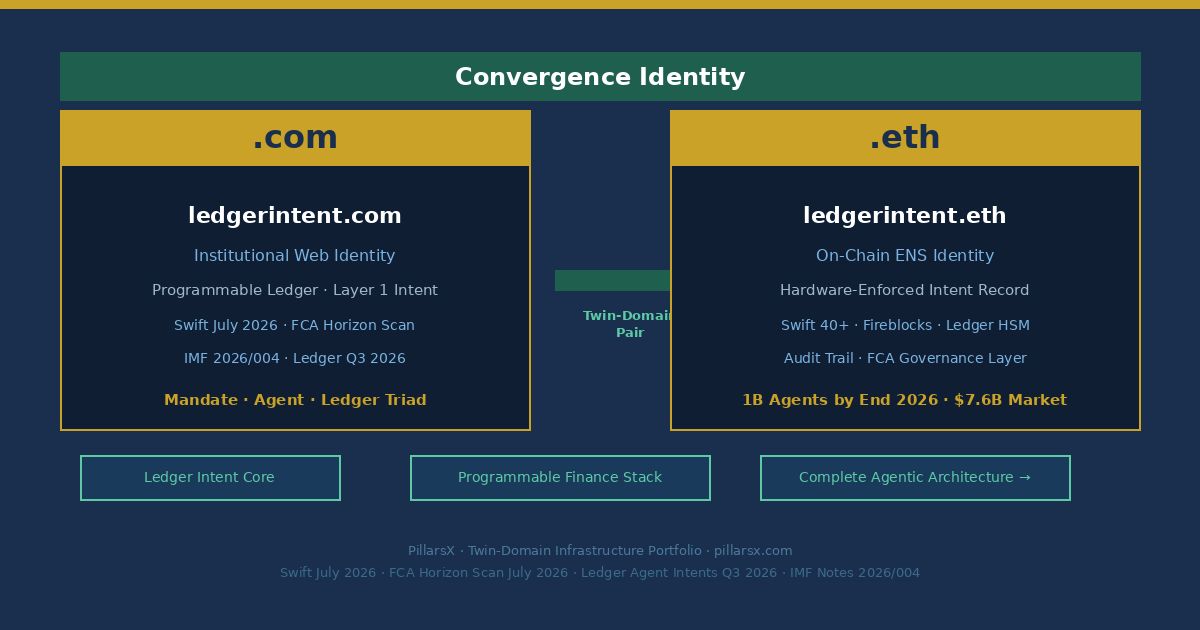
Swift confirmed in its Financial Stack of the Future (July 2026) that the institutional endpoint is a system orchestrated by AI agents operating within defined rules and mandates on highly performant programmable ledgers — establishing ledger intent as the foundational architectural concept of the next financial infrastructure cycle. The FCA's Horizon Scan (published July 2026) identified the key governance question for programmable finance as: who does the agent serve, what authority has it been given, how is intent captured, and how can outcomes be explained, challenged or reversed. Ledger is shipping Agent Intents in Q3 2026 — a hardware-enforced human-in-the-loop approval layer where agents propose actions on programmable ledgers and humans confirm with physical authorization before any consequential transaction executes. The IMF confirmed in Notes 2026/004 that intent formation and orchestration is Layer 1 of the normative architecture for agentic payment systems. The ledgerintent namespace anchors the institutional identity for the intent layer of programmable ledger infrastructure — where AI agent mandates are formed, verified, and cryptographically bound before execution on distributed settlement ledgers.
A programmable ledger without intent is an execution engine without authorization. Every smart contract, every atomic settlement, every autonomous agent transaction that executes on a distributed ledger begins with an instruction that originated somewhere — in a human decision, a regulatory mandate, an algorithmic optimization, or an AI agent’s interpretation of an objective. The question of how that originating intention is captured, verified, bound to authorized parameters, and made traceable to a responsible party is not a technical afterthought. It is the legal, regulatory, and fiduciary foundation upon which the entire programmable finance architecture rests.
Swift has named this convergence explicitly: the financial stack of the future will be orchestrated by many autonomous AI agents operating within defined rules and mandates on highly performant, quantum-safe, programmable ledgers. The mandate is the authorization boundary. The intent is what the agent proposes to execute within that boundary. The ledger is where execution becomes irrevocable. These three elements — mandate, intent, ledger — form the architectural triad that every institution deploying agentic settlement infrastructure must address. Who does the agent serve? What authority has it been given? How is intent captured? How can outcomes be explained, challenged, or reversed? These are the questions the FCA identified as the central governance challenge of programmable finance in its July 2026 Horizon Scan.
Ledger — the hardware security infrastructure provider whose Secure Element chips protect billions in digital assets — has named this challenge directly and is shipping its response in Q3 2026: Agent Intents, a hardware-enforced approval layer where agents propose actions on programmable ledgers and humans confirm them on a Trusted Display before any consequential transaction executes. The IMF has provided the normative framework: intent formation and orchestration is Layer 1 of the three-layer agentic payment architecture, the layer that must be governed before authorization and settlement can proceed. ledgerintent.com and ledgerintent.eth anchor the namespace for this Layer 1 infrastructure — the institutional identity for intent-anchored programmable ledger execution at the convergence of Swift’s strategic vision, the FCA’s governance framework, Ledger’s hardware security roadmap, and the IMF’s normative architecture.
The IMF Three-Layer Architecture — Intent as Layer 1
The IMF’s framework for agentic payment systems begins with a precise architectural statement: intent formation and orchestration is Layer 1, the layer that defines what the agent is trying to do, within what parameters, on whose behalf, and under what mandate constraints. Layer 2 is authorization and control — the strictly rules-based boundary that accepts structured intent from Layer 1 only if it satisfies verifiable mandates, policy constraints, and regulatory checks. Layer 3 is settlement — where authorized payment instructions execute with irrevocable legal finality on distributed ledger infrastructure.
This three-layer separation — intent, authorization, settlement — is not merely descriptive. It is normative: the IMF argues that keeping uncertain, probabilistic AI decision making separate from automatic payment execution is the central design principle for safe agentic finance. The intent layer must be structured, explicit, and auditable. An intent that cannot be traced to a specific mandate, verified against policy constraints, and documented in an audit trail is not eligible for Layer 2 authorization. An instruction that does not pass Layer 2 cannot reach Layer 3 settlement. The ledger executes only what the intent layer has authorized — and the intent layer can only authorize what the mandate establishes.
ledgerintent captures the namespace for this Layer 1 function at the ledger level — not the intent layer of a specific settlement type (that is dvpintent, pvpintent, fheintent) but the overarching intent infrastructure of the programmable ledger itself: the identity layer where mandates are established, agent intents are formed, and the authorization chain is anchored before any settlement rail receives an instruction.
Swift Shared Ledger, Fireblocks and the 40-Institution Intent Standard
Swift is constructing a shared ledger that lets banks’ own tokenized deposits interoperate, with banks retaining control of their keys, assets, and settlement — with its MVP involving more than 40 institutions targeting live transactions before the end of 2026. This architecture is not a single blockchain but a shared intent and interoperability layer: institutions bring their own ledgers, their own tokenized deposits, and their own settlement infrastructure; Swift provides the shared ledger that enables their intents to be expressed, routed, and matched across institutional boundaries.
The governance question that this shared ledger architecture raises is precisely the ledger intent question. When an institution’s AI agent expresses an intent to transfer tokenized deposits across Swift’s shared ledger, what is the intent format? What mandate does it represent? How is it verified by the receiving institution’s systems? How is the audit trail maintained across institutional boundaries? These questions are operational, legal, and regulatory simultaneously — and they require namespace infrastructure that both institutions recognize as authoritative. Fireblocks confirmed that of 290 transaction banking leaders globally, only 3.4% have live tokenized deposit capability today, with 21% committed to launch by June 2027. The infrastructure window for intent-anchored programmable ledger namespace is precisely this transition period.
Ledger Agent Intents, FCA Governance and the Hardware Root of Trust
Ledger’s Agent Intents framework — shipping in Q3 2026 — establishes the hardware-enforced implementation of the IMF’s Layer 1 intent architecture: agents propose actions, humans review them on a Trusted Display, and confirmation requires physical authorization before any transaction executes. Agent Policies adds the autonomous dimension: hardware-enforced rules defined by the human (spending caps, permitted counterparties, transaction limits) that the Hardware Security Module enforces on every subsequent agent action without requiring human review of each individual transaction.
The FCA’s July 2026 Horizon Scan identifies the governance challenge that Ledger’s architecture addresses: agentic systems introduce a structural complexity into market conduct surveillance because they may act within a mandate, optimise towards a target, or interact with other systems in ways that produce market impact without a trader manually directing each step. Surveillance teams may need to monitor the behaviour of automated systems as a distinct conduct population. The intent capture mechanism — how Ledger’s Agent Intents records what the agent proposed, what the human authorized, and what the ledger executed — is precisely the audit trail infrastructure that the FCA identifies as necessary for programmable finance governance.
ledgerintent.eth is the on-chain resolution layer for this intent infrastructure: an ENS-resolvable identity where agent mandate parameters, intent records, and hardware authorization attestations can be stored as cryptographically verifiable on-chain entries — the immutable audit trail that Swift, the FCA, the IMF, and Ledger all identify as the governance foundation of programmable ledger finance.
Related PillarsX Infrastructure
verifiableintent.com & .eth — Verifiable Intent Identity
cryptographic intent verification and always-on trust infrastructure for programmable finance
dvpintent.com & .eth — DVP Intent Identity
DVP-specific mandate formation and intent anchoring before atomic settlement execution
pvpintent.com & .eth — PvP Intent Identity
mandate-based authorization for autonomous cross-border PvP currency settlement
agenticdvp.com & .eth — Agentic DVP Identity
autonomous AI coordination layer executing DVP transactions within ledger intent boundaries
Strategic Constellations & Bundle Potential
Bundle 1 — Ledger Intent Coreledgerintent + verifiableintent + dvpintent — the complete intent namespace from ledger-level mandate architecture through verifiable cryptographic anchoring to DVP-specific execution intent. Targets: Swift shared ledger participants, Ledger Agent Intents enterprise partners, IMF framework implementers building Layer 1 intent infrastructure.
Bundle 2 — Programmable Finance Governance Stackledgerintent + ledgerinterop + programmablecompliance + agenticdvp — the complete programmable ledger governance namespace from intent formation through interoperability and compliance to agentic execution. Targets: FCA-regulated wholesale market participants, institutions building programmable finance infrastructure under FCA Horizon Scan governance standards.
Bundle 3 — Complete Agentic Ledger Architectureledgerintent + pvpintent + dvpintent + fheintent + settleintent — the complete intent namespace stack across ledger, PvP, DVP, FHE, and settlement layers. Targets: Swift, Ledger, Google AP2 ecosystem, institutions building complete mandate-governed agentic payment infrastructure across all settlement types.
· Swift — "The Financial Stack of the Future" · Programmable Ledger Agent Mandate Architecture (July 2026)
· FCA Horizon Scan — "Collaboration on AI and Programmable Finance Risks" · Intent Governance Framework (July 2026)
· Ledger — Agent Intents & Policies · Q3 2026 Hardware-Enforced Intent Roadmap (April 2026)
· IMF Notes 2026/004 — "How Agentic AI Will Reshape Payments" · Three-Layer Intent Architecture (April 2026)
· Fireblocks — "Tokenized Deposits and Transaction Banking" · Swift Shared Ledger 40+ Institutions (July 2026)
· arXiv:2607.00245 — "Agent-to-Agent Finance: Blockchain Payments and Trust Infrastructure" (July 2026)
Explore Related
· verifiableintent.com & .eth — Verifiable Intent Identity
· dvpintent.com & .eth — DVP Intent Identity
· ledgerinterop.com & .eth — Ledger Interop Identity
· agenticdvp.com & .eth — Agentic DVP Identity
· Portfolio Acquisition → /acquire/
Disclaimer:PillarsX is a domain portfolio business. Nothing on this page constitutes legal, financial, or regulatory advice. Domain names do not confer regulatory status, licensing, or compliance certification of any kind. All content is for informational purposes only and does not constitute financial advice.