
CoveredCustodian — The Covered Custodian Standard for Regulated Digital Asset Custody
In 2026, not every institution qualifies to hold digital assets on behalf of others — the Covered Custodian Standard defines exactly who does, under what conditions, and with what cryptographic proof.
🔴 Regulatory Update — June 2026
OCC national trust bank charters confirmed — Covered Custodian qualification now operationally active for digital asset institutions
Five OCC national trust bank charters conditionally approved for digital asset entities — making the Covered Custodian framework the live operational standard for institutional custody in 2026. Combined with the CLARITY Act QDAC requirements of May 14 and the OCC Final Rule expected before July 18, every institution providing digital asset custody must demonstrate Covered Custodian qualification under examination-ready conditions.
→ Source: OCC National Trust Bank Charter Approvals & CLARITY Act QDAC Sections 402/405, 2026🔴 Regulatory Update — May 14, 2026
CLARITY Act Senate markup establishes QDAC as mandatory federal custody standard — Covered Custodian framework directly confirmed
The Digital Asset Market Clarity Act Senate markup of May 14, 2026 formally established the Qualified Digital Asset Custodian standard under Sections 402 and 405 — requiring every FCM to hold customer digital assets in a QDAC with licensing, examination, capital requirements, and customer asset protection standards directly aligned with the OCC Covered Custodian framework.
→ Source: Digital Asset Market Clarity Act Sections 402 & 405, Senate Markup May 14, 2026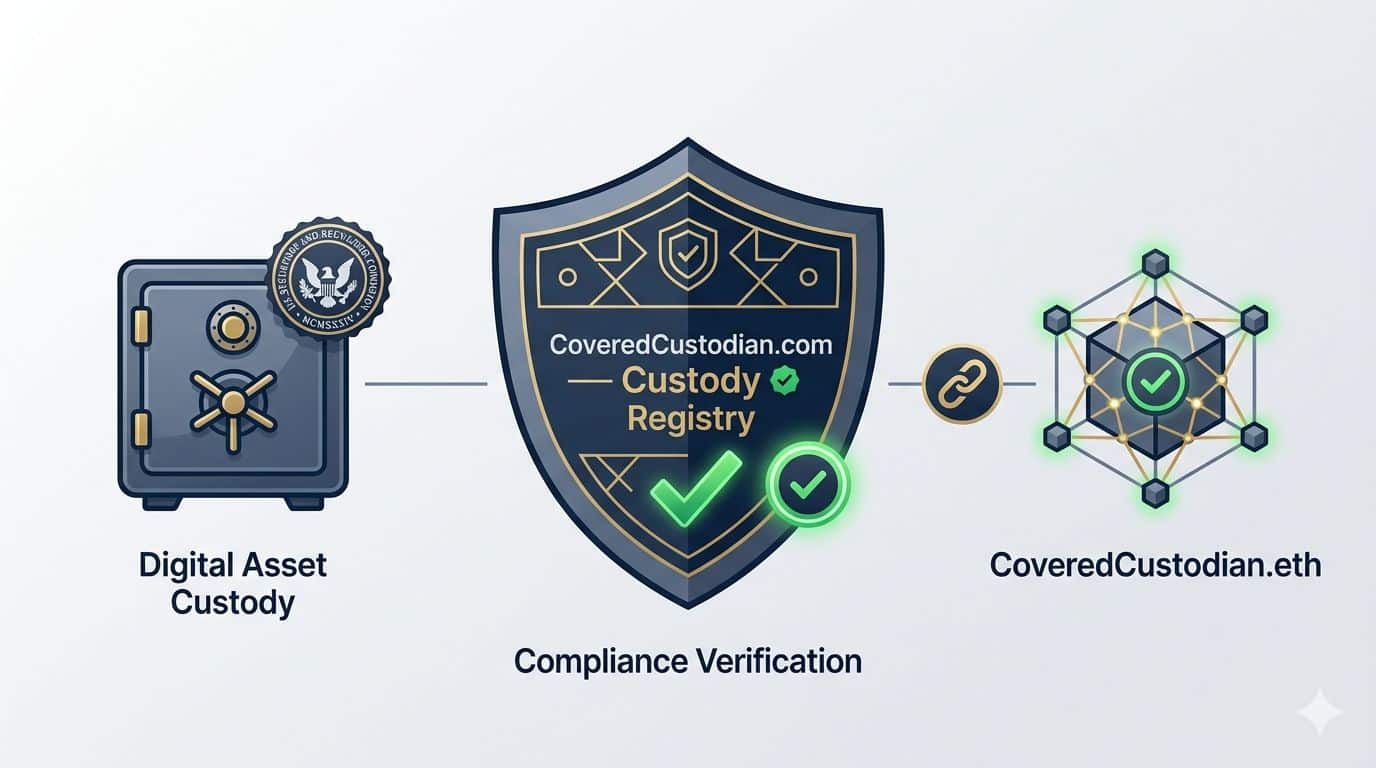
Why the Covered Custodian Standard Is the Most Critical Custody Requirement of 2026
Under the GENIUS Act (12 U.S.C. § 5909), the term Covered Custodian is not a market designation — it is a legal classification. Only institutions that meet the precise criteria defined in § 10(a) of the GENIUS Act are permitted to provide custodial or safekeeping services for payment stablecoin reserves, stablecoins used as collateral, and the private keys used to issue payment stablecoins.
The OCC operationalizes this requirement through three specific obligations:
Supervisory Qualification: A Covered Custodian must be subject to supervision by a primary Federal payment stablecoin regulator, a primary financial regulatory agency under the Dodd-Frank Act, or a State bank supervisor. Institutions operating outside this supervisory perimeter are legally prohibited from providing custody services — regardless of their technical capabilities.
Mandatory Custody Agreement: Every Covered Custodian must enter into a formally documented custody agreement with the permitted payment stablecoin issuer. This agreement must explicitly document compliance with § 10(b), (c), and (d) of the GENIUS Act — including policies and procedures for ongoing compliance verification.
Qualified Digital Asset Custody: The OCC requires that custodial services meet institutional-grade standards for asset segregation, key management, and operational continuity. A Covered Custodian that cannot demonstrate these standards on-demand — to examiners, counterparties, and automated systems — is a custodian operating outside regulatory boundaries.
The Covered Custodian Standard is the direct institutional response: a cryptographically verifiable, continuously documented custody compliance layer that satisfies all three OCC mandates simultaneously.
Source: OCC Proposed Rules – Permitted Payment Stablecoin Issuers, Federal Register, March 2, 2026
The Custody Compliance Gap — When Holding Assets Is Not the Same as Being Qualified to Hold Them
The operational challenge for institutions in 2026 is not the technical ability to hold digital assets. Vault infrastructure, key management systems, and custody technology are widely available. The critical gap is demonstrable, continuously verifiable qualification — the ability to prove at any moment that the institution holding these assets meets every legal criterion the GENIUS Act requires of a Covered Custodian.
Three failure modes define the institutional risk landscape:
Qualification Gap: An institution provides custody services for stablecoin reserves without meeting the full supervisory requirements of GENIUS Act § 10(a). Technically capable but legally unqualified — every asset held under these conditions represents an unquantified regulatory liability for both the custodian and the stablecoin issuer relying on their services.
Documentation Failure: The OCC requires a formally executed custody agreement documenting compliance with § 10(b), (c), and (d). Without a continuously updated, cryptographically verifiable record of this agreement and its ongoing compliance status, an institution cannot satisfy OCC examination requirements — regardless of how robust its underlying custody infrastructure is.
Real-Time Verification Gap: In automated settlement environments, counterparties and AI agents must verify custodian qualification status before executing high-value transactions. Without an on-chain, machine-readable signal confirming Covered Custodian status at the moment of execution, Fiduciary Agentic Responsibility cannot be discharged — and every automated custody interaction carries unquantified legal exposure.
This is where CoveredCustodian.com operates as the institutional qualification registry — a continuously updated, OCC-mapped custodian compliance layer accessible via API to compliance teams, stablecoin issuers, and counterparty systems. And this is where CoveredCustodian.eth becomes indispensable: translating that registry into a blockchain-native qualification signal, queryable by smart contracts and AI agents at the precise moment of execution — with cryptographic proof of Covered Custodian status at that exact block timestamp.
Source: BIS — Tokenisation and the future of money, 2025 — The BIS framework identifies continuously verifiable custodian qualification as a foundational requirement for institutional-grade digital asset operations across Unified Ledger infrastructures.
CoveredCustodian as the Trust Layer of the PillarsX Compliance Stack
Every institutional transaction involving digital assets requires one verified confirmation before execution: is the entity holding these assets a legally qualified Covered Custodian under GENIUS Act § 10(a)? Without that confirmation, no reserve can be legitimately attested, no collateral can be safely posted, and no settlement can achieve legal finality.
Within the PillarsX infrastructure, CoveredCustodian.com/.eth functions as the foundational trust layer — the qualification checkpoint that every downstream compliance process depends on:
EligibleAsset.eth          →  Asset classification confirmed
        ↓                     [Qualified Digital Asset Custody]
CoveredCustodian.eth       →  Custodian qualification verified
        ↓                     [Operational Resilience]
PermittedReserves.eth      →  Reserve category validated
                              [Programmable Compliance]
As part of the complete PillarsX Compliance Stack, CoveredCustodian sits at the critical intersection between asset classification and reserve validation — ensuring that every custody relationship in the chain is legally qualified before any reserve position is established or attested.
→ Before custody can be established, every asset must be classified: EligibleAsset — The Eligible Asset Standard
Strategic Constellation & Bundle Potential
“The Custody Compliance Stack” · For GENIUS Act § 10 Qualified Custodians
Designed for institutions requiring end-to-end, legally documented custody qualification — from asset eligibility verification through to continuously attested reserve compliance:
| Domain | Function | Regulatory Hook |
|---|---|---|
| CoveredCustodian.com/.eth | Custodian qualification registry & on-chain verification oracle | GENIUS Act § 10(a) – Covered Custodian Definition |
| EligibleAsset.com/.eth | Asset classification gateway before custody is established | OCC § 15.11(b) – Eligible Asset Categories |
| PermittedReserves.com/.eth | Reserve status validation for custodied assets | OCC § 15.11(c) – Diversification Requirements |
| VerifiableReserve.com/.eth | Continuous solvency attestation for custodied reserve positions | GENIUS Act § 5903 – 1:1 Reserve Backing |
→ Platzierung: Am Ende von Pfeiler 3, direkt nach dem Flow-Diagramm: „→ Before custody can be established, every asset must be classified: EligibleAsset — The Eligible Asset Standard“
„All content is for informational purposes only and does not constitute financial advice.“