
DTAVerify — The Digital Transfer Agent Standard for Cryptographic RWA Verification
Real World Assets require a verified bridge between their legal existence and their on-chain representation — the Digital Transfer Agent Standard ensures every tokenized asset is cryptographically proven, legally traceable, and institutionally compliant.
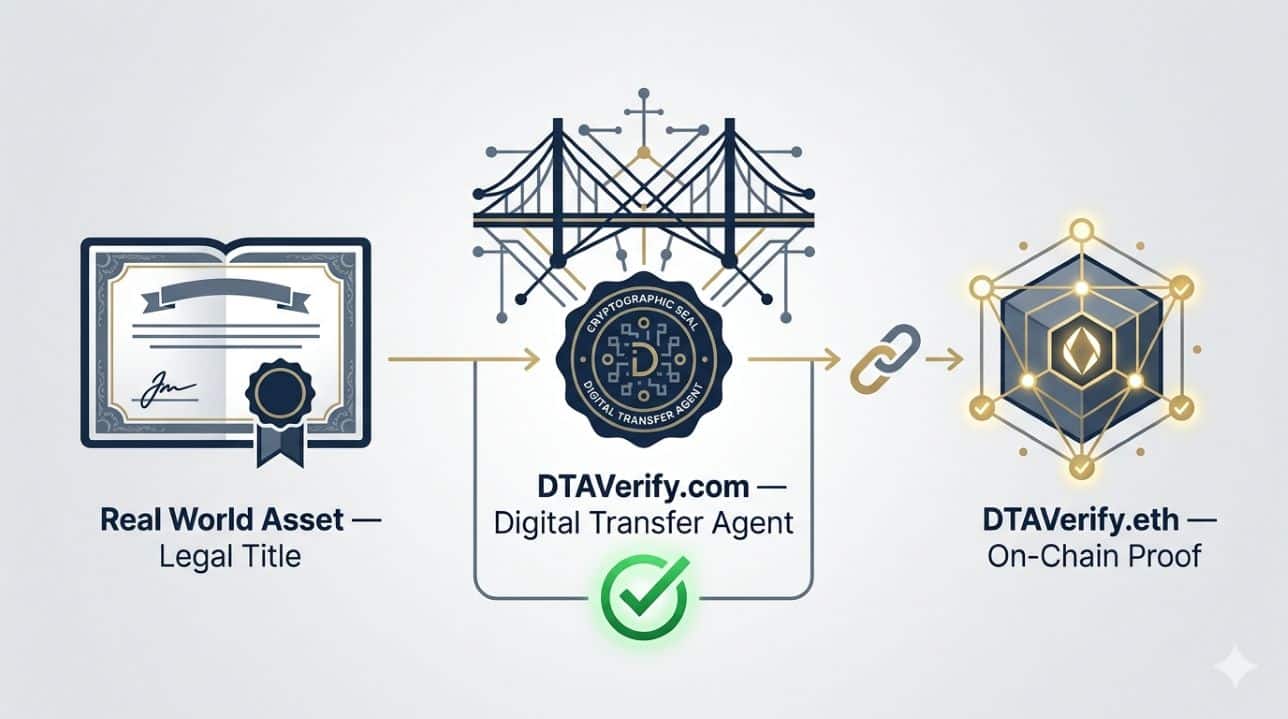
Pillar 1: Why the Digital Transfer Agent Is the Critical Link Between RWAs and Institutional Finance
The tokenization of Real World Assets has created an unprecedented opportunity for institutional capital markets — and an equally unprecedented regulatory challenge. Under the GENIUS Act (12 U.S.C. § 5903), the SEC Digital Asset Securities Framework (2026), and the latest OCC Interpretive Letters on RWA Tokenization, every tokenized asset must have a verified, legally accountable intermediary confirming the integrity of the connection between its real-world legal title and its on-chain representation.
The OCC operationalizes this requirement through two specific obligations:
Verified Asset Provenance: Every tokenized Real World Asset must have a cryptographically verifiable chain of custody linking its original legal title to its on-chain token. A token without verified provenance is not a digital asset — it is an unsubstantiated claim. The Digital Transfer Agent is the legally accountable entity that establishes, maintains, and cryptographically proves this chain at every point in the asset’s lifecycle.
Continuous Compliance Attestation: As regulatory requirements evolve — new SEC guidance on digital asset securities, updated OCC interpretive letters on eligible tokenized assets, revised GENIUS Act provisions — the Digital Transfer Agent must continuously verify that every tokenized asset in its registry remains compliant with applicable law. Static verification at the point of tokenization is insufficient in a regulatory environment that updates in real time.
The Digital Transfer Agent Standard is the direct institutional response: a continuously verified, cryptographically anchored bridge between real-world legal titles and their on-chain representations — satisfying both mandates simultaneously.
Source: OCC Proposed Rules – Permitted Payment Stablecoin Issuers, Federal Register, March 2, 2026
Pillar 2: The Provenance Gap — When Tokenized Assets Cannot Prove Their Own Legitimacy
The operational challenge for institutions tokenizing Real World Assets in 2026 is not the technical process of creating tokens. Tokenization platforms are widely available and increasingly commoditized. The critical gap is continuous, cryptographically provable legitimacy — the ability to demonstrate at any moment that every tokenized asset in circulation has a verified, legally accountable connection to its real-world counterpart.
Three failure modes define the institutional risk landscape:
Provenance Fragmentation: A tokenized asset changes hands multiple times across different platforms and jurisdictions. At each transfer, the connection between the token and its underlying real-world legal title weakens — documentation becomes incomplete, custody records fragment, and the cryptographic chain of ownership breaks. Without a Digital Transfer Agent maintaining continuous provenance verification, the token eventually becomes legally unenforceable — regardless of its on-chain existence.
Compliance Status Drift: A tokenized asset qualifies as an eligible reserve asset at the moment of tokenization — but regulatory conditions change. New OCC guidance on permitted tokenized assets, updated SEC classifications, revised GENIUS Act provisions. Without continuous Programmable Compliance verification at the DTA layer, institutions continue holding tokens whose eligibility status has silently expired — accumulating regulatory violations with every passing compliance cycle.
Cross-Border Legal Ambiguity: A tokenized Real World Asset legally domiciled in one jurisdiction is traded in another. Without a standardized Digital Transfer Agent Standard applied consistently across every jurisdiction, the legal enforceability of the token varies by market — creating settlement risk that counterparties, regulators, and AI agents cannot quantify or accept.
This is where DTAVerify.com operates as the institutional provenance registry — a continuously updated, legally accountable verification layer that maintains the cryptographic chain between every real-world asset and its on-chain representation. And this is where DTAVerify.eth becomes indispensable: translating that registry into a blockchain-native provenance oracle — queryable by smart contracts, settlement systems, and AI agents at the moment of every transaction.
Source: BIS — Tokenisation and the future of money, 2025 — The BIS framework identifies continuous, legally accountable asset provenance verification as a foundational requirement for institutional RWA participation in Unified Ledger environments.
Pillar 3: DTAVerify as the Provenance Layer of the PillarsX RWA Infrastructure Stack
Every tokenized Real World Asset in a regulated institutional environment requires one verified foundation: a cryptographically proven, continuously maintained connection between its legal title and its on-chain representation. Without that foundation, no tokenized asset can be legitimately held as a reserve, posted as collateral, or settled atomically.
Within the PillarsX infrastructure, DTAVerify.com/.eth functions as the provenance layer — sitting between asset eligibility confirmation and permitted reserve validation:
EligibleAsset.eth       →  Asset classification confirmed
        ↓                  [Qualified Digital Asset Custody]
DTAVerify.eth           →  RWA provenance verified & legally attested
        ↓                  [Digital Transfer Agent Standard]
PermittedReserves.eth   →  Tokenized asset reserve status validated
                           [Programmable Compliance]
As part of the complete PillarsX RWA Infrastructure Stack, DTAVerify sits at the critical intersection between asset classification and reserve validation — ensuring that every tokenized Real World Asset is not only classified as eligible but also cryptographically proven to have a legitimate, continuously verified connection to its underlying legal title.
→ Every tokenized asset begins with a verified eligibility classification: EligibleAsset — The Eligible Asset Standard
Strategic Constellation & Bundle Potential
“The RWA Verification Stack” · For Institutionally Compliant Real World Asset Tokenization
Designed for institutions tokenizing Real World Assets under GENIUS Act and SEC Digital Asset Securities Framework requirements — ensuring every token has verified provenance, continuous compliance status, and legitimate reserve eligibility:
| Domain | Function | Regulatory Hook |
|---|---|---|
| DTAVerify.com/.eth | RWA provenance registry & continuous legal attestation | OCC – Digital Transfer Agent Standard |
| EligibleAsset.com/.eth | Asset classification gateway before tokenization | OCC § 15.11(b) – Eligible Asset Categories |
| PermittedReserves.com/.eth | Reserve status validation for tokenized RWAs | OCC § 15.11(b)(8) – Tokenized Reserve Assets |
| VerifiableReserve.com/.eth | Continuous solvency attestation for tokenized positions | GENIUS Act § 5903 – 1:1 Reserve Backing |
„All content is for informational purposes only and does not constitute financial advice.“