
dvpagent.com & .eth — DVP Agent Identity
The IMF published Notes 2026/004 (April 2026) establishing Know-Your-Agent verification — requiring mandated verifiable identities for financial bots linked to legal entities — as the primary regulatory frontier for autonomous payment systems. Google launched the Agent-to-Agent Payment Protocol (AP2) with 60+ partner organizations including Mastercard, PayPal, and Coinbase, using cryptographically signed mandates that capture upfront scoped instructions and create an audit trail of agent intent. Swift confirmed in its Financial Stack of the Future (July 2026) that AI agents managing tokenisation programmability within defined rules and mandates on programmable ledgers is the institutional endpoint of the current infrastructure cycle. Deloitte confirmed that 44% of financial services firms plan to deploy agentic AI in production during 2026. The dvpagent namespace anchors the institutional identity for the DVP-specific AI agent layer — the autonomous execution unit that operates within verified mandate boundaries to initiate, route, and confirm delivery-versus-payment transactions at machine speed.
An agent is not an algorithm. An algorithm follows a fixed set of rules to produce a predictable output from a defined input. An AI agent interprets objectives, plans multi-step actions, selects among alternatives, and executes autonomously across digital infrastructure — adapting to changing conditions without explicit instruction at each step. This distinction matters enormously for institutional settlement infrastructure, because the entire regulatory and legal framework of financial markets is built on the assumption that instructions come from humans who can be identified, verified, held accountable, and sanctioned.
When an AI agent initiates a DVP transaction, this assumption breaks. The agent is not the principal — it acts on behalf of a principal. Its identity is not a legal entity — it is a software process running inside a legal entity’s infrastructure. Its authorization is not a signature — it is a mandate that was established in advance and must now be verified in real time, at machine speed, across the settlement infrastructure that was never designed to receive instructions from non-human actors. Payment rails designed for humans cannot authorize an agent.
The institutional response to this challenge is emerging from three directions simultaneously. The IMF has established Know-Your-Agent as the normative regulatory framework — requiring verifiable identities for financial bots linked to legal entities, with traceability, consent, and liability chains documented before execution begins. Google’s AP2 protocol has established cryptographically signed mandates as the technical standard — capturing upfront scoped instructions and creating an audit trail of agent intent. Swift has confirmed that the financial stack of the future will be orchestrated by many autonomous AI agents operating within defined rules and mandates on programmable ledgers.
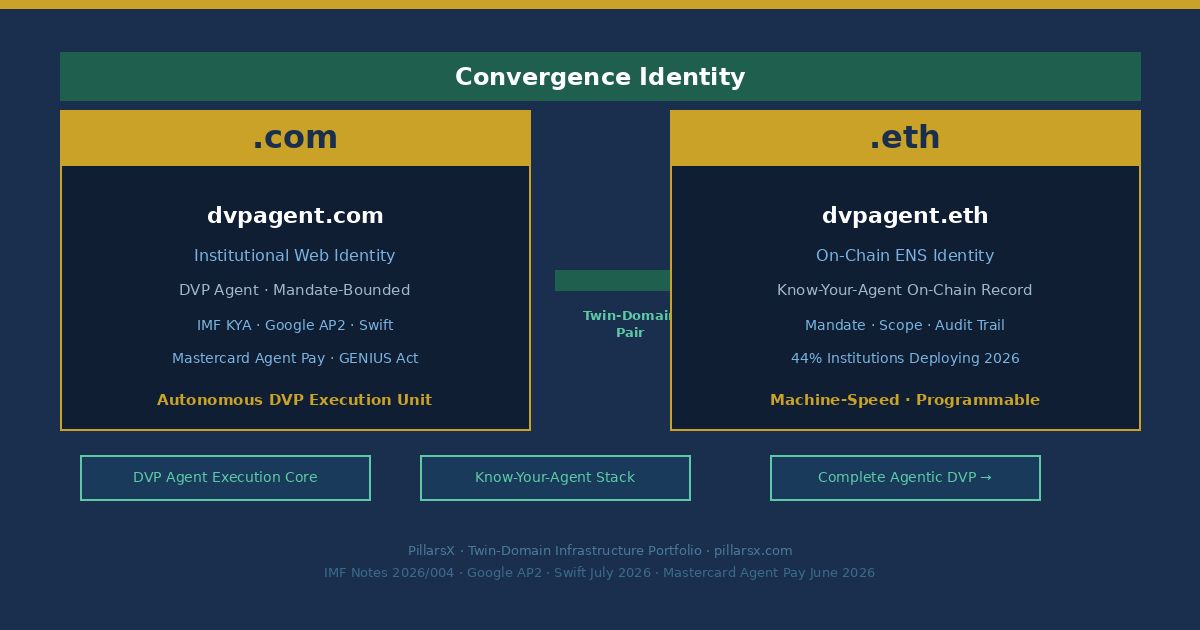
dvpagent.com and dvpagent.eth anchor the institutional namespace for the DVP-specific AI agent — the autonomous execution unit that operates within these verified mandate boundaries to initiate, route, and confirm delivery-versus-payment transactions at machine speed, with programmable compliance, and with the full audit trail that regulators require. This is not the agentic coordination layer — that is agenticdvp. This is the agent itself: its identity, its mandate, its accountability chain, its on-chain verification address.
Know-Your-Agent — The DVP Identity Standard
The shift from Know-Your-Customer to Know-Your-Agent is the most consequential regulatory transition in payment infrastructure since the introduction of AML/CFT requirements. When a human initiates a DVP transaction, compliance systems verify the human: their identity, their authorization level, their sanctions status, their regulatory eligibility. When a DVP agent initiates the same transaction, compliance systems must verify the agent itself — its mandate scope, its authorization chain, its legal linkage to a responsible entity, its technical capability to operate within the prescribed boundaries.
The IMF framework identifies the specific requirements: mandated verifiable identities for financial bots linked to legal entities; architectural separation of decision making and execution; programmable payment controls that enforce mandate boundaries at the infrastructure level; audit trails that document every agent action from intent formation through settlement confirmation. The challenge is that existing compliance infrastructure was designed for human users who explicitly approve transactions — adapting it for DVP agents that execute autonomously requires new identity frameworks, new verification protocols, and new namespace infrastructure that human-centric settlement systems simply do not have.
dvpagent.com provides the institutional web identity for this framework — the compliance portal, the mandate documentation reference, and the legal identity anchor for any DVP agent operating under Know-Your-Agent requirements. dvpagent.eth provides the on-chain resolution address — where mandate parameters, authorization scope, and settlement execution records are stored as cryptographically verifiable entries that counterparties, regulators, and audit systems can verify without requiring access to the underlying agent code or decision logic.
Google AP2, Mastercard and the DVP Agent Standard
Two developments in 2026 have defined the institutional DVP agent standard. Google’s AP2 protocol — launched with 60+ partner organizations including Mastercard, PayPal, and Coinbase — uses cryptographically signed mandates that capture the user’s upfront scoped instructions and final approval to establish and create an audit trail of user intent. This is the technical implementation of what the IMF describes normatively: a mandate-based authorization framework where the agent’s scope is defined, signed, and verifiable before any execution begins.
Mastercard’s Agent Pay for Machines simultaneously established that institutions can deploy DVP agents that transact at machine speed within rules the chain itself enforces — with settlement in seconds, predictable costs, programmable compliance, and a full audit trail so agents can only ever do what they are authorized to do. The phrase “only ever do what they are authorized to do” is the precise definition of mandate-bounded agent execution — and it is now a production-grade institutional standard, not a research concept. The DVP agent identity namespace that dvpagent provides is the missing institutional layer above these technical standards: the web and on-chain identity infrastructure that makes DVP agent authorization verifiable, auditable, and legally grounded.
dvpagent in the Complete Agentic DVP Architecture
dvpagent is the execution unit identity in the PillarsX agentic DVP namespace — distinct from but directly connected to the coordination and infrastructure layers above and below it. agenticdvp is the coordination layer: the AI system that orchestrates the complete DVP settlement lifecycle, selects among competing solver paths, and manages mandate compliance across the full transaction chain. dvpagent is the execution unit: the specific autonomous actor that carries out the DVP transaction within the mandate boundaries agenticdvp establishes. dvpsolver is the optimization layer: the intent-based solver that finds the optimal execution path and confirms delivery before releasing payment.
Together these three namespaces form the complete agentic DVP execution stack — coordination, agent identity, and solver optimization — operating above the settlement infrastructure layers of dvpsettle, dvpverify, and dvpledger. For an institution acquiring DVP agent infrastructure, the namespace bundle that signals complete agentic DVP capability spans all three execution layers plus the settlement confirmation chain: from the agent that acts, through the solver that optimizes, to the settlement that finalizes. dvpagent.com/.eth is the identity anchor for the actor at the center of this stack.
Related PillarsX Infrastructure
agenticdvp.com & .eth — Agentic DVP Identity
the coordination layer that orchestrates DVP agent execution within mandate boundaries
dvpsolver.com & .eth — DVP Solver Identity
intent-based solver optimization for atomic cross-chain DVP execution paths
dvpintent.com & .eth — DVP Intent Identity
cryptographic mandate formation layer before agentic DVP execution begins
dvpverify.com & .eth — DVP Verify Identity
Know-Your-Agent verification and settlement finality confirmation
Strategic Constellations & Bundle Potential
Bundle 1 — DVP Agent Execution Coredvpagent + agenticdvp + dvpsolver — the complete agentic DVP execution namespace: agent identity, coordination layer, and solver optimization. Targets: Mastercard Agent Pay partners, Google AP2 ecosystem participants, institutions building mandate-bounded DVP agent infrastructure.
Bundle 2 — Know-Your-Agent Compliance Stackdvpagent + dvpverify + dvpintent + verifiableintent — the complete KYA compliance namespace from agent identity through intent verification to mandate documentation. Targets: IMF framework implementers, OCC-supervised entities deploying agentic DVP, institutions requiring full audit trail documentation under GENIUS Act.
Bundle 3 — Complete Agentic DVP Infrastructuredvpagent + agenticdvp + dvpsolver + dvpintent + dvpverify + instantdvp — the complete agentic DVP namespace from mandate formation through agent execution to instant settlement finality. Targets: DTCC, Euroclear, Fnality, JPMorgan Kinexys — institutions building the complete next-generation agentic DVP settlement stack.
· IMF Notes 2026/004 — "How Agentic AI Will Reshape Payments" · Know-Your-Agent Framework (April 2026)
· Google AP2 Protocol — Cryptographic Mandate Standard · 60+ Partner Organizations (2026)
· Swift — "The Financial Stack of the Future" · Agent Mandate Framework · Nick Kerigan (July 2026)
· Mastercard — Agent Pay for Machines · Mandate-Bounded DVP Execution Standard (June 2026)
· Fenwick & West — "Is 2026 the Year of Agentic Payments?" · AP2 Mandate Architecture (April 2026)
· GENIUS Act (S.1582) — Authorization and Traceability Requirements for PPSI Settlement (18 July 2026)
Explore Related
· agenticdvp.com & .eth — Agentic DVP Identity
· dvpsolver.com & .eth — DVP Solver Identity
· verifiableintent.com & .eth — Verifiable Intent Identity
· pvpverify.com & .eth — PvP Verify Identity
· Portfolio Acquisition → /acquire/
Disclaimer:PillarsX is a domain portfolio business. Nothing on this page constitutes legal, financial, or regulatory advice. Domain names do not confer regulatory status, licensing, or compliance certification of any kind. All content is for informational purposes only and does not constitute financial advice.