
OrderlyRedemption — The GENIUS Act Redemption Standard
In 2026, every permitted payment stablecoin issuer operates under a legally mandated redemption framework — Orderly Redemption defines exactly when, how, and under what conditions a PPSI must return value to stablecoin holders, with or without regulatory intervention.
🔴 Regulatory Update — April 7, 2026
FDIC GENIUS Act Rule establishes two-business-day redemption standard for PPSIs
The FDIC Proposed Rule implementing the GENIUS Act requires PPSIs to process redemption requests within two business days — with mandatory FDIC notification for significant redemption requests exceeding 10% of outstanding payment stablecoin value within 24 hours.
→ Source: FDIC GENIUS Act Proposed Rule, April 7, 2026Pillar 1: Why Orderly Redemption Is the Most Operationally Complex Obligation in the GENIUS Act
Under the GENIUS Act and the OCC’s Notice of Proposed Rulemaking (February 25, 2026), Orderly Redemption is not a market practice — it is a legal obligation. Every PPSI must establish and publicly disclose a redemption policy that meets the OCC’s precise standards for timeliness, transparency, and crisis management.
The GENIUS Act requires that a PPSI disclose its redemption policy, which must establish clear and conspicuous procedures for the timely redemption of outstanding payment stablecoins. The OCC defines timely redemption as completion within two business days following the date of a valid redemption request. Sullivan & Cromwell
Three structural requirements define every compliant redemption framework:
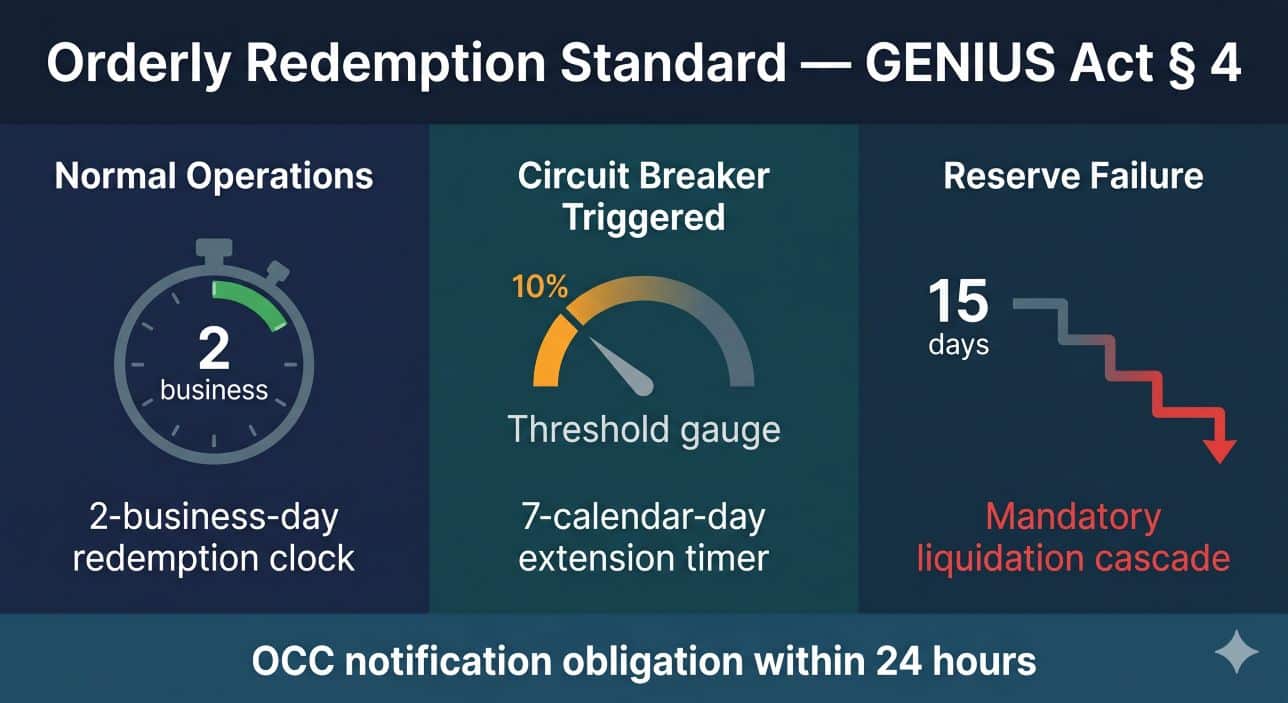
The Two-Business-Day Outer Limit: A PPSI must redeem payment stablecoins no later than two business days after a valid request. While issuers may choose faster timelines — including same-day or near-instant redemption — the two-day limit is the regulatory ceiling. No PPSI may exceed it without OCC approval.
Mandatory Public Disclosure: Every PPSI redemption policy must include the timeframe for redemption, a statement that discretionary limitations may only be imposed by the OCC (or, for state-qualified issuers, by the OCC, the Federal Reserve, or the relevant state regulator), disclosure of the circumstances under which redemption periods may be extended, and the minimum redemption amount. Arnold & Porter
Fee Prohibition at Reserve Failure: If a PPSI is unable to meet reserve requirements for 15 consecutive business days, it must begin liquidation of reserve assets and redemption of outstanding payment stablecoins — and may not charge a redemption fee to the stablecoin holder. Morgan Lewis
Source: OCC Proposed Rules – Permitted Payment Stablecoin Issuers, Federal Register, March 2, 2026
Pillar 2: The Circuit Breaker — When Orderly Redemption Becomes Mandatory
The GENIUS Act’s most operationally significant redemption mechanism is the automatic circuit breaker: a non-discretionary gating mechanism that activates the moment redemption pressure exceeds defined thresholds — regardless of the issuer’s preference or internal liquidity position.
If redemption demands exceed 10 percent of a PPSI’s outstanding issuance value within a single 24-hour period, the redemption period is automatically and non-discretionarily extended to seven calendar days. A PPSI may redeem outstanding or subsequent requests prior to the expiration of the seven-day period only if the OCC determines that the issuer has the ability to redeem sooner in an orderly, fair, and transparent manner. Covington & Burling LLP
Upon triggering the circuit breaker, the PPSI is required to notify the OCC within 24 hours. The seven-day extension is designed to mitigate run risk and facilitate orderly liquidation of reserve assets, particularly where reserve assets must be monetized under market stress conditions. Gibson Dunn
Three failure modes define the institutional risk landscape:
Threshold Miscalculation: A PPSI that fails to monitor intraday redemption volume against the 10% threshold in real time risks triggering the circuit breaker without adequate OCC notification — exposing both the issuer and its counterparties to unquantified regulatory liability.
Policy Documentation Gap: Without a publicly disclosed, OCC-compliant redemption policy that explicitly addresses circuit breaker conditions and extension scenarios, a PPSI cannot satisfy examination requirements — regardless of its actual liquidity position.
Agentic Execution Risk: In automated settlement environments, smart contracts and AI agents executing redemption requests must receive a machine-readable signal confirming whether the PPSI is operating under normal two-day or extended seven-day conditions at the precise moment of execution. Without an on-chain, continuously updated redemption status signal, every automated redemption interaction carries unresolved legal exposure.
This is where OrderlyRedemption.com operates as the institutional redemption compliance registry — a continuously updated, OCC-mapped redemption status layer accessible via API. And this is where OrderlyRedemption.eth becomes indispensable: translating that registry into a blockchain-native signal, queryable by smart contracts and settlement agents at the exact moment of execution.
Pillar 3: OrderlyRedemption as the Liquidity Layer of the PillarsX Compliance Stack
Every institutional transaction involving payment stablecoins requires one verified confirmation before settlement: is the issuer currently operating under orderly redemption conditions — and if a circuit breaker has been triggered, when does normal redemption resume?
Within the PillarsX infrastructure, OrderlyRedemption.com/.eth functions as the liquidity status layer — the real-time redemption signal that every downstream compliance process depends on:
PermittedReserves.eth      →  Reserve composition validated
        ↓                     [Redemption Eligibility]
OrderlyRedemption.eth      →  Redemption status confirmed
        ↓                     [Settlement Clearance]
CoveredCustodian.eth       →  Custodian qualification verified
                              [Programmable Compliance]
→ Before redemption can be confirmed, reserve composition must be validated: PermittedReserves — The Permitted Reserves Standard
Strategic Constellation & Bundle Potential
“The Redemption Compliance Stack” · For GENIUS Act § 4 Compliant Payment Stablecoin Issuers
| Domain | Function | Regulatory Hook |
|---|---|---|
| OrderlyRedemption.com | Redemption status registry & circuit breaker monitor | GENIUS Act § 4 – Timely Redemption Obligation |
| PermittedReserves.com/.eth | Reserve composition validation before redemption | OCC § 15.11(c) – Eligible Reserve Assets |
| CoveredCustodian.com/.eth | Custodian qualification for reserve monetization | GENIUS Act § 10(a) – Covered Custodian Definition |
| OperationalBackstop.com/.eth | Liquidity runway confirmation during stress events | OCC § 15.13 – Operational Backstop Requirement |
All content is for informational purposes only and does not constitute financial advice.