
Pass Through Insurance — The FDIC Exclusion Standard for Payment Stablecoin Reserves
Pass Through Insurance: The GENIUS Act is silent on whether stablecoin reserve deposits qualify for pass-through FDIC insurance. The FDIC is not. In its April 2026 NPRM, the FDIC resolved this question definitively — and the answer reshapes how every PPSI structures its reserve deposits and communicates with stablecoin holders.
🔴 Regulatory Update — April 7, 2026
FDIC proposes pass-through insurance framework for PPSI reserve holders
The FDIC GENIUS Act Proposed Rule establishes pass-through deposit insurance for payment stablecoin holders — requiring PPSIs to maintain reserve assets in FDIC-insured institutions with cryptographic linkage between reserve accounts and individual stablecoin holders.
→ Source: FDIC GENIUS Act Proposed Rule, April 7, 2026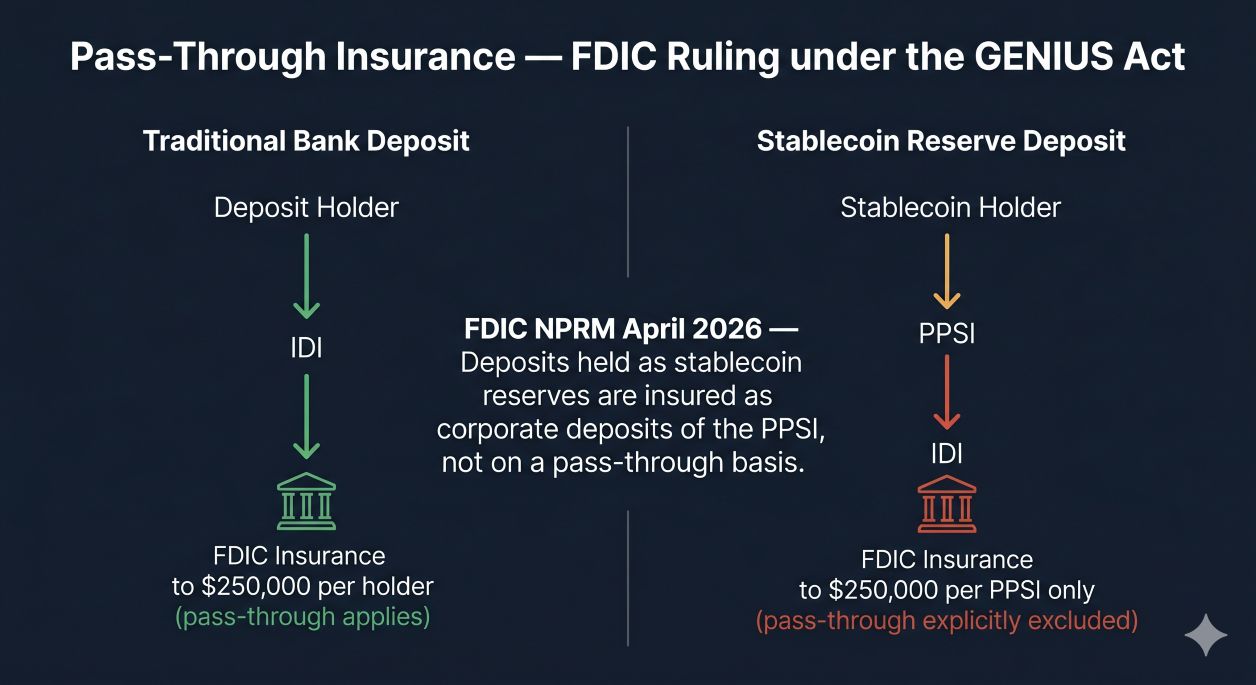
Pillar 1: Why Pass-Through Insurance Is the Most Consequential Deposit Insurance Ruling of 2026
Under conventional deposit insurance rules, when a fiduciary or agent holds deposits on behalf of beneficial owners, each beneficial owner can receive FDIC coverage up to $250,000 — a structure known as pass-through insurance. For decades, this framework protected customers in money market funds, brokerage accounts, and similar pooled deposit arrangements.
The GENIUS Act provides that payment stablecoins may not be subject to FDIC deposit insurance. However, the GENIUS Act is silent on whether reserves deposited by a PPSI with an insured depository institution in a deposit account may qualify for pass-through deposit insurance — treating the PPSI as the agent of the stablecoin holder. Mayer Brown
The FDIC resolved this ambiguity in its April 2026 NPRM with three structural determinations:
Pass-Through Coverage Excluded: The FDIC Proposal states that the prohibition against direct deposit insurance of payment stablecoins is inconsistent with providing deposit insurance to payment stablecoin holders on a pass-through basis. Therefore, deposits held as reserves for a payment stablecoin are not insured to payment stablecoin holders on a pass-through basis. Instead, such deposits would be treated as deposits of the PPSI — insured up to $250,000 with respect to the PPSI, not with respect to each stablecoin holder. Mayer Brown
Tokenized Deposits Confirmed: Deposits held as payment stablecoin reserves are insured to the PPSI, not on a pass-through basis to holders. Tokenized deposits remain subject to existing deposit insurance frameworks. Arnold & Porter
Disclosure Obligation Triggered: The pass-through deposit insurance clarification directly affects the marketing and disclosure obligations of stablecoin issuers holding customer reserves in IDI accounts. Every PPSI must now communicate clearly to holders that their stablecoins carry no FDIC pass-through protection. Prokopiev Law Group
Source: FDIC NPRM — GENIUS Act Requirements and Standards, Federal Register, April 10, 2026
Pillar 2: The Compliance Gap — Three Failure Modes for PPSIs and Their Counterparties
The FDIC’s exclusion of pass-through insurance is not merely a technical clarification — it restructures the risk landscape for every institution in the stablecoin reserve chain.
Three failure modes define the institutional risk exposure:
Misrepresentation Risk: The FDIC Proposal would prohibit PPSIs from misrepresenting payment stablecoins as covered by FDIC deposit insurance. Any PPSI marketing materials, disclosure documents, or automated communications that imply pass-through protection — explicitly or by omission — constitute a statutory violation after the GENIUS Act effective date. Arnold & Porter
Reserve Structuring Gap: With pass-through insurance excluded, PPSIs can no longer rely on per-holder FDIC coverage as a reserve safety mechanism. Deposits held as stablecoin reserves are insured only as corporate deposits of the PPSI — capped at $250,000 per PPSI regardless of the number of stablecoin holders. PPSIs with large reserve pools held at a single IDI carry concentrated, largely uninsured exposure. Jones Day
Counterparty Verification Gap: In automated settlement environments, institutional counterparties and AI agents executing transactions involving PPSI-issued stablecoins must verify pass-through insurance status before execution. Without a machine-readable, on-chain signal confirming that no pass-through coverage applies — and that the PPSI’s disclosures are current and compliant — every automated interaction carries unresolved disclosure liability.
This is where PassThroughInsurance.com functions as the institutional insurance status registry — continuously updated against FDIC rulemaking. And where PassThroughInsurance.eth translates that registry into a blockchain-native disclosure signal, queryable by smart contracts and compliance systems at the exact moment of execution.
Pillar 3: PassThroughInsurance as the Disclosure Layer of the PillarsX Compliance Stack
Every institutional transaction involving a PPSI-issued payment stablecoin requires one confirmed signal before settlement: has the PPSI correctly disclosed the absence of pass-through insurance to all relevant counterparties?
Within the PillarsX infrastructure, PassThroughInsurance.com/.eth functions as the disclosure compliance layer:
PermittedReserves.eth        →  Reserve composition validated
        ↓                       [Insurance Status]
PassThroughInsurance.eth     →  Pass-through exclusion confirmed
        ↓                       [Holder Disclosure]
OrderlyRedemption.eth        →  Redemption status verified
                                [Programmable Compliance]
→ For the complete reserve compliance framework: PermittedReserves — The Permitted Reserves Standard
Strategic Constellation & Bundle Potential
| Domain | Function | Regulatory Hook |
|---|---|---|
| PassThroughInsurance.com/.eth | Insurance status registry & disclosure compliance layer | FDIC NPRM April 2026 — Pass-Through Exclusion |
| PermittedReserves.com/.eth | Reserve composition validation | OCC § 15.11(c) – Eligible Reserve Assets |
| CoveredCustodian.com/.eth | Custodian qualification for reserve deposits | GENIUS Act § 10(a) – Covered Custodian |
| EligibleAsset.com/.eth | Asset classification before reserve deposit | OCC § 15.11(b) – Eligible Asset Categories |
All content is for informational purposes only and does not constitute financial advice.