
The PillarsX Principle: Four Pillars of the 2026 Institutional Financial Stack
The global financial system is undergoing its most fundamental transformation since the introduction of electronic trading. We are moving from a world of latent processes to an era of atomic protocols — from trust-by-institution to trust-by-cryptography. This transformation is not driven by incremental improvement. It is driven by four structural pillars that together form the operating system of the new on-chain economy. The GENIUS Act is law. The BIS has proven atomic settlement in production. The SEC has approved blockchain-native clearing. The infrastructure is no longer experimental — it is statutory.
🔴 Regulatory Update — June 2026
All four pillars now have binding regulatory anchors — CLARITY Act on Senate Calendar, OCC Final Rule before July 18, 2026
The GENIUS Act is Public Law 119-27. The CLARITY Act entered the US Senate Legislative Calendar June 1, 2026 — Senate floor vote imminent, August 3 presidential signing target. OCC Final Rules expected before July 18, 2026. BIS Project Agorá Final Report confirmed atomic multi-currency settlement across eight central bank jurisdictions on May 27, 2026. All four PillarsX pillars now have explicit regulatory anchors in active federal law. The pre-rulemaking namespace window closes July 18, 2026.
→ Full CLARITY Act analysis: PillarsX Stablecoin Disclosure Infrastructure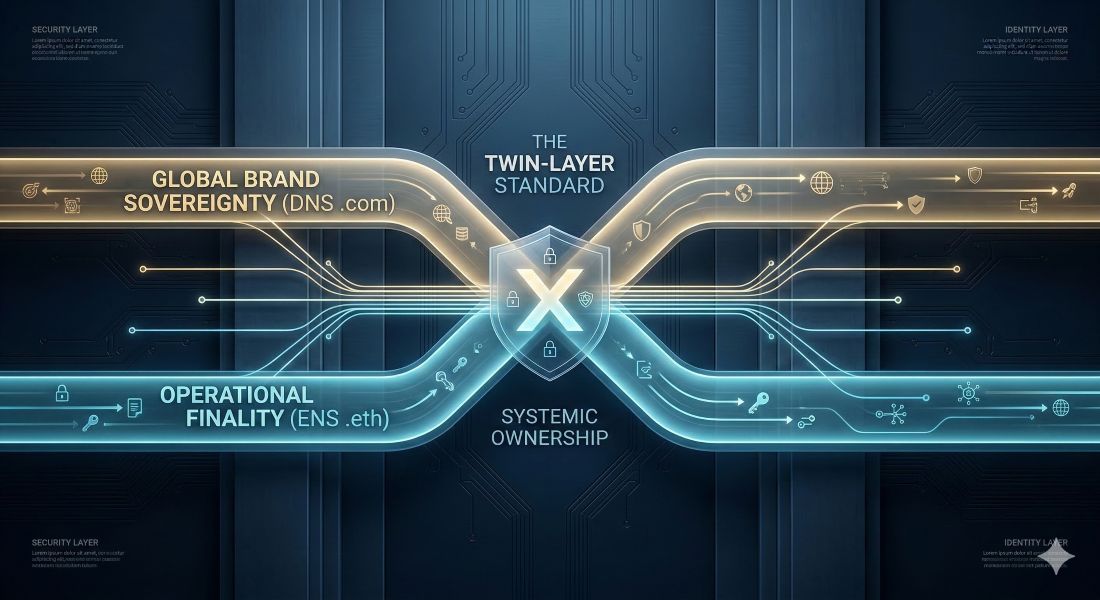
Trustless Infrastructure — From Institution to Protocol
The foundation of the new financial system is the replacement of human intermediaries with mathematical certainty. In the legacy world, trust was an institutional promise — backed by balance sheets, legal agreements, and regulatory supervision. In the 2026 world, trust is a cryptographic property — backed by code that executes identically every time, without discretion, without delay, and without counterparty risk.
Blockchain and Distributed Ledger Technologies no longer function merely as data storage — they are programmable trust layers that enable the error-free settlement of trillions in value, from sovereign bonds to complex derivatives, without the counterparty risk of traditional clearing houses.
The BIS Project Agorá Final Report, published May 27, 2026, delivered the definitive institutional validation of Pillar I: atomic settlement of wholesale cross-border payments across seven central bank jurisdictions — including the Federal Reserve Bank of New York, Bank of England, and Bank of Japan — is achievable securely and with finality. The prototype demonstrated settlement in seconds across currencies, with compliance requirements and conditional payment triggers embedded directly into transactions via smart contracts. The Bank of Canada joined the initiative and real-value testing is now underway. Trustless infrastructure is no longer a crypto thesis — it is proven central bank architecture moving to live production.
Privacy-Preserving Computation — Solving the Transparency Paradox
The greatest barrier to institutional capital entering on-chain infrastructure has been the transparency paradox of public blockchains: banks cannot afford to expose their trading strategies or client positions on an open ledger. With the breakthrough of Fully Homomorphic Encryption (FHE) and Zero-Knowledge Proofs (ZKP), this problem is solved.
FHE enables computation on encrypted data without ever decrypting it — allowing regulators to verify solvency and AML compliance in real time while market participants retain complete confidentiality. Intel’s Heracles chip delivers 5,000x FHE acceleration compared to standard CPUs. Zama’s fhEVM has become the embedded confidentiality layer for the T-REX Ledger — the ERC-3643 compliant infrastructure whose members include DTCC, Deloitte, and OpenZeppelin — confirming that FHE is shared institutional infrastructure, not a proprietary offering. The DTCC, which custodies over $114 trillion in assets, selected the Canton Network precisely for its privacy computing architecture — enabling atomic settlement while keeping positions, counterparties, and trading strategies fully confidential.
The OCC’s requirement for on-chain auditability without market exposure is no longer a theoretical challenge. FHE is the architecture that makes it operationally achievable — and PillarsX holds the institutional namespace for every major FHE settlement, ledger, and verification function.
→ See: Verifiable Infrastructure Standard — PillarsX
Programmable Settlement — The Era of Atomic Finality
In a world moving at machine speed, T+2 settlement is an unacceptable systemic risk. Pillar III transforms settlement from a time-lagged administrative process into a synchronous software function. Through Atomic Delivery-versus-Payment (DVP), asset and payment exchange hands in a single, indivisible heartbeat — eliminating settlement risk entirely and freeing billions in collateral currently trapped in legacy clearing cycles.
On May 29, 2026, Paxos received full SEC registration as the first blockchain-native clearing agency in US history — confirming that programmable settlement satisfies full regulatory examination standards. The DTCC launched ComposerX, its institutional tokenization engine, with initial production trades of tokenized Russell 1000 equities, ETFs, and US Treasury bills planned for July 2026 and full service launch in October 2026 — backed by a three-year SEC No-Action Letter and an Industry Working Group of 50+ financial institutions. SWIFT moved its blockchain-based shared ledger to MVP status on March 30, 2026, enabling 24/7 cross-border payments through tokenized commercial bank deposits. Broadridge’s Distributed Ledger Repo platform continues to process $8 trillion monthly. The era of atomic settlement is not coming — it is already in production at the world’s largest financial institutions and systemic market utilities.
The PillarsX Execution Layer — MCPSettle, DVPSettle, PPSISettle, MCISettle — names every endpoint in this infrastructure chain.
→ See: dvpsettle.com & .eth — Atomic DVP Settlement Standard → See: ppsisettle.com & .eth — PPSI Settlement Infrastructure
Regulatory Convergence — Compliance-by-Design
Technology without legitimacy remains an experiment. The GENIUS Act is Public Law 119-27. The CLARITY Act has entered the US Senate Legislative Calendar — Senate floor vote imminent, August 3 presidential signing target, 75% passage probability confirmed by Galaxy Research. OCC Final Rules take effect before July 18, 2026. The FDIC comment period closed June 9, 2026. OCC Bulletin 2026-19 is active supervisory guidance. The BIS has defined the MCI as a distinct regulatory category requiring consolidated supervision. European MiCA is fully effective across all 27 jurisdictions.
Regulation is no longer a post-trade audit report — it is a software-defined condition built directly into settlement protocols. Every PPSI must demonstrate T0 settlement capacity, 1:1 reserve backing, monthly attestation with CEO/CFO certification, and BSA/AML compliance at the moment of every transaction. The FDIC confirmed June 9 that deposits held as stablecoin reserves are insured as corporate deposits of the PPSI — not on a pass-through basis — forcing every institution to make an explicit legal classification decision before January 18, 2027. The SEC confirmed on May 29 that blockchain-native clearing satisfies full regulatory examination standards. Compliance-by-Design is not a competitive differentiator in 2026. It is the statutory floor.
PillarsX holds the namespace infrastructure for this floor: from MCICompliance and PPSISettle to StablecoinDisclosure and ProgrammableCompliance — every regulatory vocabulary term that defines the new institutional standard.
→ See: mcisettle.com & .eth — MCI Settlement Identity → See: Stablecoin Disclosure Infrastructure
The Twin-Bundle Standard — Non-Negotiable Infrastructure
The PillarsX Framework is not mere theory — it is the operational blueprint for the new institutional standard. In this architecture, a domain is no longer just a web address. It is a system-critical infrastructure asset.
Every PillarsX domain follows the Digital Twin Standard:
The .com Identity (DNS): Global accessibility, legal anchoring, and institutional authority. The frontend for regulatory compliance, API access, and OCC examination.
The .eth Execution (ENS): The native cryptographic identifier on distributed ledger infrastructure. The execution endpoint for smart contract interaction, Proof of Intent, and on-chain settlement finality.
Why the Bundle is Non-Negotiable: In a world of Atomic Finality (Pillar III) and Compliance-by-Design (Pillar IV), institutional infrastructure can only operate with full Front-to-Back compliance when identity and execution form an inseparable unit. Owning only one side creates the liability gap that OCC examiners will target under the GENIUS Act.
PillarsX occupies the interfaces between all four pillars through a consistent Twin-Bundle portfolio of 200+ DNS and ENS domain assets — the complete namespace infrastructure of the 2026 institutional financial stack.